National Firearms Act, ch. 757, 48 Stat. 1236 (Public, No. 474, 73d Congress), approved 26 June 1934
The statute "to provide for the taxation of manufacturers, importers, and dealers in certain firearms and machine guns." It defines "firearm" and "machine gun," sets occupational taxes of $500, $200 and $300, and a transfer tax of $200 for each firearm.
- Date
- 1934-06-26
- Kind
- case-file
- Retrieved
- 2026-10-12
- Docket
- 48 Stat. 1236; Pub. L. 73-474
- Rights
- An Act of Congress, a federal work in the public domain under 17 U.S.C. § 105.
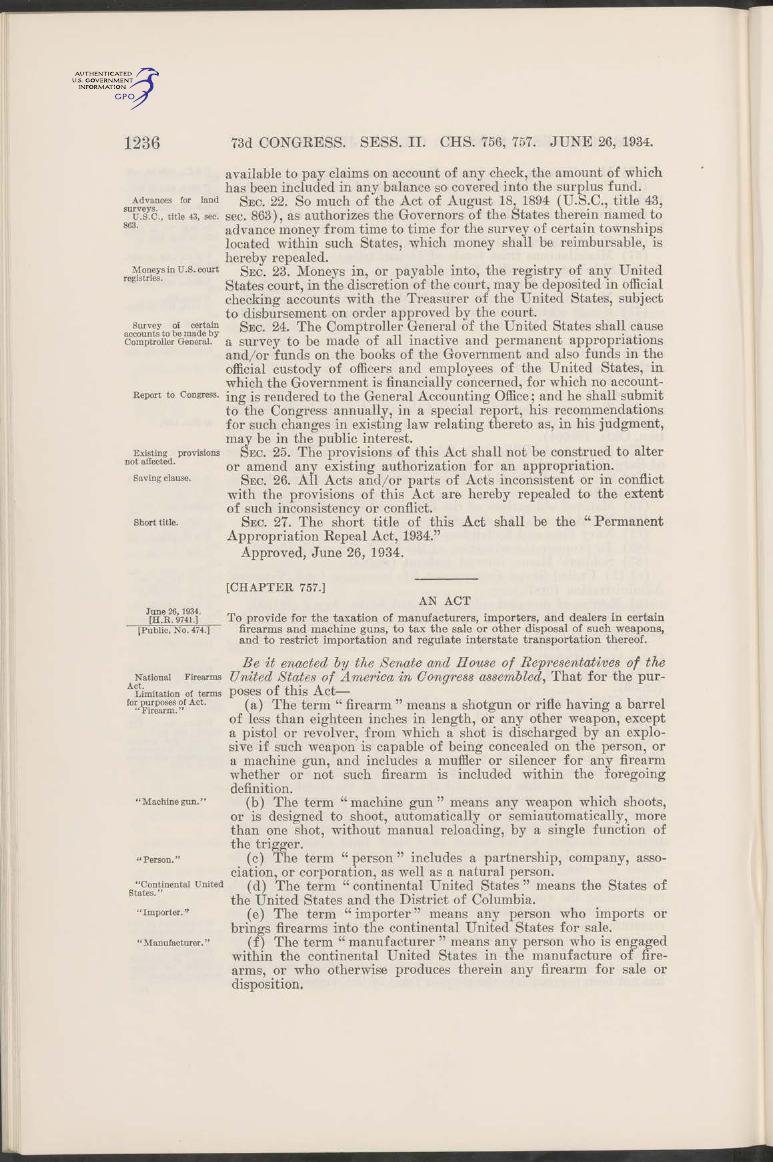
H.R. 9741, approved 26 June 1934, titled “To provide for the taxation of manufacturers, importers, and dealers in certain firearms and machine guns, to tax the sale or other disposal of such weapons, and to restrict importation and regulate interstate transportation thereof.” Section 18 provides that “This Act may be cited as the National Firearms Act.” The Statutes at Large PDF begins with the end of the preceding chapter; the Act starts partway down page 1236.
Section 1 defines “firearm” as “a shotgun or rifle having a barrel of less than eighteen inches in length, or any other weapon, except a pistol or revolver, from which a shot is discharged by an explosive if such weapon is capable of being concealed on the person, or a machine gun,” including “a muffler or silencer.” It defines “machine gun” as “any weapon which shoots, or is designed to shoot, automatically or semiautomatically, more than one shot, without manual reloading, by a single function of the trigger.”
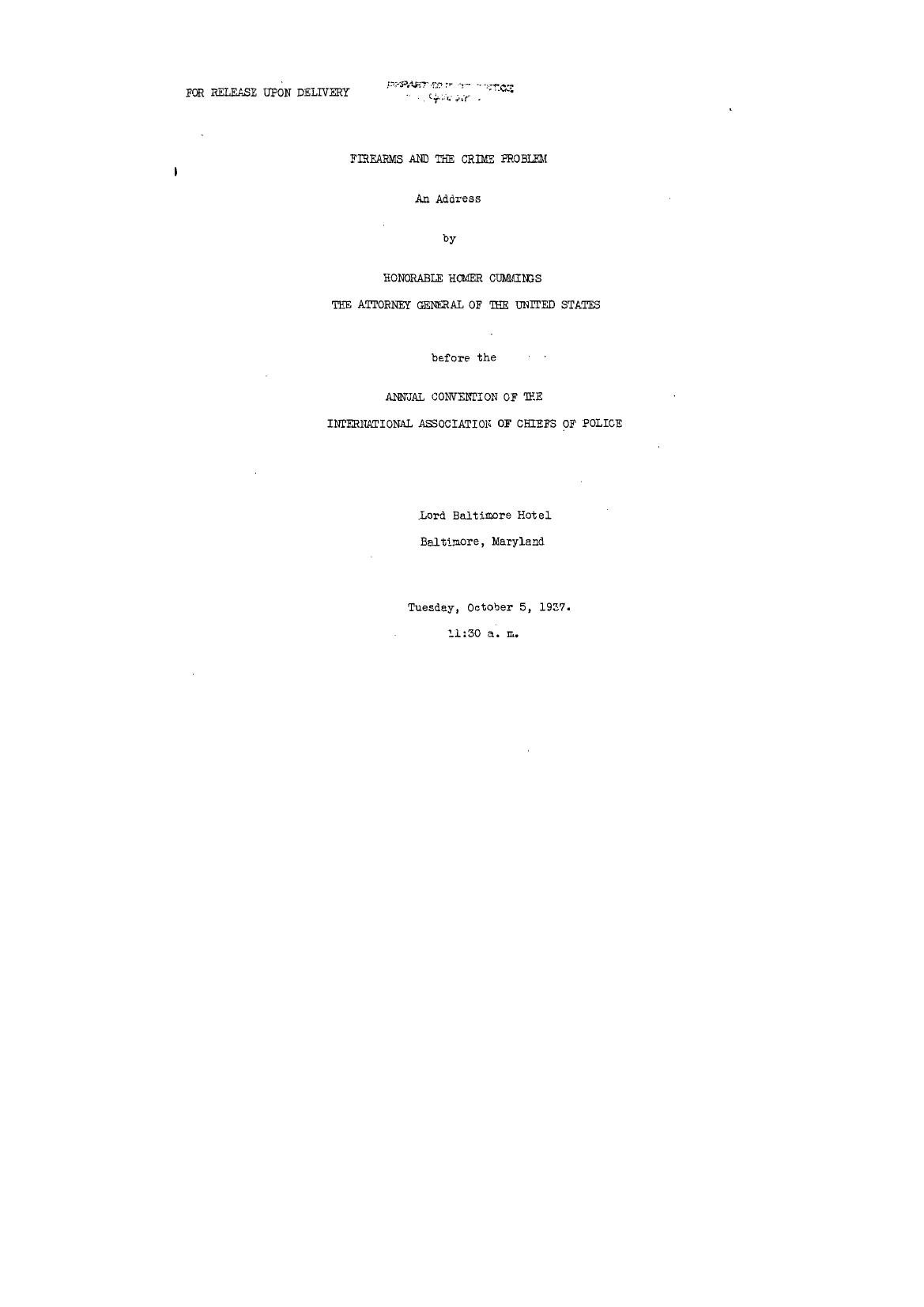
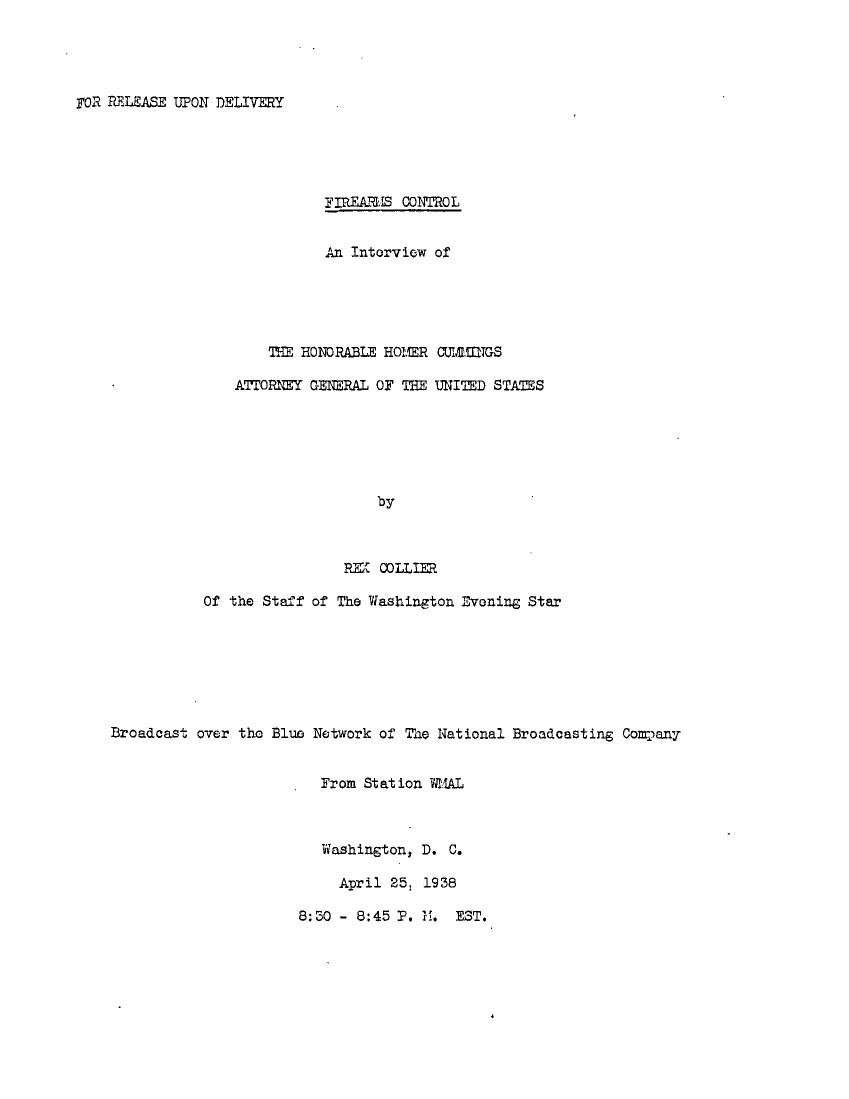
Section 2 requires importers, manufacturers and dealers to register with the collector of internal revenue and pay a special tax: “Importers or manufacturers, $500 a year; dealers, other than pawnbrokers, $200 a year; pawnbrokers, $300 a year.” Section 3 levies “a tax at the rate of $200 for each firearm” transferred, paid by the transferor and represented by stamps. Attorney General Cummings’s own account of the Act is in his 1937 and 1938 statements, filed separately.