Testimony of Lt. Walter Casey, New York City Police Department, July 11, 1950 (Kefauver Committee, Part 7, pp. 1–6)
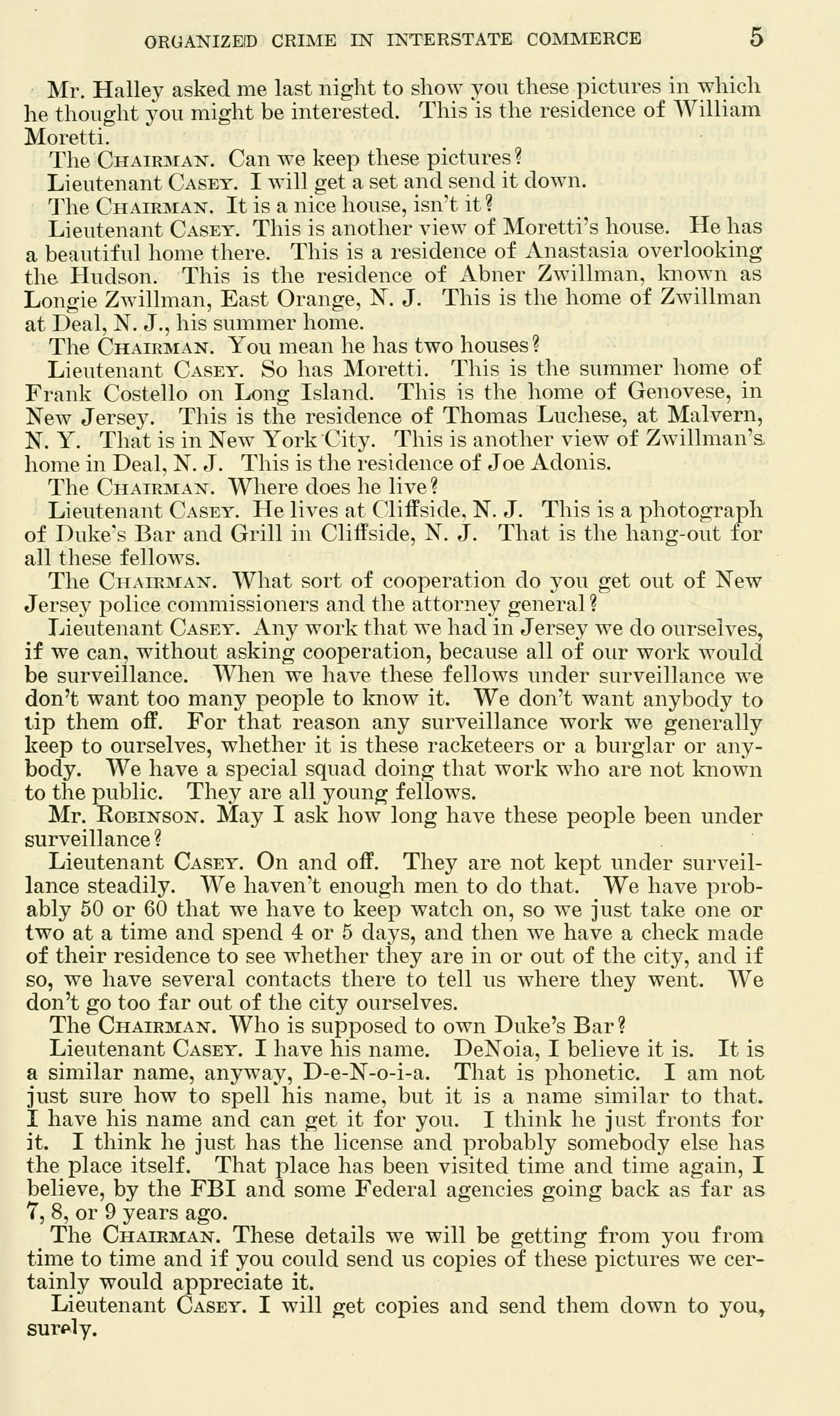
At the committee's first New York-New Jersey session, a police lieutenant hands over photographs of houses, among them "the residence of Abner Zwillman, known as Longie Zwillman, East Orange, N.J.," his summer home at Deal, and Joe Adonis's residence at Cliffside.
- Date
- 1950-07-11
- Kind
- hearing
- Retrieved
- 2026-10-12
- Docket
- Investigation of Organized Crime in Interstate Commerce, Hearings before the Special Committee, 81st and 82d Cong., Part 7: New York-New Jersey, pp. 1–6
- Rights
- A work of the United States Congress, printed by the Government Printing Office. Public domain in the United States under 17 U.S.C. § 105. The scan is of a GPO printing; Internet Archive marks it not in copyright. The stored page image was taken from the Internet Archive scan; quotations follow the Archive OCR, checked against the page image.
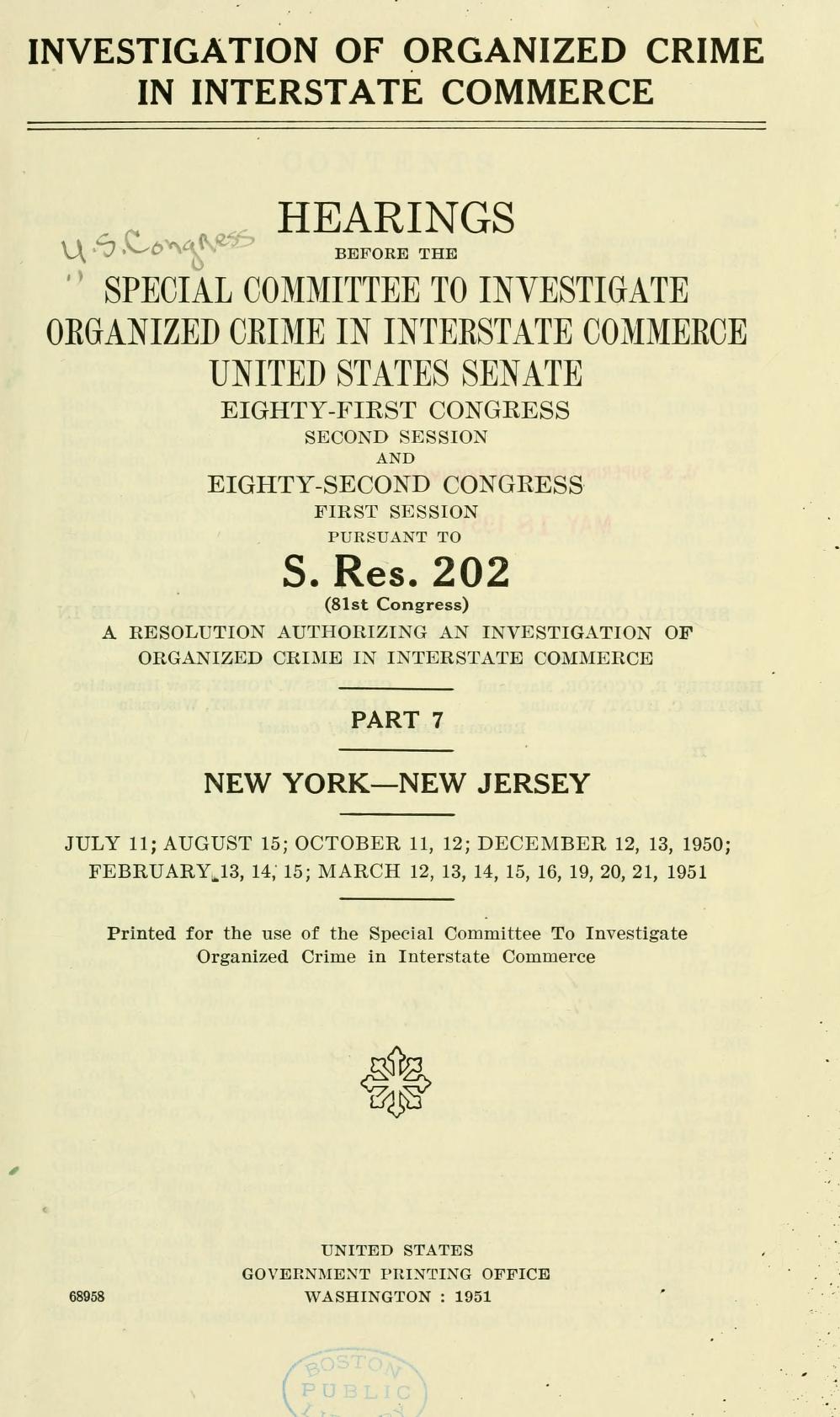
Printed at the start of Part 7; the contents list dates the opening session July 11, 1950. Acting Lieutenant Walter Casey of the New York City Police Department shows the committee photographs that, he says, counsel Halley had asked him to bring. The stored image is page 5.
He identifies them one by one: “This is the residence of William Moretti”; “a residence of Anastasia overlooking the Hudson”; “This is the residence of Abner Zwillman, known as Longie Zwillman, East Orange, N.J. This is the home of Zwillman at Deal, N.J., his summer home”; the summer home of Frank Costello on Long Island; “the home of Genovese, in New Jersey”; Thomas Luchese’s residence; and “the residence of Joe Adonis,” who “lives at Cliffside, N.J.” He adds a photograph of “Duke’s Bar and Grill in Cliffside, N.J. That is the hang-out for all these fellows.” He says the police kept “probably 50 or 60” men under occasional surveillance.
The photographs are not reproduced in the printed text, and the plates in the scan were not searched. The descriptions are a police officer’s statements. This archive gives the towns only and does not map the houses.