Record
Hearing
1951-03
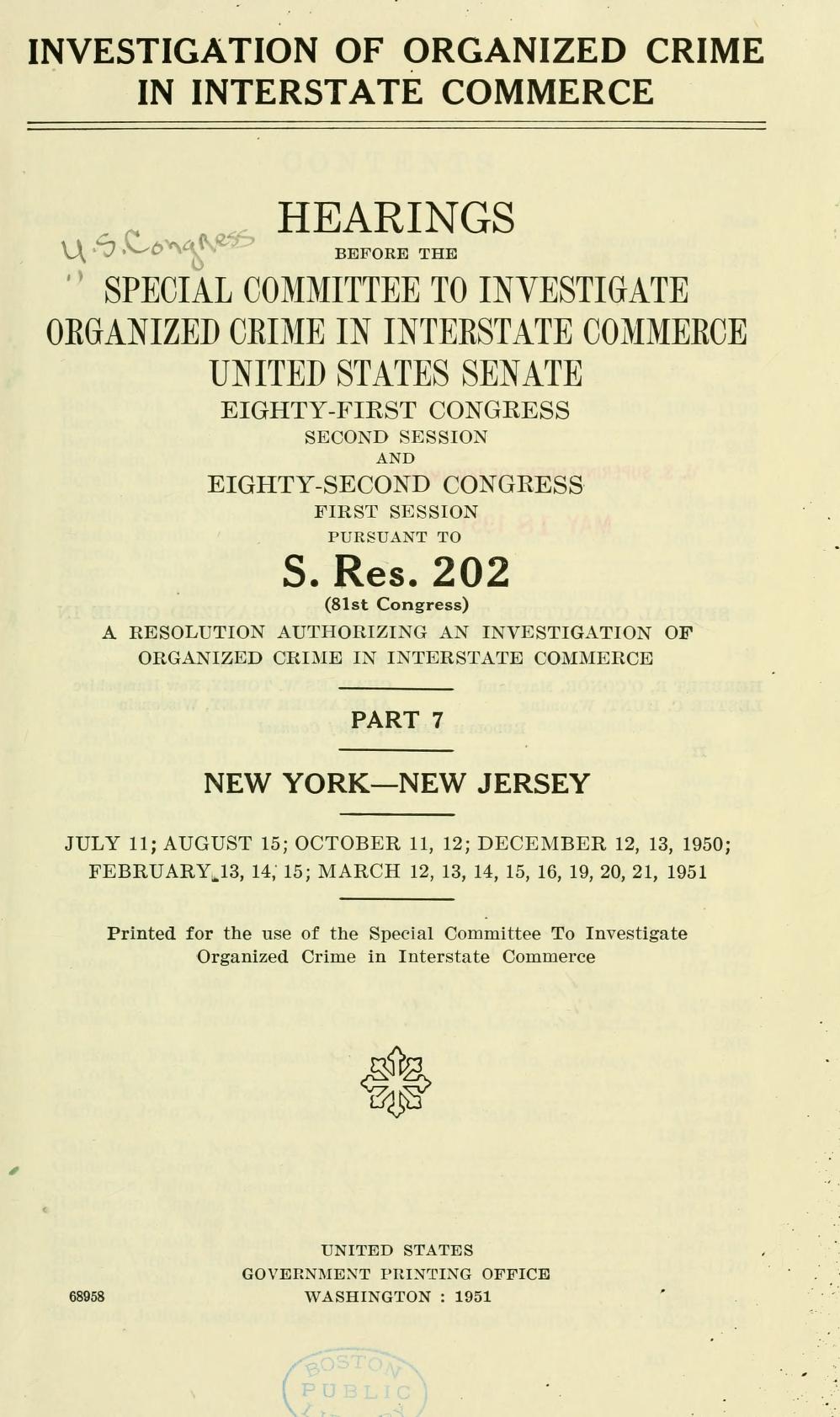
Internet Archive, scan of the printed hearings, Part 7: New York-New Jersey (Boston Public Library copy)
Kefauver Committee, New York: testimony of Chief Magistrate John M. Murtagh on the 1944 'black book' (March 1951)
John M. Murtagh, Chief Magistrate of New York City and former Commissioner of Investigation, told the committee of a raid on "a little grocery store in Harlem" where a policy operator kept books, and said his later analysis of the seized book showed payments to 111 police officers, though no officer went to jail.
- Date
- 1951-03
- Kind
- hearing
- Retrieved
- 2026-10-12
- Docket
- Investigation of Organized Crime in Interstate Commerce, Hearings before the Special Committee, 81st and 82d Cong., Part 7: New York-New Jersey
- Rights
- A work of the United States Congress, printed by the Government Printing Office. Public domain in the United States. 17 U.S.C. § 105. The scan is of a GPO printing; Internet Archive marks it not in copyright.
Printed pages 1401 to 1408 of Part 7. Sworn by Senator O’Conor, John M. Murtagh gave his position as “Chief magistrate of the city of New York,” held since 15 February 1950, and said that before that, from 1 January 1946, he had been Commissioner of Investigation of the city. Most of his testimony, under questioning by chief counsel Rudolph Halley, concerns his department’s investigation of bookmaking and wire rooms from 1946. The sitting is in March 1951; the last legible dateline before it in the OCR is Monday, 19 March 1951, and the exact day should be checked on the page images.
The passage on policy is at pages 1406 and 1407. Asked about “that black book,” received in 1944, Murtagh said: “A raid was conducted by the department of investigation in cooperation with the police department on a little grocery store in Harlem. As you Senators may not know, policy is conducted there more than bookkeeping.” The storekeeper, he said, kept methodical books and “even recorded entries of payments to police officers.” He said that after he took office he found the case among the department’s open files, and that “In cooperation with the Federal Bureau of Investigation, I turned all hell loose on that black book, with the result that, while I couldn’t prove it by the sworn testimony of any witness, my analysis showed payments to 111 police officers during the period 1943 to ‘44 or ‘42 to ‘43, I don’t know which.” He turned the results over to the police commissioner and the district attorney. Asked how many officers went to jail, he said: “None did. Frank Hogan felt that there wasn’t evidence on which a prosecution could be based.”
This is Murtagh’s own account, and by his own words not proved by testimony. The grocery’s name and address, and the storekeeper’s name, are not given. A search of the volume’s OCR for this section found no other passage on policy in Harlem. The OCR prints the years as “1043” and “1046”; they are corrected here as obvious misreadings.