Testimony of Arthur Pitman, Hoboken trucking company president, July 6, 1959 (McClellan Committee, Part 55, pp. 19239 ff.)
A New Jersey trucking executive tells the McClellan Committee that Anthony Provenzano, then a Local 560 business agent, asked him for $5,000 and said he "wouldn't be in business too long" if he did not pay, and that he eventually paid $2,500.
- Date
- 1959-07-06
- Kind
- hearing
- Retrieved
- 2026-10-12
- Docket
- Investigation of Improper Activities in the Labor or Management Field, Hearings before the Select Committee, 86th Cong., Part 55, pp. 19239 ff.
- Rights
- A work of the United States Congress, printed by the Government Printing Office. Public domain in the United States under 17 U.S.C. § 105. The scan is of a GPO printing; Internet Archive marks it not in copyright. The stored page image was taken from the Internet Archive scan; quotations follow the Archive OCR, checked against the page image.
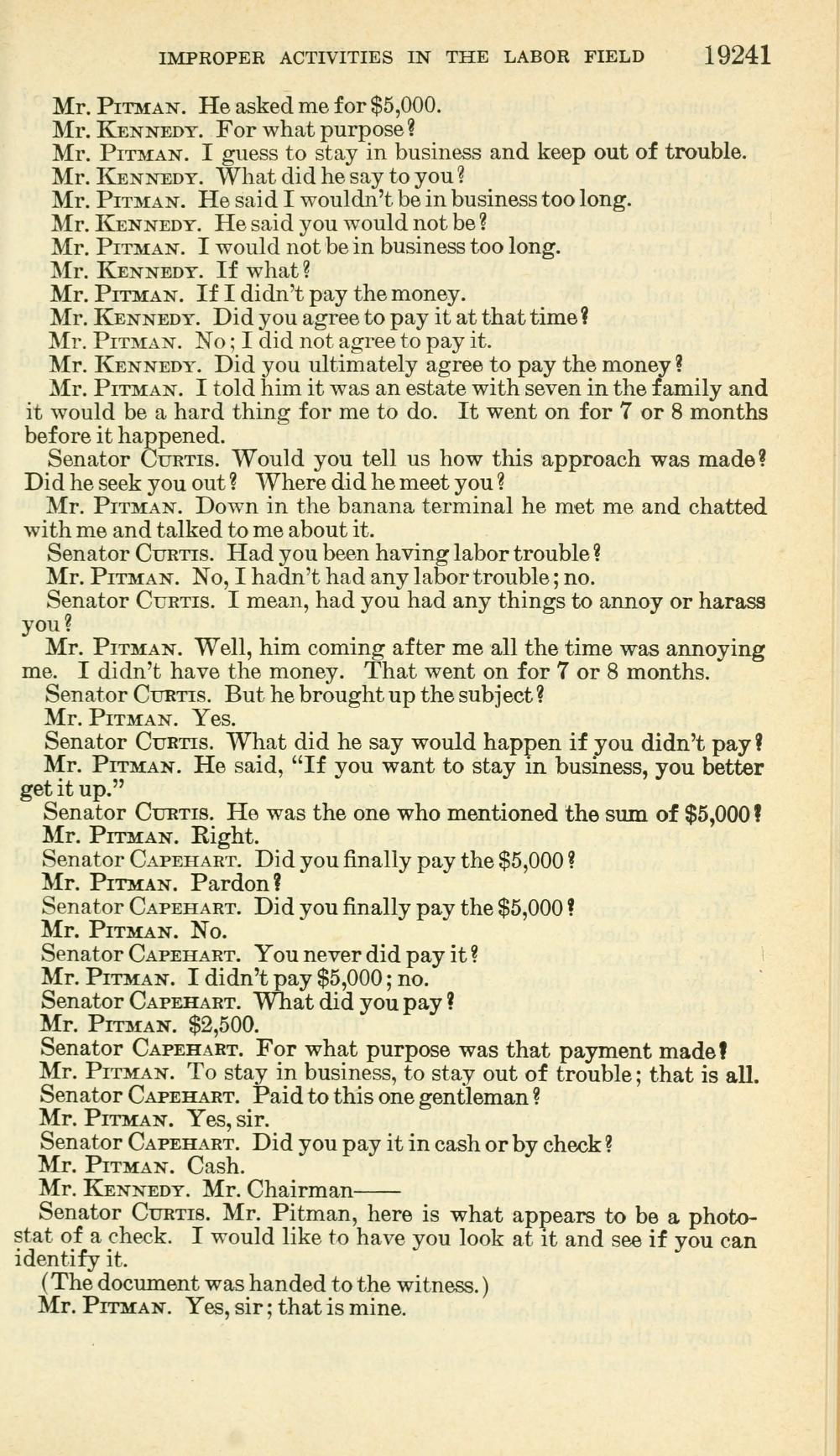
Printed in Part 55. The session of Monday, July 6, 1959 met in the caucus room of the Senate Office Building with Senator Carl T. Curtis presiding. Pitman, of a Hoboken banana-trucking company, said he moved his business from New York to New Jersey in about November 1952 and was approached to sign with Local 560. The stored image is page 19241.
Chief counsel Robert F. Kennedy identified Provenzano: “He is now president of local 560 of the International Brotherhood of Teamsters. At that time he was a business agent,” adding that in May 1959 he had been elected president of Joint Council 73 of Newark. Asked about an approach “in 1953 or 1954 for a payment in order to continue to have labor peace,” Pitman says Provenzano “asked me for $5,000.” Kennedy: “What did he say to you?” Pitman: “He said I wouldn’t be in business too long.” “If what?” “If I didn’t pay the money.” He says the demand went on “for 7 or 8 months,” that Provenzano said “If you want to stay in business, you better get it up,” and that he finally paid “$2,500” in cash, “To stay in business, to stay out of trouble.”
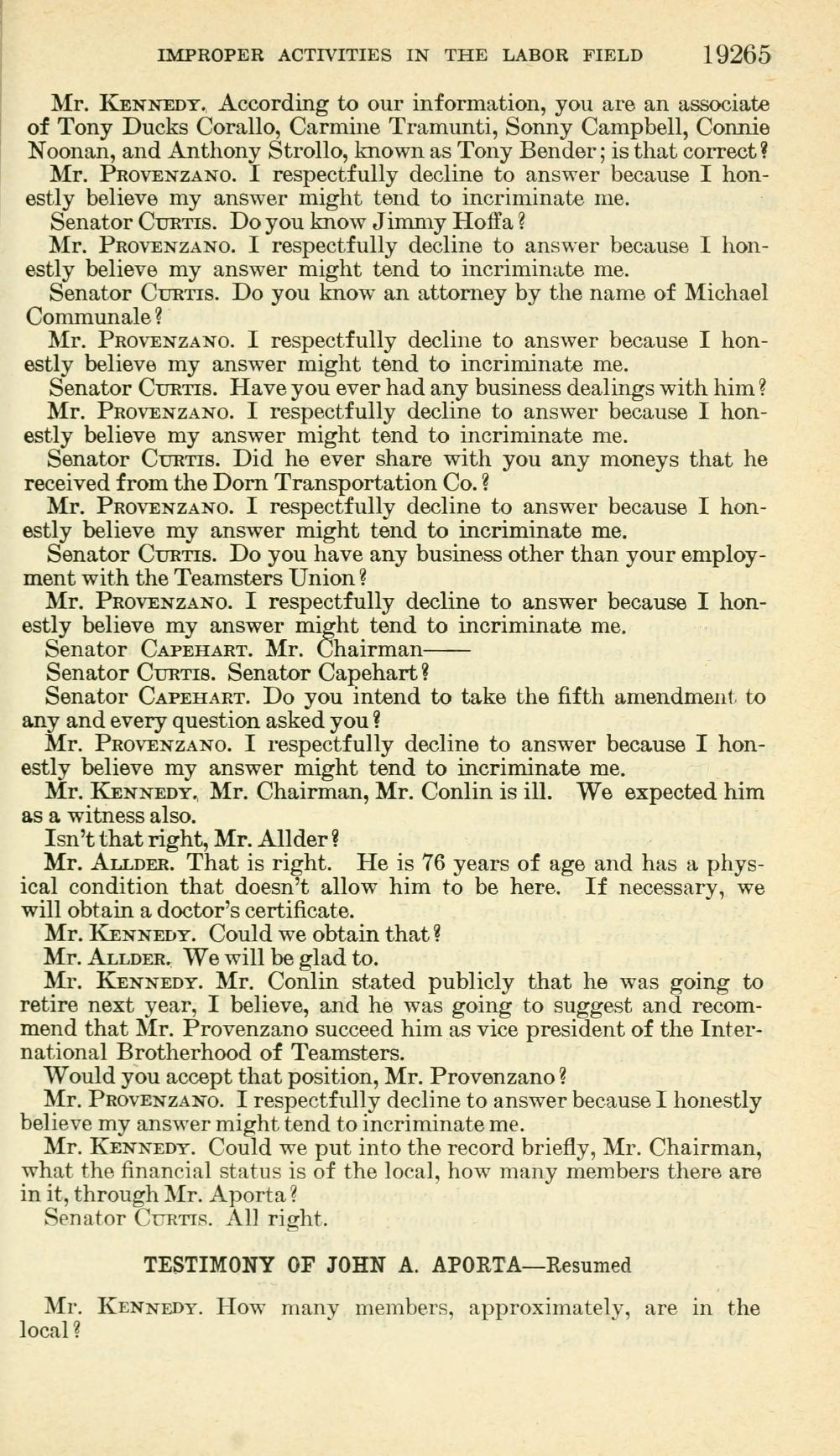
This is a witness’s sworn account, not a finding. Provenzano declined to answer questions about it the same day (testimony). Counsel’s statements identifying Provenzano are counsel’s, not testimony.