U.S. vs. Gianni Alongi: threatening-letter case, Chicago, 1911 (case file)
National Archives case file from the federal court at Chicago: the catalog note says Gianni Alongi was accused in February 1911 of mailing three letters demanding $500 under threat of murder, in which he claimed to be a member of the Black Hand, and was found guilty and sentenced to five years and a $1,000 fine.
- Date
- 1911-02/1911-03
- Kind
- case-file
- Retrieved
- 2026-10-12
- NAID
- 49566908
- Rights
- A record of the U.S. District Court for the Northern District of Illinois, Eastern Division, held by the National Archives at Chicago in Record Group 21. A United States government work, public domain in the United States under 17 U.S.C. § 105. The National Archives catalog lists access and use as unrestricted.
The National Archives catalogs this file as “U.S. vs. Gianni Alongi,” a criminal case file of the U.S. District Court for the Northern District of Illinois, Eastern Division, with 89 digital pages. Its catalog note says Alongi was accused in February 1911 of sending three threatening letters to a man in Chicago, demanding $500 or threatening to murder him, and that in the letters Alongi “claims … to be a member of the Black Hand organization.” The note says he was found guilty and sentenced to five years and a $1,000 fine. The letters, translated from Italian, are in the file.
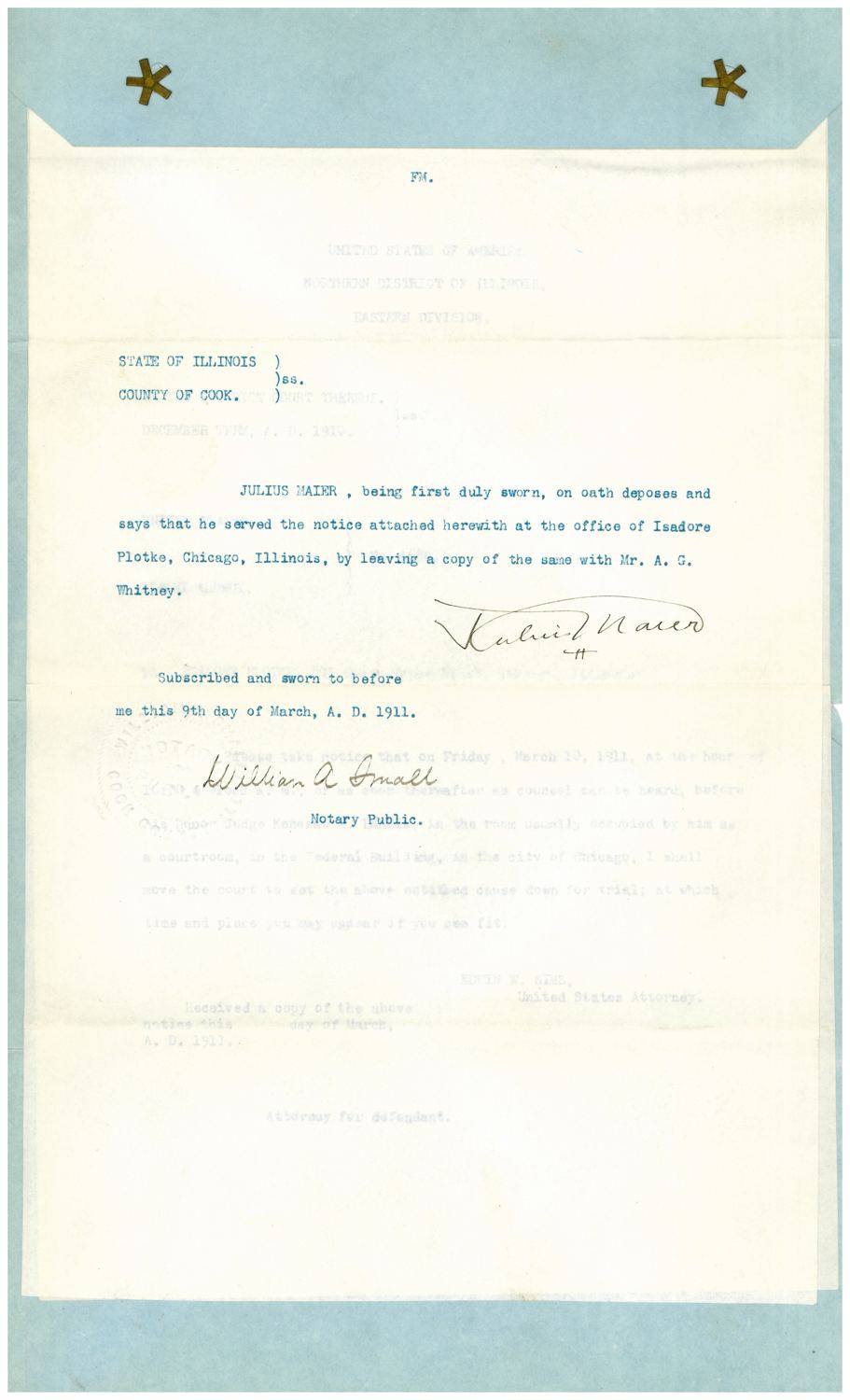
The page stored here is file page 1, a process-server’s affidavit sworn on 9 March 1911 before William A. Small, notary public, by Julius Maier, stating that he served the attached notice at a Chicago lawyer’s office. Faintly visible through the paper is the notice itself: a motion to set the cause down for trial on Friday, 10 March 1911, in a courtroom in the Federal Building at Chicago, signed by Edwin W. Sims, United States Attorney; it is partly illegible. It is a plate for the file; the letters are on other pages that were not stored.
The claim of membership is the letter writer’s, as the catalog summarises it; the conviction was for the mail offence.