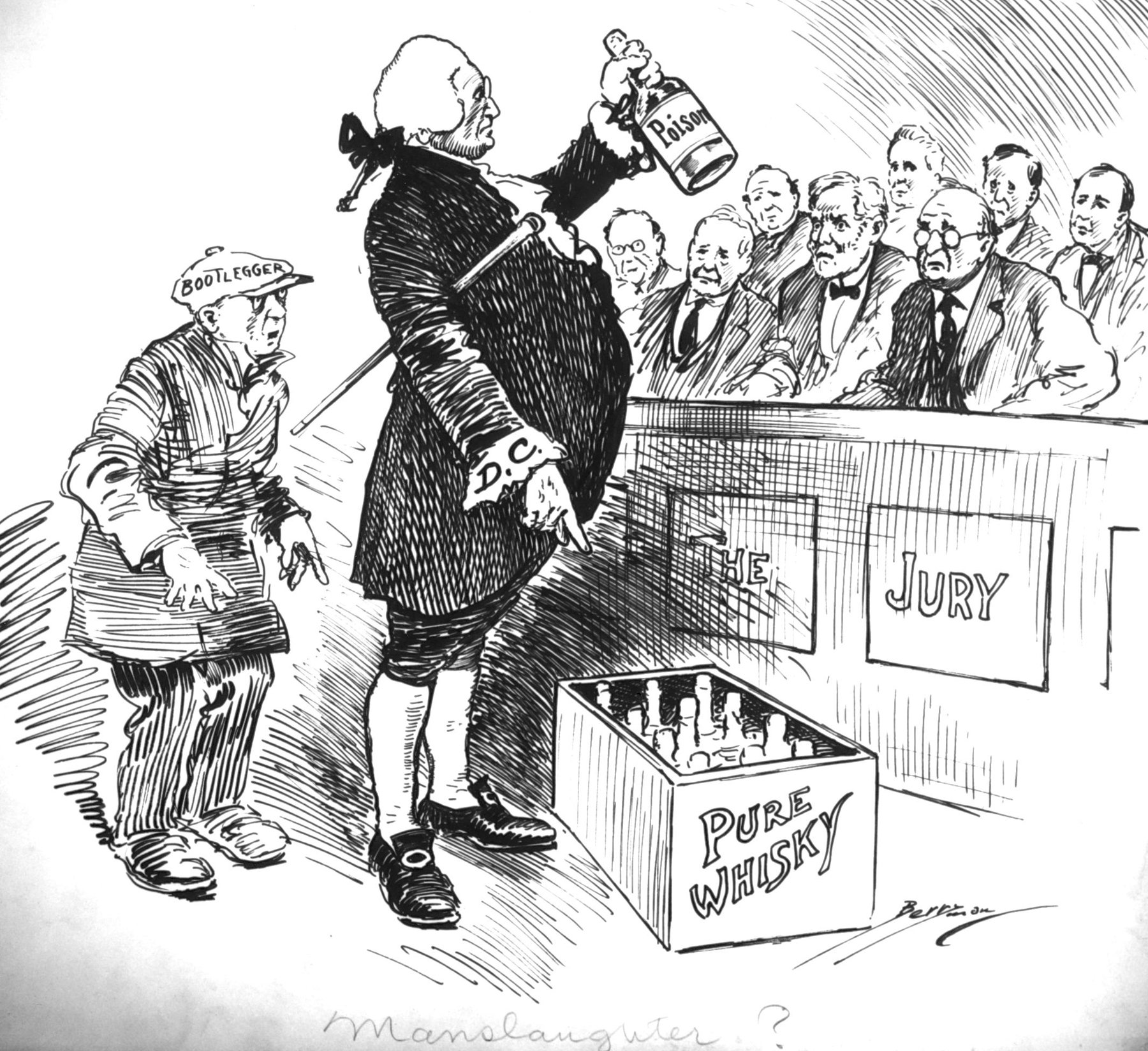
Clifford Berryman cartoon, "Manslaughter?" (8 March 1922)
A Berryman drawing of 8 March 1922: his character Mr. D.C., as prosecutor, holds up a bottle marked "Poison" before a jury and points to a crate marked "Pure Whisky" while a bootlegger watches.
- Date
- 1922-03-08
- Kind
- photograph
- Source
- National Archives Catalog, Records of the U.S. Senate (RG 46), Berryman Political Cartoon Collection
- Retrieved
- 2026-10-12
- NAID
- 6011715
- Rights
- A drawing by Clifford K. Berryman in the Records of the U.S. Senate (Record Group 46), series "Berryman Political Cartoon Collection" (NAID 306080), whose use note reads: "Some records in this series may be subject to copyright restrictions. It is the responsibility of the researcher to determine the copyright holder and arrange for permission to reproduce the items, if necessary." The item record reads "Use Restriction: Unrestricted." Berryman was a newspaper cartoonist, not a federal employee, so 17 U.S.C. § 105 is not the basis. The catalog dates the drawing 8 March 1922. A work published in the United States in 1930 or earlier is in the public domain there, and an unpublished work by an author who died in 1949, as Berryman did, passed out of copyright at the end of 2019; on either footing, and on the item-level "Unrestricted" mark, a copy is stored here.
The catalog title is “Manslaughter?”, local identifier F-028, dated 8 March 1922. Berryman’s recurring figure Mr. D.C. stands in a courtroom in a wig and knee breeches, his sleeve marked “D.C.,” holding up a bottle labelled “POISON” and pointing at a crate marked “PURE WHISKY.” A small man in a cap marked “BOOTLEGGER” looks on from the left, and men sit in a box labelled “THE JURY.” The drawing is signed by Berryman.
The National Archives note says bootleggers prospered as demand for liquor rose, that the quality of bootleg liquor could not be assured, and that “government studies indicated that poison was found in 98% of bootleg whisky.” That figure is the note’s; the study it refers to is not filed here and the number is not adopted as a finding.
The drawing is an editorial comment of 1922, cited for its content and for the catalog’s account of its subject.