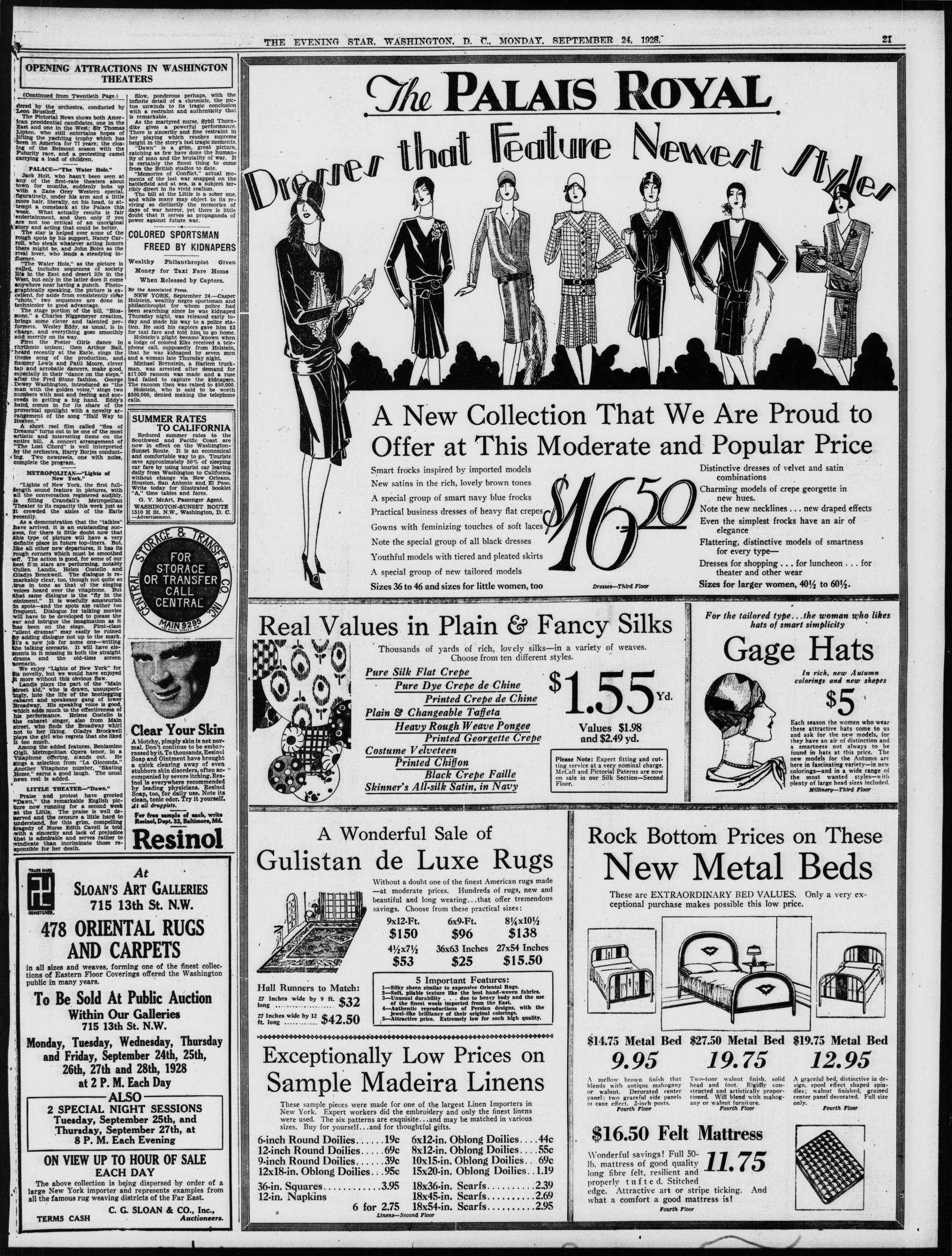
Evening Star, 24 September 1928, page 21: Casper Holstein freed by kidnapers
Colored Sportsman Freed by Kidnapers
- Paper
- Evening Star (Washington, D.C.)
- Date
- 1928-09-24
- Page
- Page 21
- Headline
- Colored Sportsman Freed by Kidnapers
- Rights
- A United States newspaper published in 1930 or earlier. Public domain in the United States. The Library of Congress serves the page from Chronicling America.
Page 21 of the Evening Star for Monday, 24 September 1928, is almost entirely a department-store advertisement. In the narrow left-hand column, below the theater reviews, is a short item headed “Colored Sportsman Freed by Kidnapers,” with the deck “Wealthy Philanthropist Given Money for Taxi Fare Home When Released by Captors.” It is credited “By the Associated Press” under a “NEW YORK, September 24” dateline. The headline’s wording is the paper’s.
The dispatch says that Casper Holstein, “wealthy negro sportsman and philanthropist for whom police had been searching since he was kidnaped Thursday night, was released early today and made his way to a police station,” and that “his captors gave him $3 for taxi fare and told him to go home.” It says a lodge of colored Elks had received a telephone call, “supposedly from Holstein,” that he had been kidnapped “by seven men and a woman”; that “Michael Bernstein, a Harlem truck man, was arrested after demand for $17,000 ransom was made and a ruse had failed to capture the kidnapers”; that “The ransom then was raised to $50,000”; and that Holstein, “who is said to be worth $500,000, denied making the telephone calls.”
The same Associated Press text was printed that day in other papers, among them the New Britain Herald, the Bismarck Tribune and the Brownsville Herald; this page is filed as the example. The $17,000 first demand and the “seven men and a woman” are the wire service’s account. The Savannah Tribune’s report from the New York World gives other details (page 1, page 4).