Testimony of Buffalo Police Lt. Michael Amico on Stefano Magaddino and John C. Montana, October 16, 1963
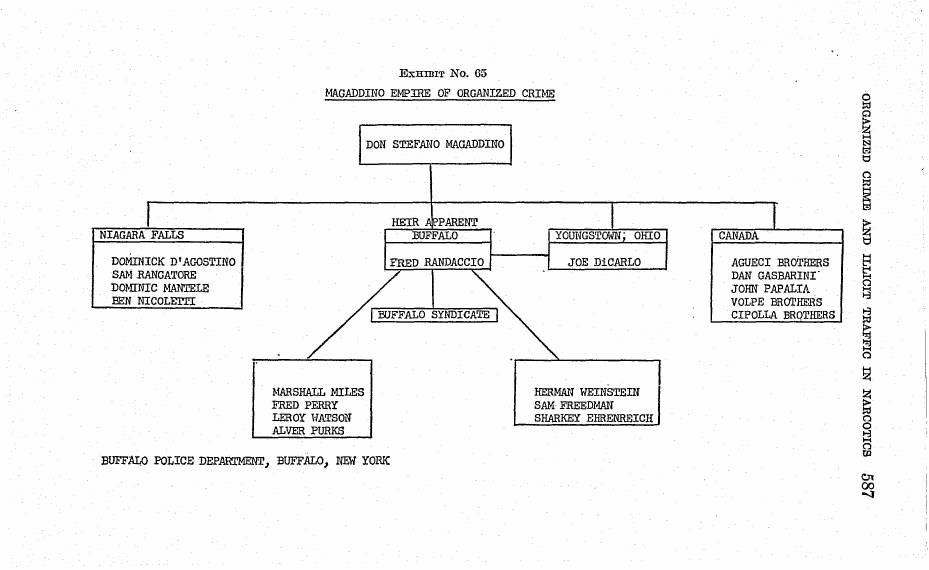
The head of Buffalo's Criminal Intelligence Bureau introduced the "Magaddino Empire of Organized Crime" chart (Exhibit 65), read a statement calling Stefano Magaddino the "titular head" of syndicated crime in the Buffalo-Niagara Falls and Toronto areas, and said police had found no arrest of John C. Montana before Apalachin.
- Date
- 1963-10-16
- Kind
- hearing
- Retrieved
- 2026-10-12
- Rights
- A work of the United States Senate, printed by the Government Printing Office. Public domain in the United States under 17 U.S.C. § 105. The page image stored here was rendered from the National Criminal Justice Reference Service scan of the printed hearings.
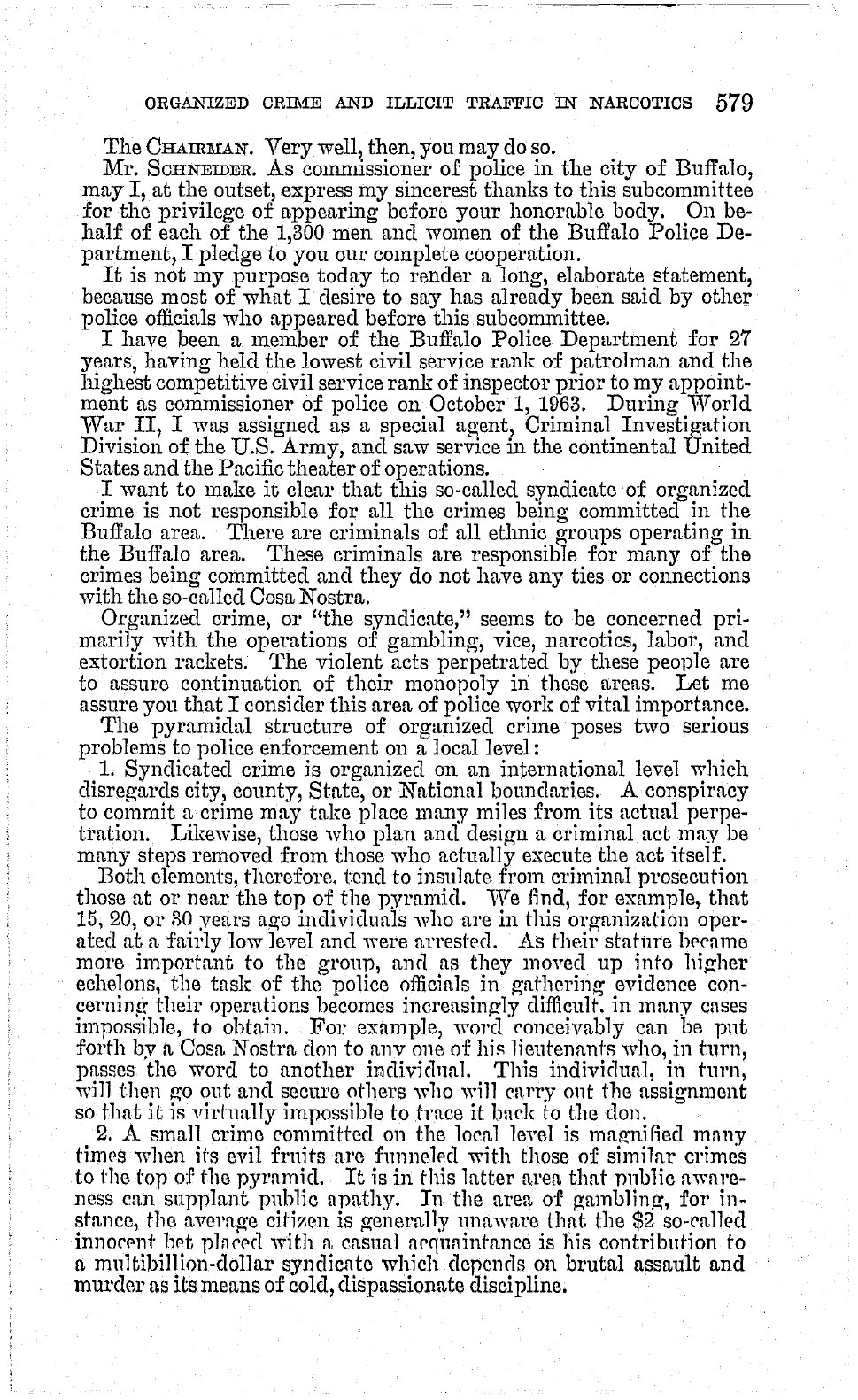
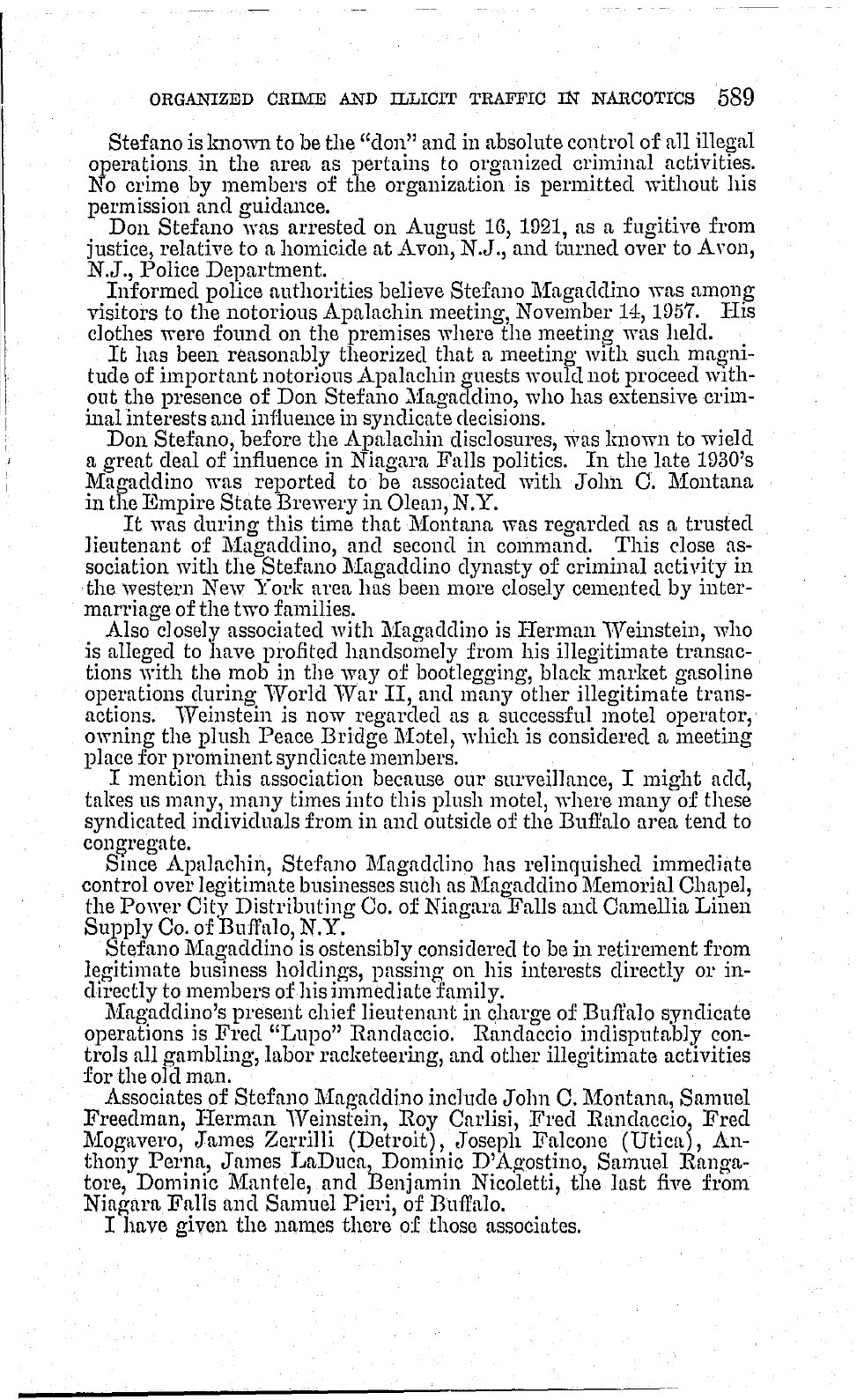
Part 2 of the 1963 hearings, printed pages 584 to 592 (NCJRS PDF pages 654 to 662). Michael A. Amico described himself as “the lieutenant commanding the criminal intelligence bureau” of the Buffalo Police Department, formed in July 1960. His long prepared statement was ordered inserted in full; he summarized parts of it. The stored image is printed page 589. The page before it prints a home address, which this archive does not reproduce.
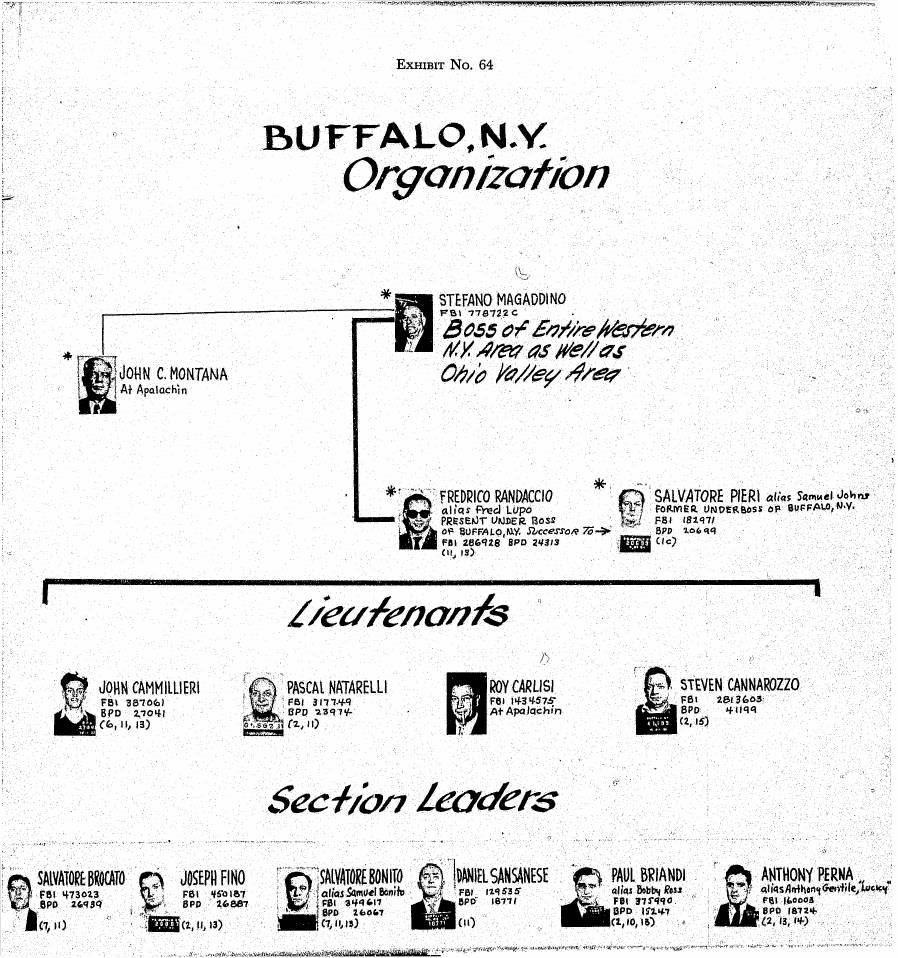
Amico said he agreed “in essence” with Joseph Valachi’s estimate of about 100 to 125 members in the area, qualifying it as “some 75 to 80” in Buffalo, “some 20 or better in Niagara Falls,” and “some 20 and better in nearby Canadian areas.” He said the chart had been prepared before Valachi was consulted. The chairman received the “Magaddino empire of organized crime” chart as Exhibit 65. Amico read: “Don Stefano is the irrefutable lord paramount and titular head of syndicated organized crime in the Buffalo-Niagara Falls and Toronto areas.” He said Magaddino “was arrested on August 16, 1921, as a fugitive from justice, relative to a homicide at Avon, N.J.,” and that “Informed police authorities believe Stefano Magaddino was among visitors to the notorious Apalachin meeting, November 14, 1957.” He said Magaddino had, since Apalachin, “relinquished immediate control over legitimate businesses such as Magaddino Memorial Chapel, the Power City Distributing Co. of Niagara Falls and Camellia Linen Supply Co. of Buffalo.” Asked by Senator Javits whether Magaddino was in retirement, he answered: “He is still running the empire.” He described James LaDuca as Magaddino’s son-in-law.
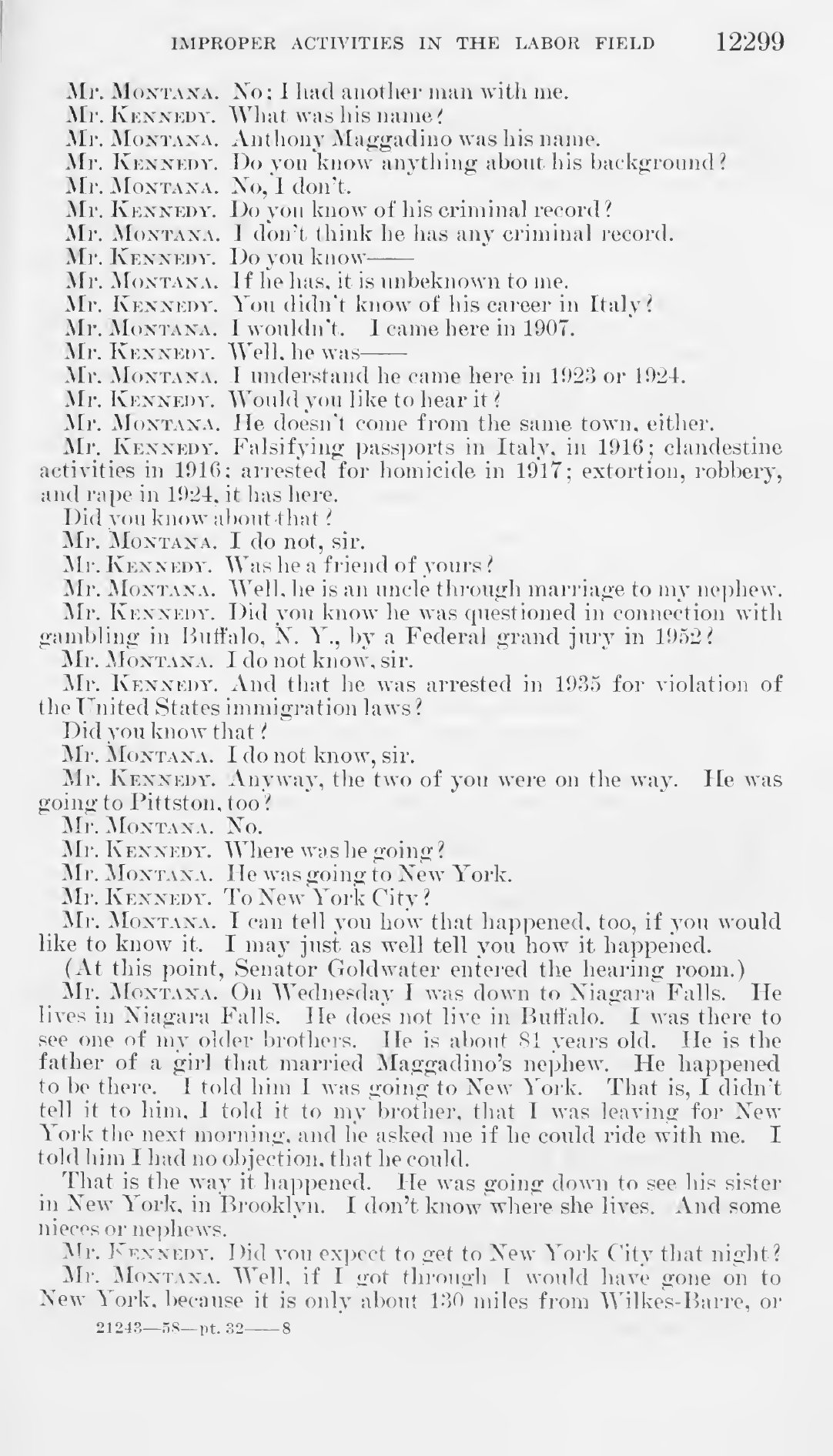
On John C. Montana, Amico said: “our research disclosed no arrest on either a local, State, Federal, or international level,” before Apalachin, but that police observation showed “his associations throughout the years.” He added that “at the present time, he is separated his activities or terminated his activities completely, so to speak, with the mob.” He summarized Montana’s taxicab business and his terms on the Buffalo city council, and said Montana had testified to the Senate Rackets Committee that he went to Apalachin with Antonio Magaddino, “an uncle of Montana’s nephew through marriage.” He noted that Montana’s conviction “was subsequently reversed on appeal.” At Senator Javits’s suggestion, he agreed the chart heading “Jewish ties” should have read “other associates.”
This is a police intelligence officer’s testimony. He described much of it as what police “believe” or what “has been reasonably theorized.” None of it is a court finding, and this archive does not use it to fill a chart seat. Quotations follow the NCJRS text layer, checked against the page images; obvious OCR slips are corrected.