Record

Court opinion

1964-06-30

CourtListener (Free Law Project), text of the opinion

United States v. Provenzano, 334 F.2d 678 (3d Cir. 1964)

The Third Circuit affirmed Anthony Provenzano's Hobbs Act conviction. He was indicted in 1960, as an officer of Teamsters Local 560, for extorting $17,100 from Dorn's Transportation Company between 1952 and 1959.

Date
1964-06-30
Kind
court-opinion
Retrieved
2026-10-12
Docket
No. 14614 (3d Cir.); 334 F.2d 678
Rights
Opinion of a United States court. Works of the federal judiciary are in the public domain in the United States (17 U.S.C. § 105). The text was read on CourtListener (Free Law Project).

United States Court of Appeals, Third Circuit, argued 12 March 1964 and decided 30 June 1964; Chief Judge Biggs wrote the opinion. CourtListener’s header gives the date rehearing was denied, 28 July 1964.

The opinion begins: “The defendant-appellant, Anthony Provenzano, was indicted on November 15, 1960, in a single-count indictment charging him, an officer of Local 560, International Brotherhood of Teamsters (Local 560), with obstructing, delaying, and affecting interstate commerce from January 1, 1952 to June 1, 1959, by extorting through economic fear” from Dorn’s Transportation Company or its vice president, Walter A. Dorn. The sum charged was $17,100.

The court summarizes the testimony. Dorn’s moved its trucking terminal from New York City to Secaucus, New Jersey, on 1 January 1952, and labor trouble followed. Dorn paid Provenzano cash in 1952 and 1953 and later paid a lawyer whose name Provenzano supplied, which Dorn described as “the method of making the payment.” The court concluded: “The judgment of conviction will be affirmed.”

The court noted that under the trial judge’s charge Provenzano “could not be convicted of an offense committed prior to November 15, 1955,” the limitations date. The payments the Government relied on were made by the Dorn company to a man the opinion names as Communale. Provenzano argued that there was no proof “that he received any benefit, pecuniary or otherwise, direct or indirect,” from those payments; the court rejected the argument that personal benefit had to be shown.

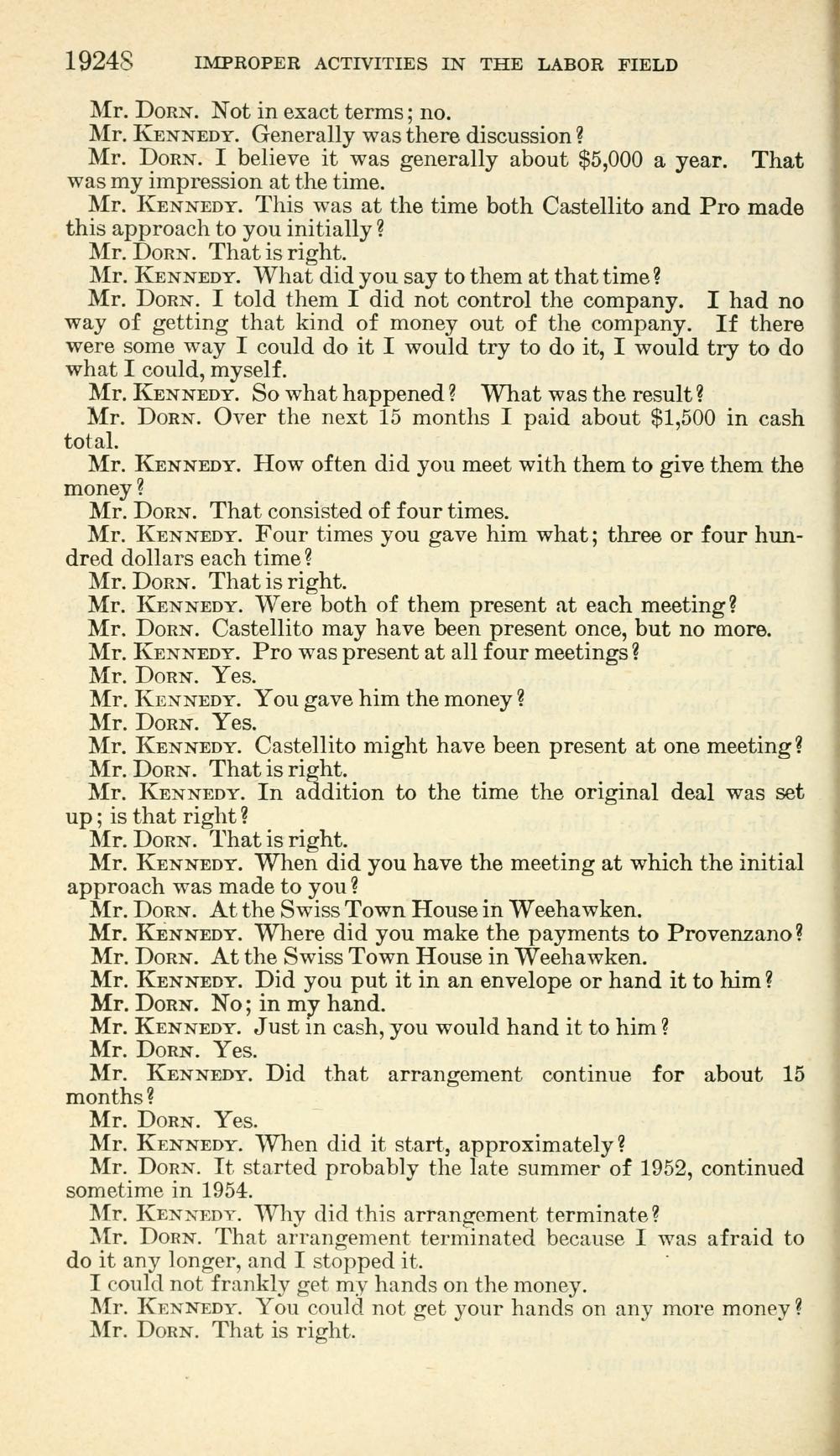
Walter Dorn had described the start of the payments to the McClellan Committee in 1959 (testimony). The later civil RICO findings list the Dorn extortion among the acts by which the “Provenzano Group” controlled Local 560 (581 F. Supp. 279).
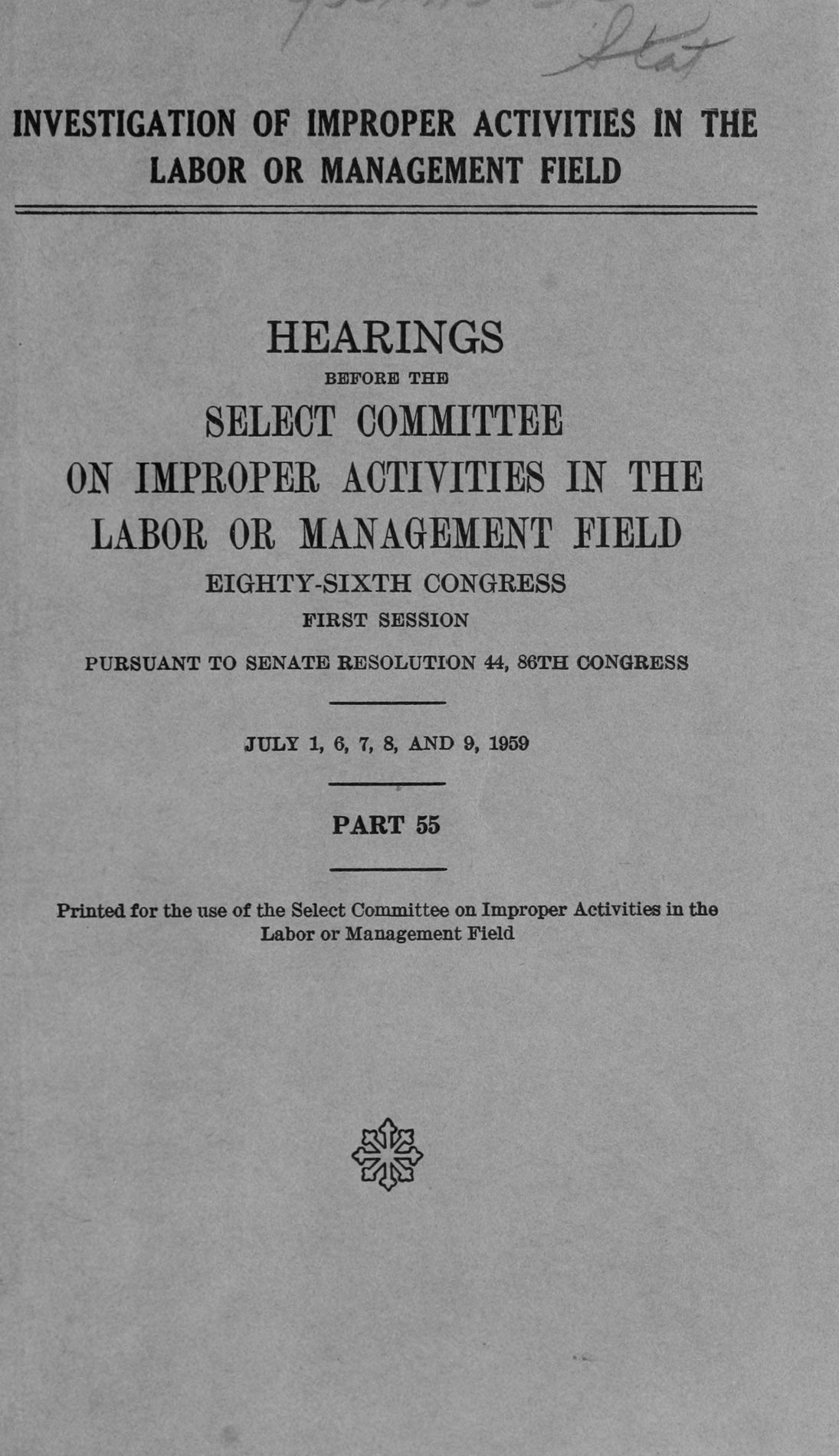
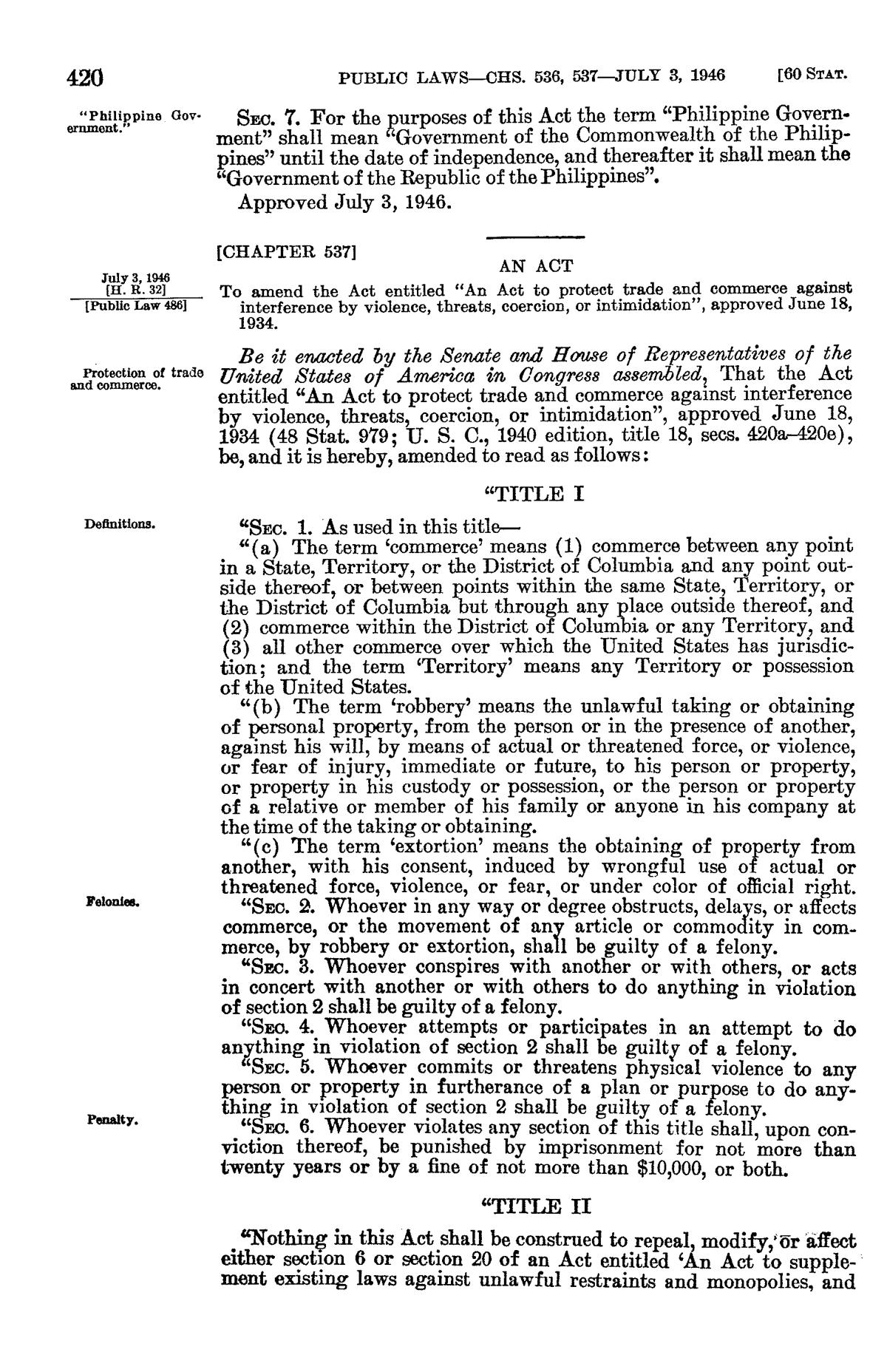
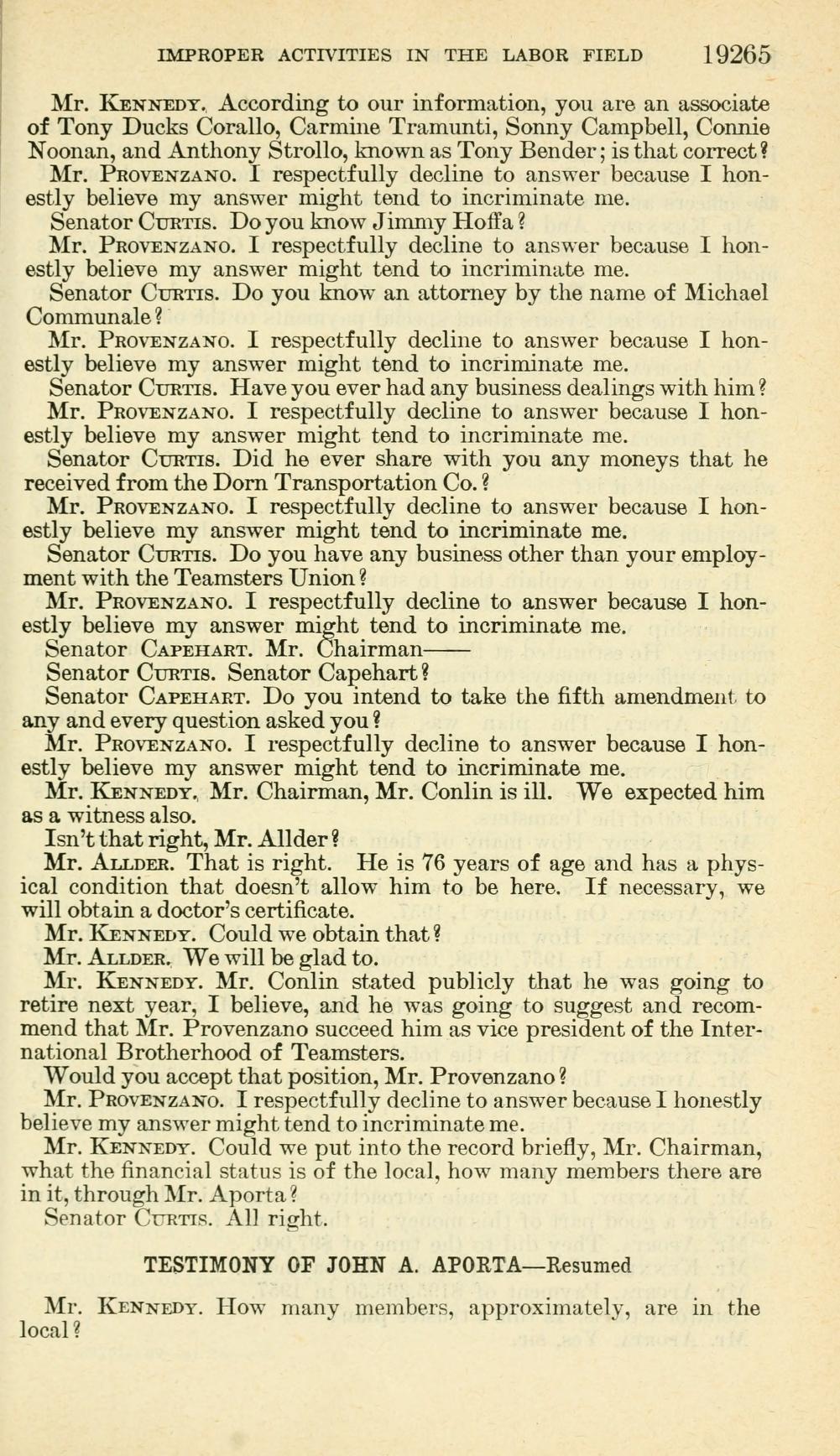
itemUnited States v. Provenzano, 620 F.2d 985 (3d Cir. 1980)The Third Circuit affirmed the RICO and RICO-conspiracy convictions of Anthony Provenzano, Thomas Andretta and Stephen Andretta in a scheme to extort "labor peace" payments from Interocean Services, an in-house trucker for Seatrain Lines.itemUnited States v. Local 560, International Brotherhood of Teamsters, 780 F.2d 267 (3d Cir. 1985)The Third Circuit affirmed the civil RICO judgment that found Teamsters Local 560 a "captive labor organization," removed its executive board and imposed a trusteeship until free elections could be held.itemMcClellan Committee hearings, Part 55: Anthony Provenzano declines to answer (July 1959)Printed hearings of 1, 6, 7, 8 and 9 July 1959. On 6 July Anthony Provenzano, with counsel, declined to state his occupation or to answer Robert Kennedy's questions about Teamsters offices and payments, saying his answer "might tend to incriminate me."itemHobbs Act: 60 Stat. 420 (Chapter 537, Public Law 486), 3 July 1946The 1946 Act that rewrote the 1934 Anti-Racketeering Act: "Whoever in any way or degree obstructs, delays, or affects commerce, or the movement of any article or commodity in commerce, by robbery or extortion, shall be guilty of a felony."itemUnited States v. Local 560, 550 F. Supp. 511 (D.N.J. 1982)In the government's civil RICO suit alleging that Teamsters Local 560 had become a "captive labor organization" controlled by the "Provenzano Group," the district court denies the union's motion to dismiss, calling the question one "of first impression."itemUnited States v. Local 560, 581 F. Supp. 279 (D.N.J. 1984)After a civil RICO trial, the district court finds that Teamsters Local 560 has been since 1961 "a captive labor organization" dominated by the "Provenzano Group" through fear and intimidation, and orders a trusteeship and injunctions.itemUnited States v. Local 560 (I.B.T.), 694 F. Supp. 1158 (D.N.J. 1988)On the court-appointed trustee's application, the district court bars two former Local 560 officers from union affairs. It restates the 1984 findings that the Provenzano Group was organized in the late 1940s as part of the Genovese family and that Anthony Provenzano "was a made-member" of it.itemUnited States v. Local 560 (Sciarra), 974 F.2d 315 (3d Cir. 1992)The Third Circuit affirms a permanent injunction barring Michael Sciarra, a former Local 560 president, from union office and influence, on findings that he remained under the influence of the Genovese organized crime family.itemTestimony of Anthony Provenzano, July 6, 1959 (McClellan Committee, Part 55, pp. 19264–19268)Anthony Provenzano, with counsel, answers nearly every question from the McClellan Committee, including whether he was president of Teamsters Local 560 and whether he took money from Pitman and Dorn, with "I respectfully decline to answer because I honestly believe my answer might tend to incriminate me."itemTestimony of Walter A. Dorn, Dorn's Transportation Co., July 6, 1959 (McClellan Committee, Part 55, pp. 19246 ff.)A trucking executive tells the McClellan Committee that in 1952 two Local 560 business agents told him "if I wanted to stop having trouble I had better get him some money," and that he paid Anthony Provenzano about $1,500 in cash at the Swiss Town House in Weehawken over the next fifteen months.