Hobbs Act: 60 Stat. 420 (Chapter 537, Public Law 486), 3 July 1946
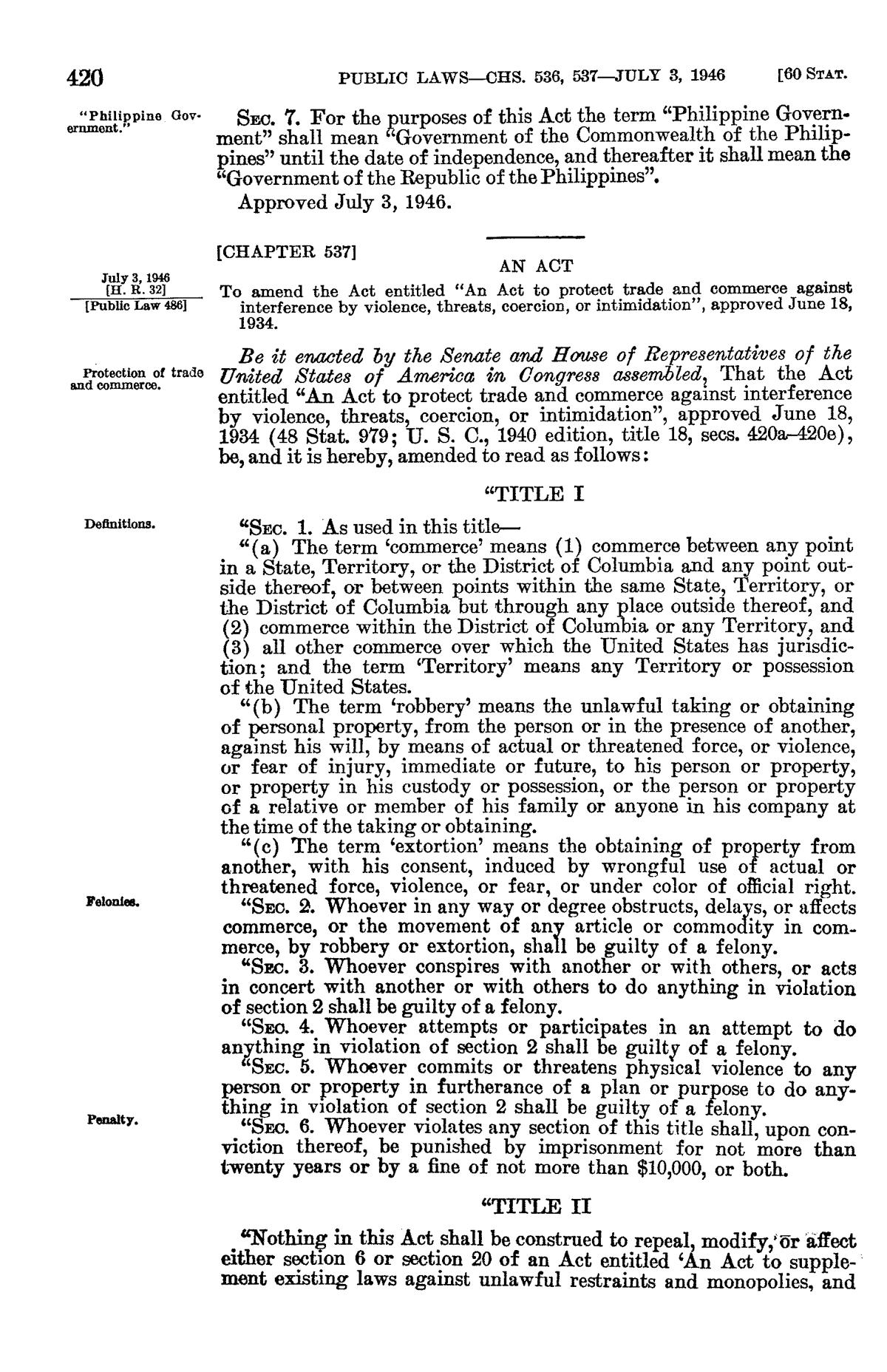
The 1946 Act that rewrote the 1934 Anti-Racketeering Act: "Whoever in any way or degree obstructs, delays, or affects commerce, or the movement of any article or commodity in commerce, by robbery or extortion, shall be guilty of a felony."
- Date
- 1946-07-03
- Kind
- case-file
- Retrieved
- 2026-10-12
- Docket
- 60 Stat. 420 (79th Cong., 2d Sess., ch. 537; H.R. 32; Public Law 486)
- Rights
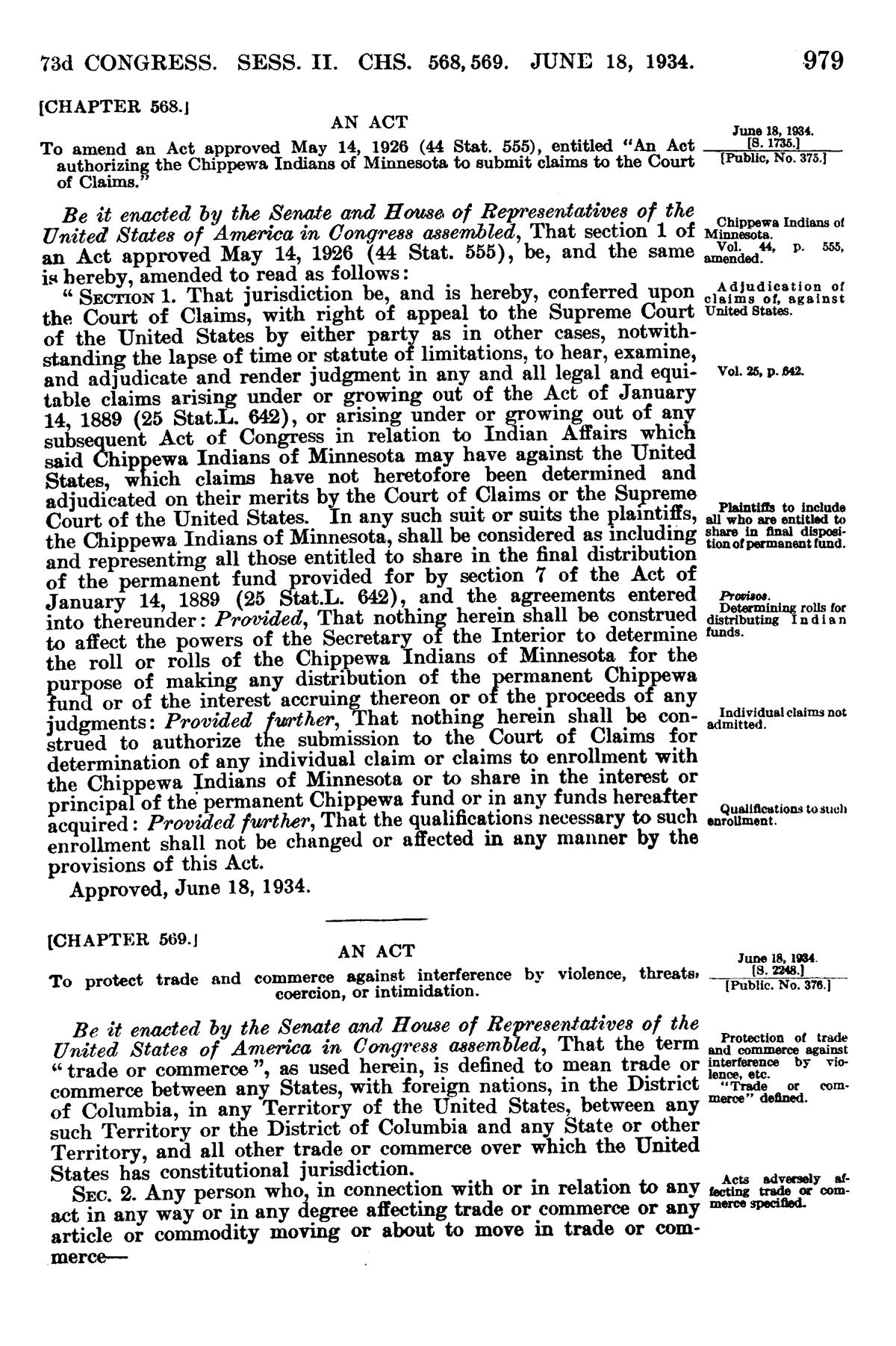
- An Act of Congress, a federal work in the public domain under 17 U.S.C. § 105. The text was read from the Library of Congress's digitised United States Statutes at Large; the page image stored here is the Library of Congress scan of that page.
Page 420 of volume 60 prints Chapter 537, with the margin “July 3, 1946 [H. R. 32] [Public Law 486]”: “An Act To amend the Act entitled ‘An Act to protect trade and commerce against interference by violence, threats, coercion, or intimidation’, approved June 18, 1934.” It amends the 1934 Act (48 Stat. 979) to read as a new Title I.
Section 2 of the new Title I reads: “Whoever in any way or degree obstructs, delays, or affects commerce, or the movement of any article or commodity in commerce, by robbery or extortion, shall be guilty of a felony.” (60 Stat. 420, Title I, sec. 2.) Conspiring or attempting to do so, or committing or threatening physical violence in furtherance of such a plan, is also covered. The penalty is imprisonment of not more than twenty years, a fine of not more than $10,000, or both. “Extortion” is defined as obtaining property from another, with his consent, induced by wrongful use of actual or threatened force, violence or fear, or under color of official right.
The name “Hobbs Act” is not printed in the text. The Justice Department’s Criminal Resource Manual, an archived agency page, says: “Although the Hobbs Act was enacted in 1946 to combat racketeering in labor-management disputes, the extortion statute is frequently used in connection with cases involving public corruption, commercial disputes, and corruption directed at members of labor unions.” Only page 420 was read; Title II, a savings clause, begins at its foot. The section now codified at 18 U.S.C. 1951 is listed among the predicate offenses in the 1970 RICO definition and among the offenses for which the 1968 Title III allows interception orders.