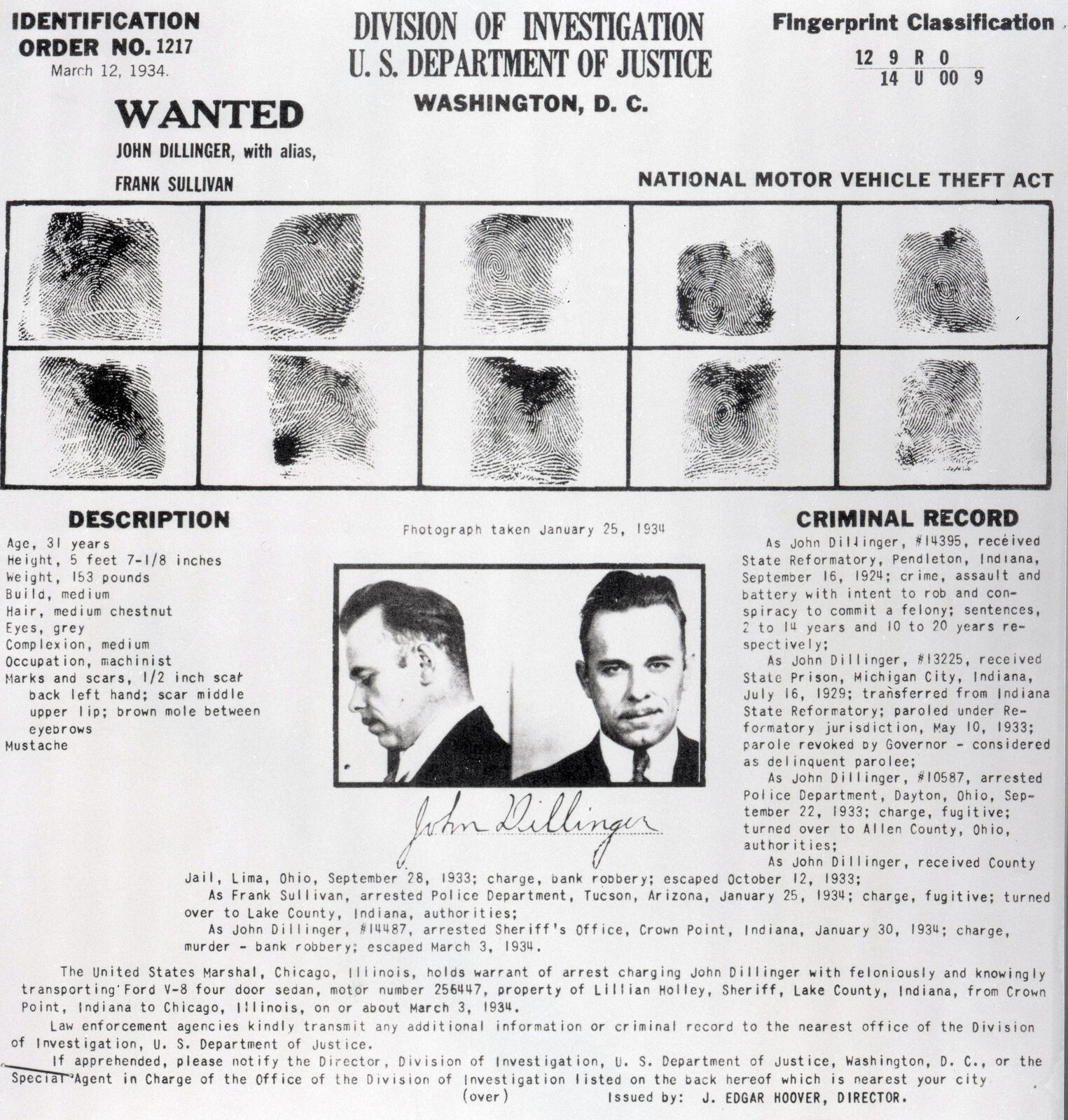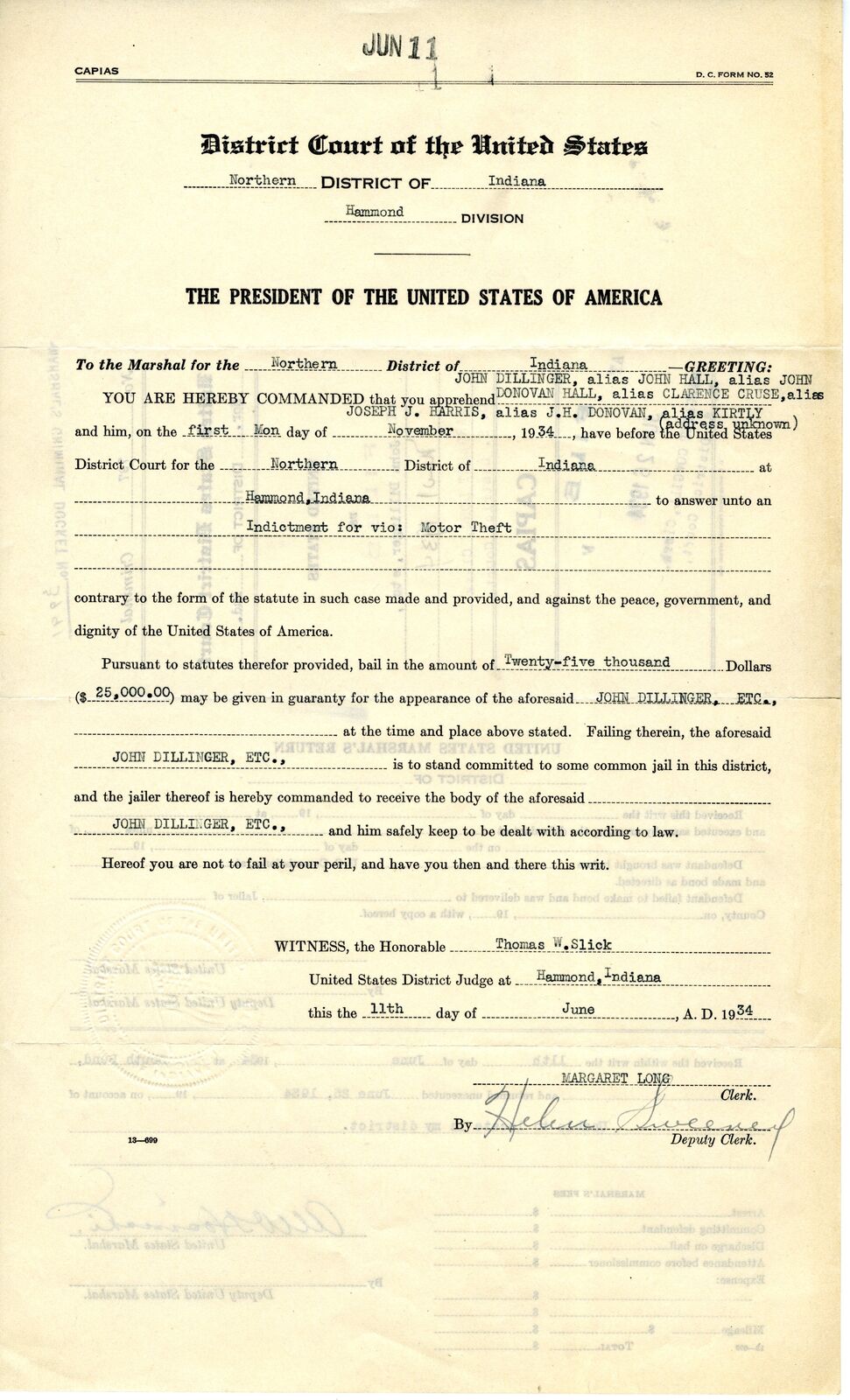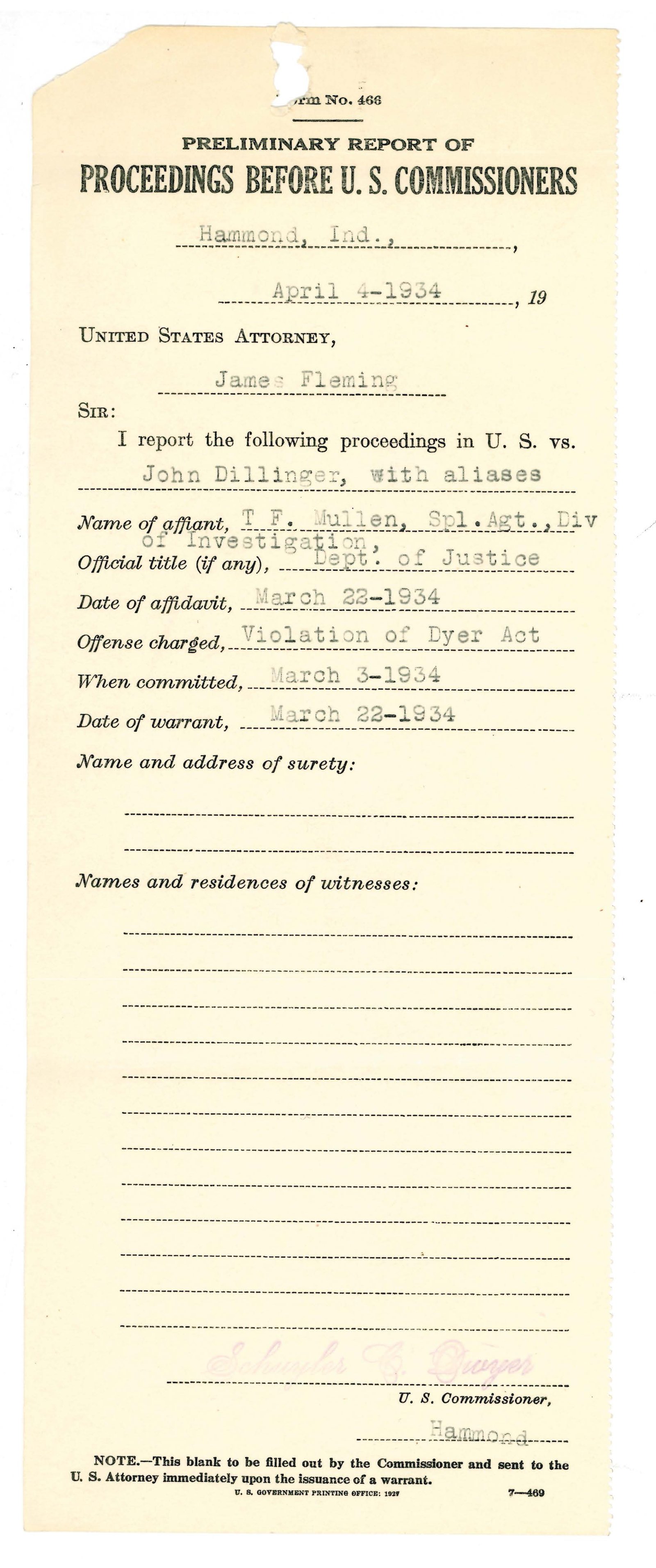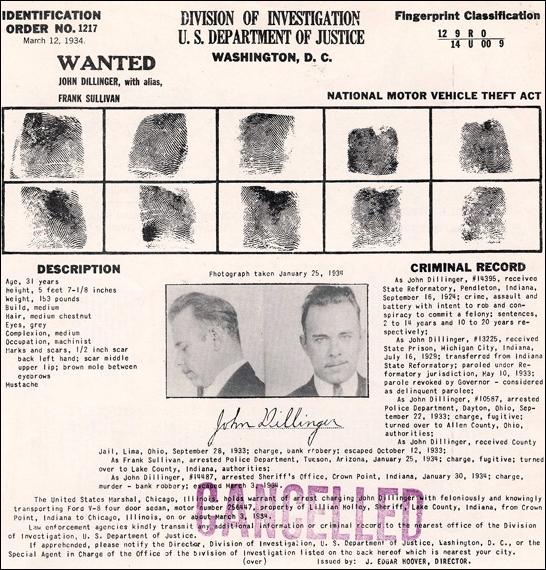
Identification Order No. 1217: John Dillinger (12 March 1934), stamped "Cancelled"
Division of Investigation wanted notice for John Dillinger, alias Frank Sullivan, under the National Motor Vehicle Theft Act, issued nine days after the Crown Point jail escape. The FBI's copy is stamped CANCELLED. A copy is stored here.
- Date
- 1934-03-12
- Kind
- case-file
- Retrieved
- 2026-10-12
- Rights
- A wanted notice issued by the Division of Investigation, U.S. Department of Justice, over the name of J. Edgar Hoover, Director. A United States government work, public domain under 17 U.S.C. § 105. The stored copy was captured from the FBI's image page.
This is the FBI’s own copy of Identification Order No. 1217, dated March 12, 1934. It names “John Dillinger, with alias, Frank Sullivan” under the heading “National Motor Vehicle Theft Act,” and prints ten fingerprints, a front and profile photograph captioned “Photograph taken January 25, 1934,” a description and a criminal record. A large stamp across the lower right reads CANCELLED. The FBI does not say when it was cancelled.
The criminal record lists, among other entries, his receipt at the county jail at Lima, Ohio on September 28, 1933 and escape on October 12, 1933; his arrest as Frank Sullivan at Tucson on January 25, 1934; and his receipt at the sheriff’s office, Crown Point, Indiana on January 30, 1934, “charge, murder - bank robbery; escaped March 3, 1934.” The closing paragraph states that the United States Marshal at Chicago “holds warrant of arrest charging John Dillinger with feloniously and knowingly transporting Ford V-8 four door sedan” belonging to Lillian Holley, Sheriff of Lake County, from Crown Point to Chicago on or about March 3, 1934.
The federal charge printed here is the stolen-car charge, which was the Bureau’s jurisdiction at the time; the other entries are the record as the Division compiled it. The National Archives holds another copy of the same order, without the stamp.