Record
Hearing
1950-06-20
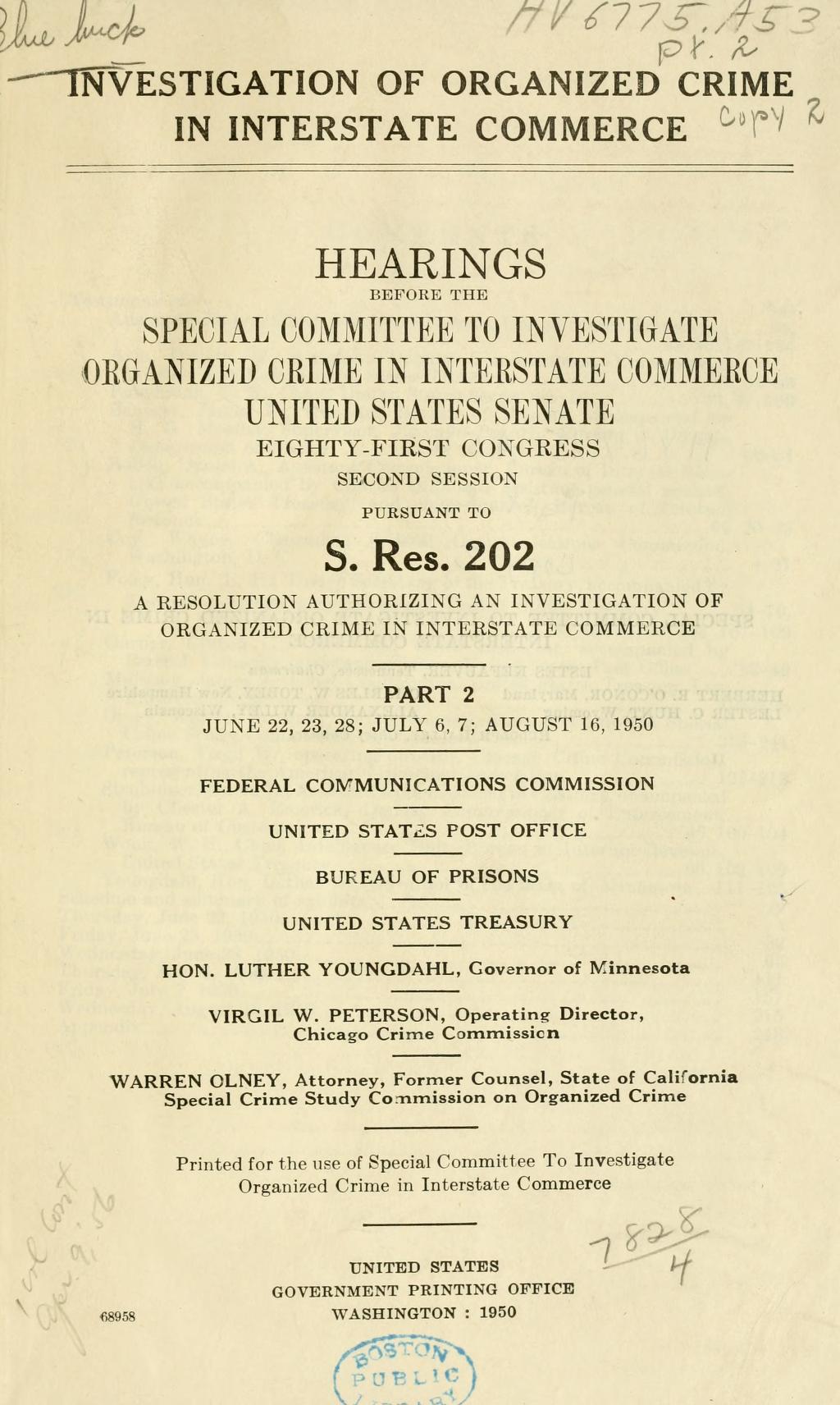
U.S. Senate Special Committee to Investigate Organized Crime in Interstate Commerce, printed hearings, Part 2: Federal agencies, via Internet Archive
Kefauver Part 2: testimony of Wayne Coy, FCC chairman, on Continental Press and leased wires (20 June 1950), pp. 4-31
The chairman of the Federal Communications Commission told the committee that "the principal disseminator of racing information used by illegal bookmakers is the Continental Press Service," described its leased Western Union circuits, and read the carriers' tariff clauses into the record.
- Date
- 1950-06-20
- Kind
- hearing
- Retrieved
- 2026-10-12
- Rights
- A hearing print of the United States Senate, published by the Government Printing Office. A work of the United States Congress, public domain under 17 U.S.C. § 105. The scan is the Internet Archive copy of the Boston Public Library's printed volume.
Wayne Coy, chairman of the Federal Communications Commission, was the first witness at the committee’s Washington hearings (Part 2, pp. 4-31; pp. 4-10 were read for this page). The session heading before his testimony reads Tuesday, June 20, 1950. The volume’s title page lists other hearing dates (June 22, 23 and 28, July 6 and 7, and August 16, 1950), so the date here is the session heading’s.
Drawing on the Senate Interstate and Foreign Commerce Committee’s 1950 hearings on S. 3358 and on a 1943 FCC staff report, Coy said “the principal disseminator of racing information used by illegal bookmakers is the Continental Press Service.” He described “23,000 miles of telegraph circuits” leased from Western Union, “24 primary or regional distributors” and “about 2,500 subdistributors,” and three ways of collecting results at a track: a direct wire from the press box, a telescope from a point outside the track, or a “wigwag” signaller inside it. The dissemination itself, he said, “is not at present a violation of any Federal law.”
He read the regulation in Western Union’s leased-facility tariff, FCC No. 219, under which the company “reserves the right to discontinue the service to any drop or connection or to all drops and connections when it receives notice from Federal or State law-enforcing agencies that the service is being supplied contrary to law,” and cited McBride v. Western Union as “a recent case in point.” He then quoted the Senate committee’s report on S. 3358, which is filed as its own page.