Record
Hearing
1950-06-20
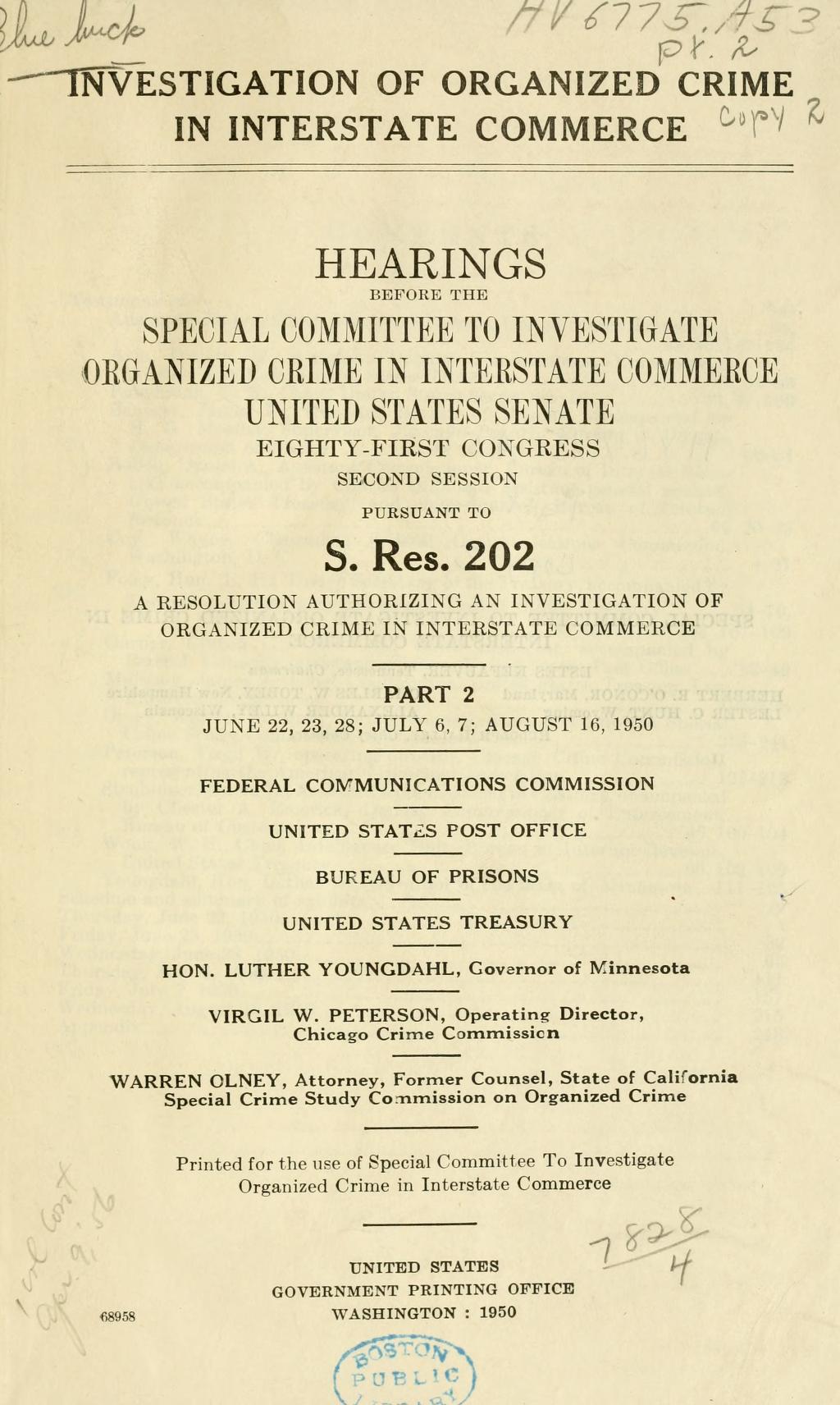
U.S. Senate Special Committee to Investigate Organized Crime in Interstate Commerce, printed hearings, Part 2: Federal agencies, via Internet Archive
S. Rept. 81-1752 on Continental Press, as quoted in Kefauver Part 2, pp. 9-10 (1950)
FCC chairman Wayne Coy read pages 15 and 16 of the Senate Commerce Committee's report on S. 3358 into the Kefauver record: it calls Continental the successor to the Annenberg wire service and finds that it has "a near monopoly in the transmission of racing news."
- Date
- 1950-06-20
- Kind
- hearing
- Retrieved
- 2026-10-12
- Rights
- A hearing print of the United States Senate, published by the Government Printing Office. A work of the United States Congress, public domain under 17 U.S.C. § 105. The scan is the Internet Archive copy of the Boston Public Library's printed volume.
This page files a quotation, not the report itself. At Part 2, pp. 9-10, Wayne Coy read pages 15 and 16 of the Senate committee’s report on the racing-information bill, Senate Report No. 1752. The OCR prints the bill number in this passage as 3858; Coy calls it S. 3358 elsewhere in the same statement. The report, of the Senate Committee on Interstate and Foreign Commerce, 81st Congress, was not found in an open copy, so its text on this site is only what the hearing print reproduces. It is not the Kefauver Committee’s own Second Interim Report.
The quoted report says Continental is “the successor organization to the Nation-Wide News Service,” which it says the Annenberg interests abandoned in 1939, and that “Annenberg’s employees were Arthur McBride of Cleveland and James Ragen of Chicago, and they took over the news-distributing wire service in 1939.” It says McBride later presented the business to his son Edward, a law student, and that the principal office was in Cleveland, “although its network of wire service is controlled from Chicago,” where its general manager was located. The report names him Thomas J. Kelly; he testified in Part 5 as Thomas F. Kelly.
It finds that “Continental today has a near monopoly in the transmission of racing news which ultimately reaches the bookmakers in the country,” and that “some, perhaps many, of its distributors are not without blemishes in character.” It also relays, as “the reports being,” that Ragen refused to let Chicago gangsters “muscle” into the race-wire business before he was shot and later poisoned in hospital. That is the report’s account of reports, not the finding of a court.