Record
Hearing
1951-01-18
Internet Archive, scan of the printed hearings, Part 6: Ohio-Kentucky (Boston Public Library copy)
Kefauver Committee, Cleveland: testimony of Youngstown Police Chief Edward J. Allen (January 1951)
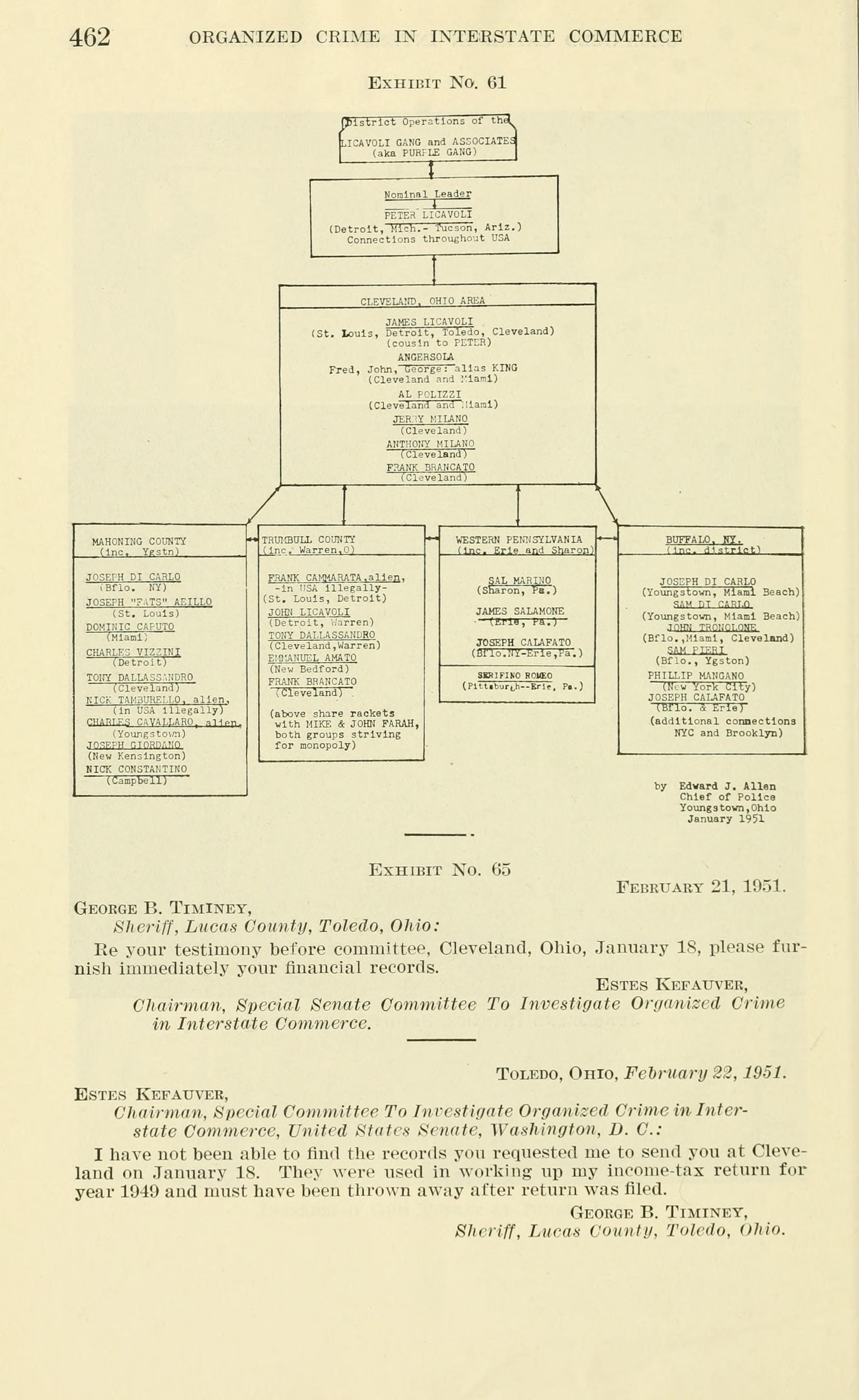
Youngstown's police chief, Edward J. Allen, described a 1945-1948 bookmaking racket in his city, linked it to Detroit, St. Louis and Cleveland figures including Pete and James Licavoli, and introduced a chart he had drawn for the committee (exhibit 61).
- Date
- 1951-01-18
- Kind
- hearing
- Source
- Internet Archive, scan of the printed hearings, Part 6: Ohio-Kentucky (Boston Public Library copy)
- Retrieved
- 2026-10-12
- Docket
- Investigation of Organized Crime in Interstate Commerce, Hearings before the Special Committee, 82d Cong., Part 6: Ohio-Kentucky
- Rights
- A work of the United States Congress, printed by the Government Printing Office. Public domain in the United States. 17 U.S.C. § 105. The scan is of a GPO printing; Internet Archive marks it not in copyright.
Printed pages 229 to 243 of Part 6. Edward J. Allen, chief of police of Youngstown, Ohio, testified about a bookmaking racket in Youngstown from about March 1945 to early 1948 in which, he said, a group took 50 percent of local bookmakers’ receipts, and he connected it to men from Detroit, St. Louis and Cleveland, among them Pete and James Licavoli.
He introduced a chart. Asked when he drew it, he said, “For the purpose of this committee.” Counsel Rudolph Halley observed, “I notice you have Pete Licavoli of Detroit as the nominal leader,” and Allen agreed that he tied the men together “by association.” The chart is filed here as exhibit 61.
Asked by the chairman whether anybody had ever told him they were a member of the Mafia, Allen said: “Nobody admits being a member of the Mafia. The Mafia is known by their actions and their methods, rather than by names.” His account is a police chief’s own investigative conclusion, given as testimony; it is not a finding.