Record
Hearing
1951-01-17
Internet Archive, scan of the printed hearings, Part 6: Ohio-Kentucky (Boston Public Library copy)
Kefauver Committee, Cleveland: testimony of Public Safety Director Alvin G. Sutton (January 1951)
Cleveland's Director of Public Safety, Alvin G. Sutton, gave the committee his account of the city's Prohibition bootleggers, naming Morris Kleinman, Lou Rothkopf, Moe Dalitz, Sam Tucker and Maxie Diamond, their move into gambling in Kentucky and Las Vegas, and the later numbers rackets.
- Date
- 1951-01-17
- Kind
- hearing
- Source
- Internet Archive, scan of the printed hearings, Part 6: Ohio-Kentucky (Boston Public Library copy)
- Retrieved
- 2026-10-12
- Docket
- Investigation of Organized Crime in Interstate Commerce, Hearings before the Special Committee, 82d Cong., Part 6: Ohio-Kentucky
- Rights
- A work of the United States Congress, printed by the Government Printing Office. Public domain in the United States. 17 U.S.C. § 105. The scan is of a GPO printing; Internet Archive marks it not in copyright.
Printed pages 32 to 43 of Part 6 of the Kefauver Committee’s hearings, from the Cleveland sittings of January 1951. Alvin G. Sutton, Cleveland’s Director of Public Safety, read a prepared statement and answered questions from the chairman and associate counsel.
On Prohibition he said: “At the top of Cleveland’s bootleggers were Morris Kleinman, Lou Rothkopf, Moe Dalitz, Sam Tucker, and Maxie Diamond.” He described killings along the way and said that “the road to riches … took Kleinman up to a gross income in 1929 of approximately $931,000,” adding, “Kleinman dominated his field.” He said that after repeal the group moved into gambling clubs and, under pressure from Governor Lausche, “bought into the gambling casinos in liberal-minded Newport and Covington, Ky.,” and that “Now they have gone out to Las Vegas.” Of the numbers rackets he said the “muscle men” of the bootleg days moved in, naming among others Angelo Lonardo, and he listed among those convicted in Eliot Ness’s later extortion cases “Angelo Lonardo, heir to a corn-sugar fortune, Milton Rockman, and Angelo Sciria.”
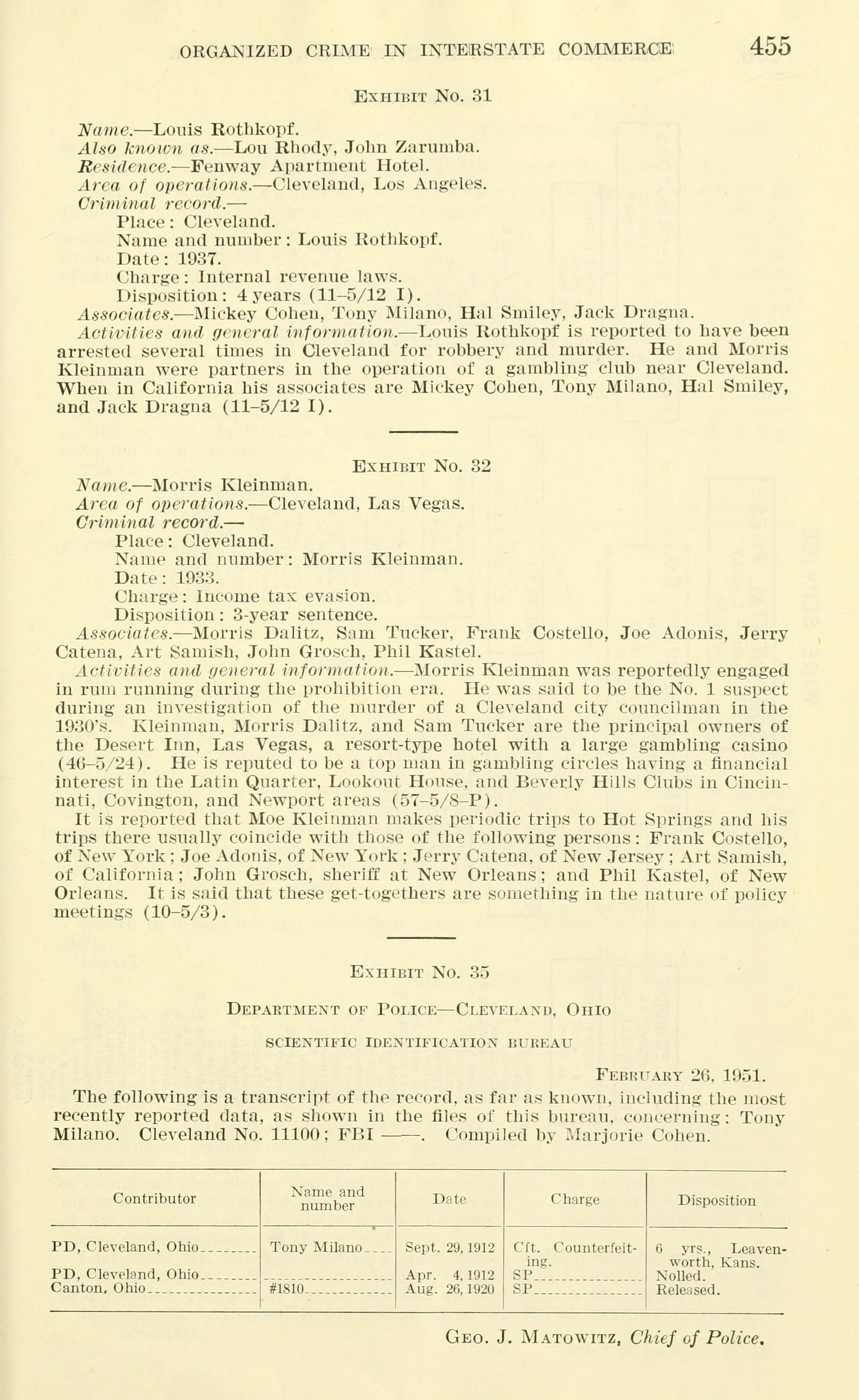
In answers to the chairman, Sutton said of Kleinman that “he was the king of the bootleggers in the northern district of Ohio” and was “caught by Uncle Sam in 1931”; that Dalitz, “Moe Dalitz or Moe Davis,” had spent his time between Detroit and Cleveland for thirty years, had a linen business (the Pioneer Linen Co.), and “As far as I know, he has never been arrested”; that “Frank Milano is living in Mexico,” and, asked whether he had gone there over an income-tax problem, “As I recall it, yes. He fled to Mexico”; and that “Tony Milano has the Brotherhood Loan Co. out here on Mayfield Road.” He placed Cleveland police records in evidence as exhibits 29 to 33.
Sutton was a city official giving his own account; his statement is testimony, not a finding, and several of the men he named were not before the committee. The police record printed as exhibit 32 gives Kleinman’s income-tax case as 1933, not 1931; both dates are recorded here as printed.