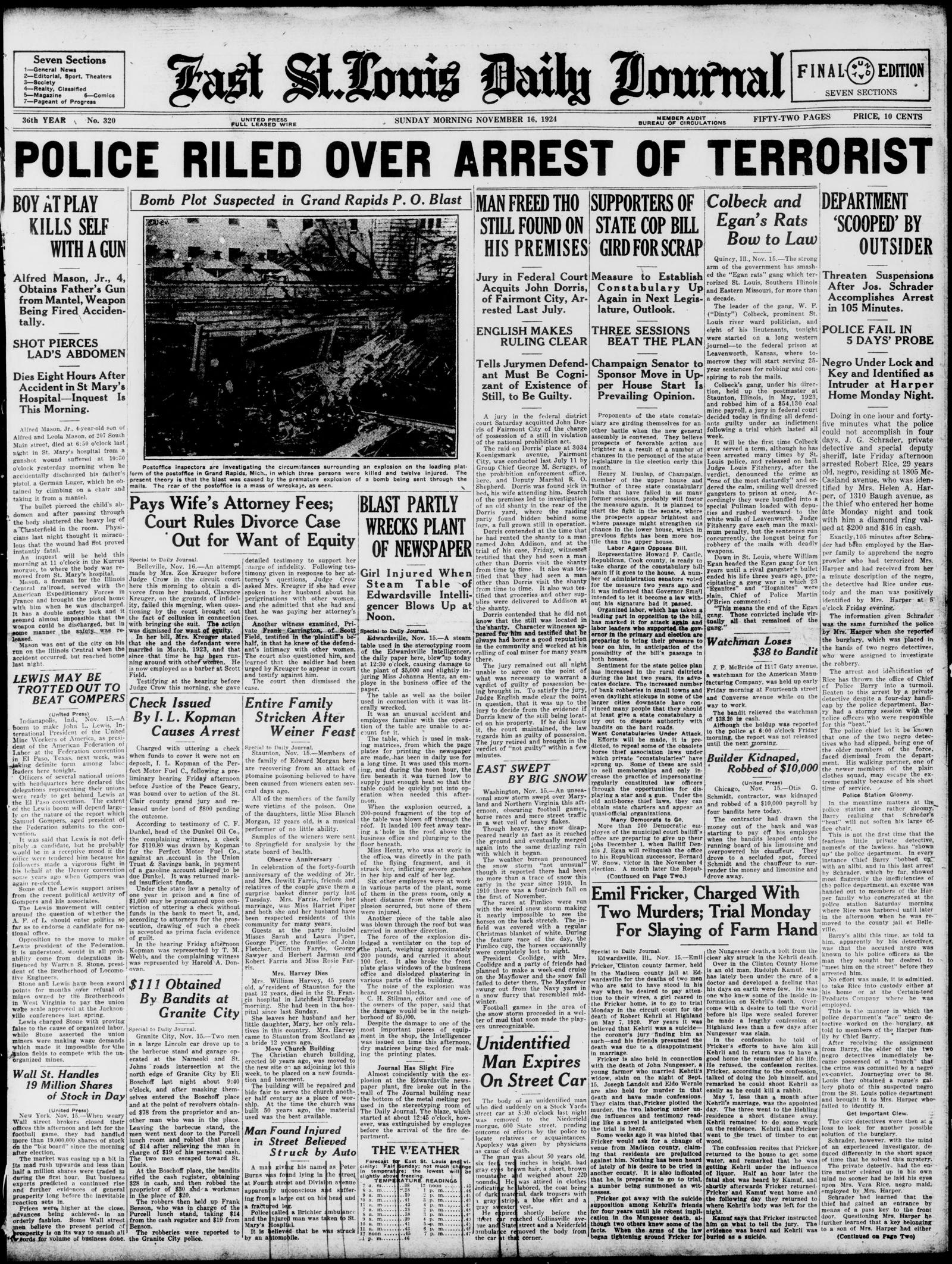
East St. Louis Daily Journal, 16 November 1924, page 1: Colbeck and Egan's Rats Bow to Law
Colbeck and Egan's Rats Bow to Law
- Paper
- East St. Louis Daily Journal
- Date
- 1924-11-16
- Page
- Page 1
- Headline
- Colbeck and Egan's Rats Bow to Law
- Rights
- A United States newspaper published in 1930 or earlier. Public domain in the United States. The Library of Congress serves the page from Chronicling America.
Front page of the East St. Louis Daily Journal, Final Edition, Sunday morning, 16 November 1924. The story sits in the second column from the right under the italic headline “Colbeck and Egan’s Rats Bow to Law,” datelined Quincy, Ill., November 15.
As read on the scan, it begins: “The strong arm of the government has smashed the “Egan rats” gang which terrorized St. Louis, Southern Illinois and Eastern Missouri, for more than a decade. The leader of the gang, W. P. (“Dinty”) Colbeck, prominent St. Louis river ward politician, and eight of his lieutenants, tonight were started on a long western journey”—printed “journel”—“to the federal prison at Leavenworth, Kansas, where tomorrow they will start serving 25-year sentences for robbing and conspiring to rob the mails.” It says the gang “held up the postmaster at Staunton, Illinois, in May, 1923, and robbed him of a $54,130 coal mine payroll,” that a jury in federal court found all the defendants guilty that day after a week-long trial, and that Judge Louis Fitzhenry called the crime “one of the most dastardly” and gave each man the maximum, the sentences to run concurrently. It closes with a comment from the St. Louis chief of police, Martin O’Brien: “This means the end of the Egan gang. Those convicted include virtually all that remained of the gang.”
“Egan rats,” “leader” and “lieutenants” are the newspaper’s words. The indictment and the Seventh Circuit’s opinion do not use the name or assign any defendant a rank. The page’s figure of $54,130 differs by four dollars from the total of the three registered packages the indictment lists ($45,000, $5,000 and $4,134). The story’s dates agree with the Alcatraz card of one defendant, which gives the date of sentence as November 15, 1924 and the start of the sentence as November 16. The story’s account of an earlier gang war in St. Louis is the paper’s and is not repeated here as fact.