Record
Court opinion
1960-06-06
CourtListener (Free Law Project), text of the opinion
De Veau v. Braisted, 363 U.S. 144 (1960)
The Supreme Court upheld § 8 of the New York Waterfront Commission Act of 1953, which barred a waterfront union from collecting dues while an officer convicted of a felony remained in office.
- Date
- 1960-06-06
- Kind
- court-opinion
- Retrieved
- 2026-10-12
- Docket
- No. 71, October Term 1959; 363 U.S. 144
- Rights
- Opinion of a United States court. Works of the federal judiciary are in the public domain in the United States (17 U.S.C. § 105). The text was read on CourtListener (Free Law Project).
Supreme Court of the United States, argued 1 March 1960 and decided 6 June 1960. Justice Frankfurter wrote the plurality opinion. Justice Harlan took no part.
The appellant had been, beginning in 1950, secretary-treasurer of Local 1346 of the International Longshoremen’s Association, a local with offices in Richmond County, New York. Section 8 of the New York Waterfront Commission Act barred the collection of dues on behalf of a waterfront union if any of its officers or agents had been convicted of a felony and had not been pardoned or otherwise relieved. In 1956 the District Attorney of Richmond County told the president of the ILA that because of the appellant’s 1920 conviction, § 8 prohibited anyone from collecting dues for Local 1346 while he remained an officer. The New York courts upheld the section.
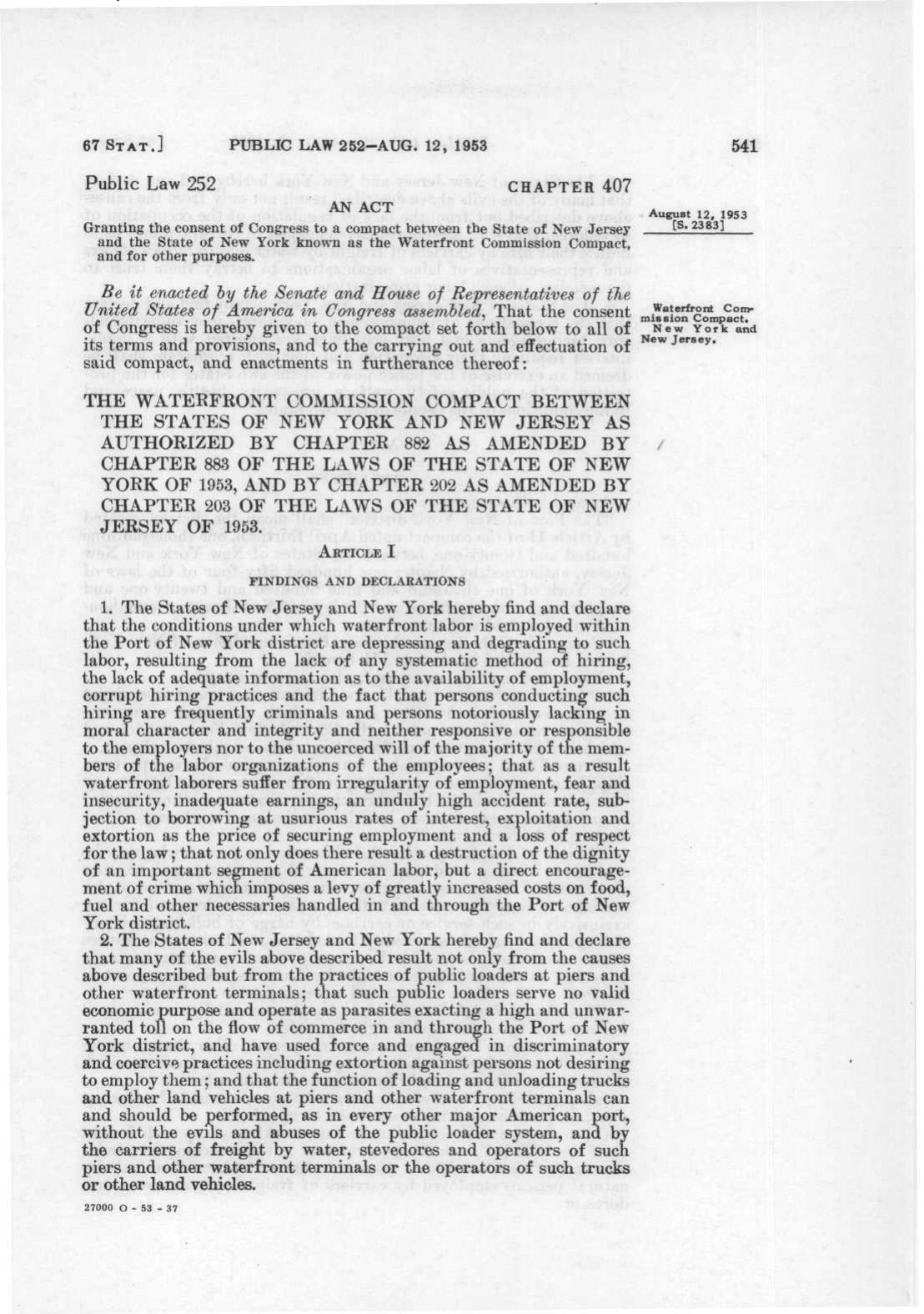
Thomas W. Gleason argued for the appellant. The Court affirmed, saying New York “sought not to punish ex-felons, but to devise what was felt to be a much-needed scheme of regulation of the waterfront.” The opinion describes the Act’s scheme for supervising waterfront employment in the Port of New York, which rests on the Waterfront Commission Compact.
Justice Frankfurter’s opinion was joined by Justices Clark, Whittaker and Stewart, and the judgment of the Court was announced by Justice Brennan. The case began as “an action brought in the Supreme Court of Richmond County, New York, for a declaratory judgment regarding the constitutional validity of § 8 of the New York Waterfront Commission Act of 1953 … and for an injunction restraining its operation.” The appellant argued that § 8 conflicted with federal labor law and violated due process and the bans on ex post facto laws and bills of attainder. The Third Circuit relied on this decision in 1995 to reject a New Jersey union officer’s challenge (Carson).