Record

Court opinion

1964-06-15

CourtListener (Free Law Project), text of the opinion

Murphy v. Waterfront Commission of New York Harbor, 378 U.S. 52 (1964)

Witnesses at a Waterfront Commission hearing on a work stoppage at the Hoboken piers, granted state immunity, refuse to answer for fear of federal prosecution. The Supreme Court holds that the privilege against self-incrimination protects a state witness against incrimination under federal law.

Date
1964-06-15
Kind
court-opinion
Retrieved
2026-10-12
Docket
No. 138
Rights
Opinion of a United States court. Works of the federal judiciary are in the public domain in the United States. The text was read on CourtListener.

Supreme Court of the United States, No. 138, argued March 5, 1964, decided June 15, 1964, opinion by Justice Goldberg. “Petitioners were subpoenaed to testify at a hearing conducted by the Waterfront Commission of New York Harbor concerning a work stoppage at the Hoboken, New Jersey, piers.” After they refused to answer on self-incrimination grounds, they were “granted immunity from prosecution under the laws of New Jersey and New York,” and still refused, because the answers might incriminate them under federal law.

The Court held: “the constitutional privilege against self-incrimination protects a state witness against incrimination under federal as well as state law and a federal witness against incrimination under state as well as federal law.” It rejected earlier decisions to the contrary and ruled that compelled state testimony and its fruits cannot be used against the witness in a federal prosecution.

The opinion does not describe the work stoppage beyond naming it. The rule was central to Gerardo Catena’s later challenge to New Jersey’s immunity statute (449 F.2d 40).
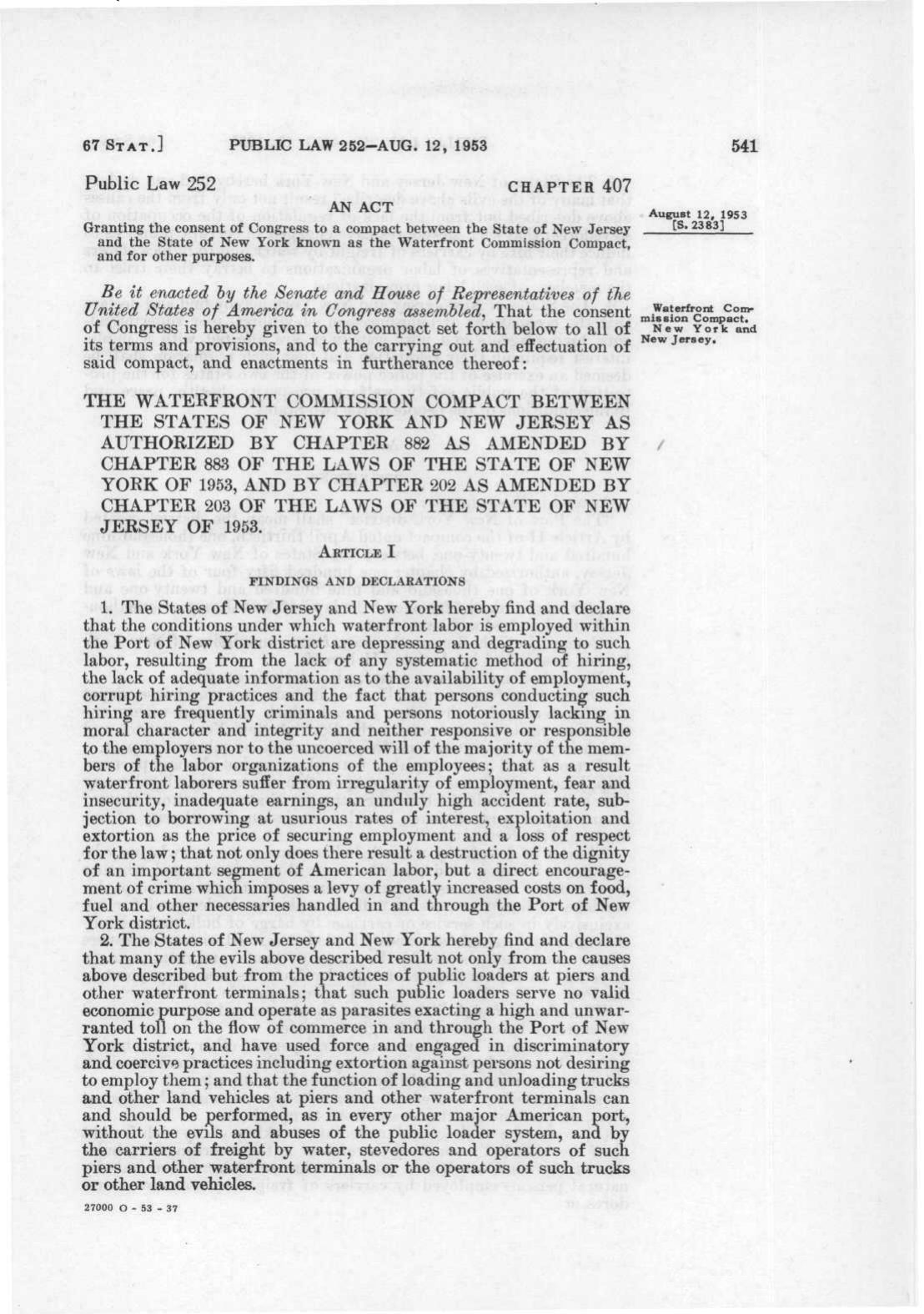
itemWaterfront Commission Compact: 67 Stat. 541 (Public Law 252, Chapter 407), 12 August 1953The 1953 Act of Congress consenting to the New York-New Jersey Waterfront Commission Compact. In the compact's findings the two states declare that hiring on the Port of New York waterfront was marked by "corrupt hiring practices" by persons who "are frequently criminals."itemLinehan v. Waterfront Commission of New York Harbor, 347 U.S. 439 (1954)The Supreme Court summarily affirms judgments upholding the Waterfront Commission Compact. Justices Douglas and Black dissent from the summary treatment and describe the compact's registration of longshoremen.itemDe Veau v. Braisted, 363 U.S. 144 (1960)The Supreme Court upheld § 8 of the New York Waterfront Commission Act of 1953, which barred a waterfront union from collecting dues while an officer convicted of a felony remained in office.itemCarson v. Waterfront Commission of New York Harbor, 73 F.3d 24 (3d Cir. 1995)The Third Circuit rejects a convicted International Longshoremen's Association officer's Supremacy Clause challenge to section 8 of the Waterfront Commission Act, holding the claim barred by De Veau v. Braisted.itemWaterfront Commission of New York Harbor v. Construction and Marine Equipment Co., 928 F. Supp. 1388 (D.N.J. 1996)The district court grants the Waterfront Commission a preliminary injunction against a company working as an unlicensed stevedore, and recounts the 1953 compact's purpose and Congress's consent in Public Law 83-252.itemUnited States ex rel. Catena v. Elias, 449 F.2d 40 (3d Cir. 1971) (en banc)The en banc Third Circuit holds that New Jersey's use-immunity statute did not justify jailing Gerardo Catena for contempt after he refused to testify before the State Commission of Investigation in an inquiry "into organized crime," and orders its mandate to issue at once because he had been held for more than a year.