Record
Agency history
1932/1944
Federal Bureau of Investigation, History: Cases and Criminals
Fur Dressers Case (FBI history page)
The FBI's own account of its 1932 to 1939 antitrust investigation of the Protective Fur Dressers Corporation and the Fur Dressers Factor Corporation, in which Louis Buchalter and Jacob Shapiro were named defendants, through Buchalter's surrender on August 24, 1939.
- Date
- 1932/1944
- Kind
- agency-history
- Retrieved
- 2026-10-12
- Rights
- A page of the Federal Bureau of Investigation, a work of the United States government. Public domain in the United States under 17 U.S.C. § 105. The page's photograph of Buchalter in 1940 is credited to the Library of Congress and is not used here.
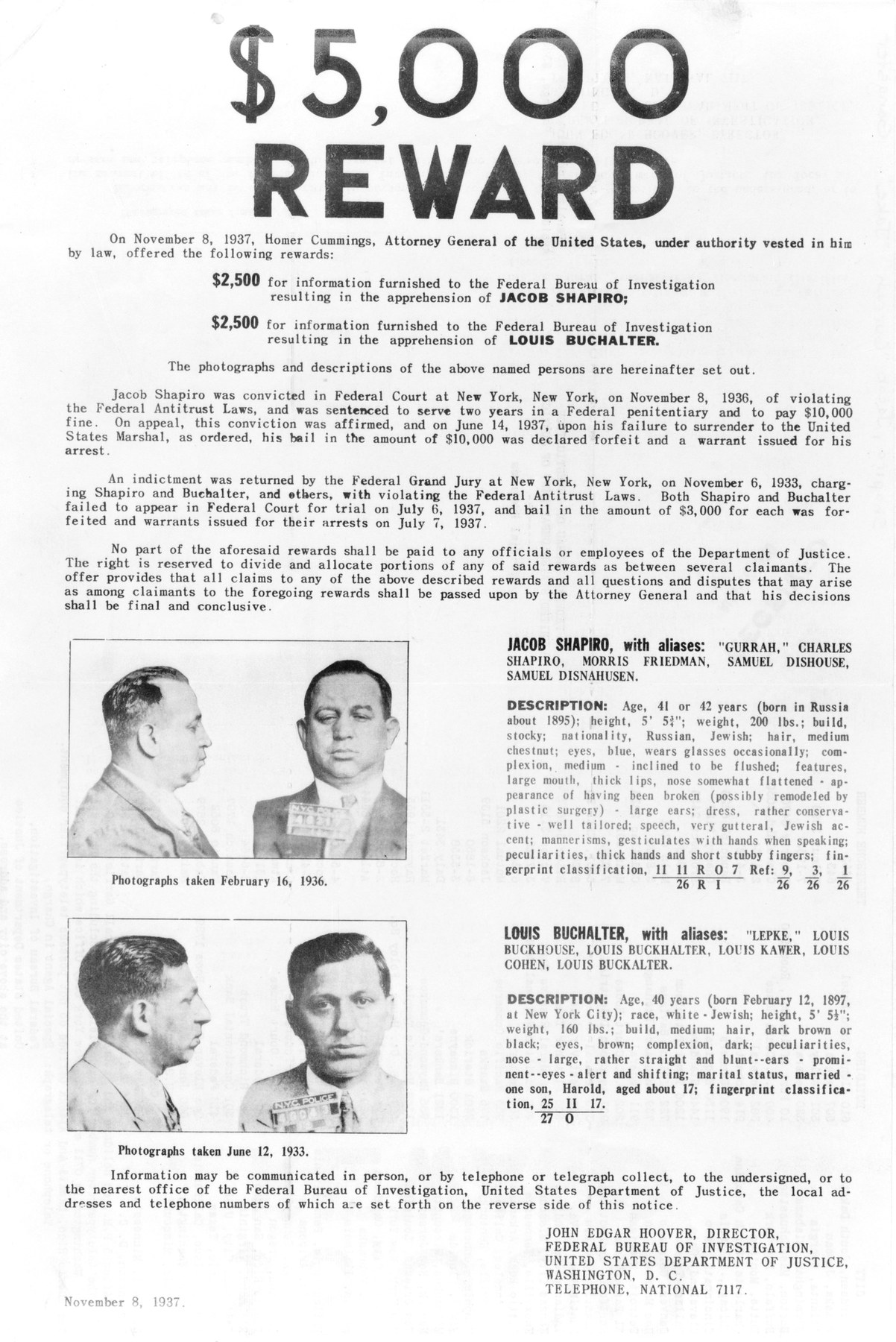
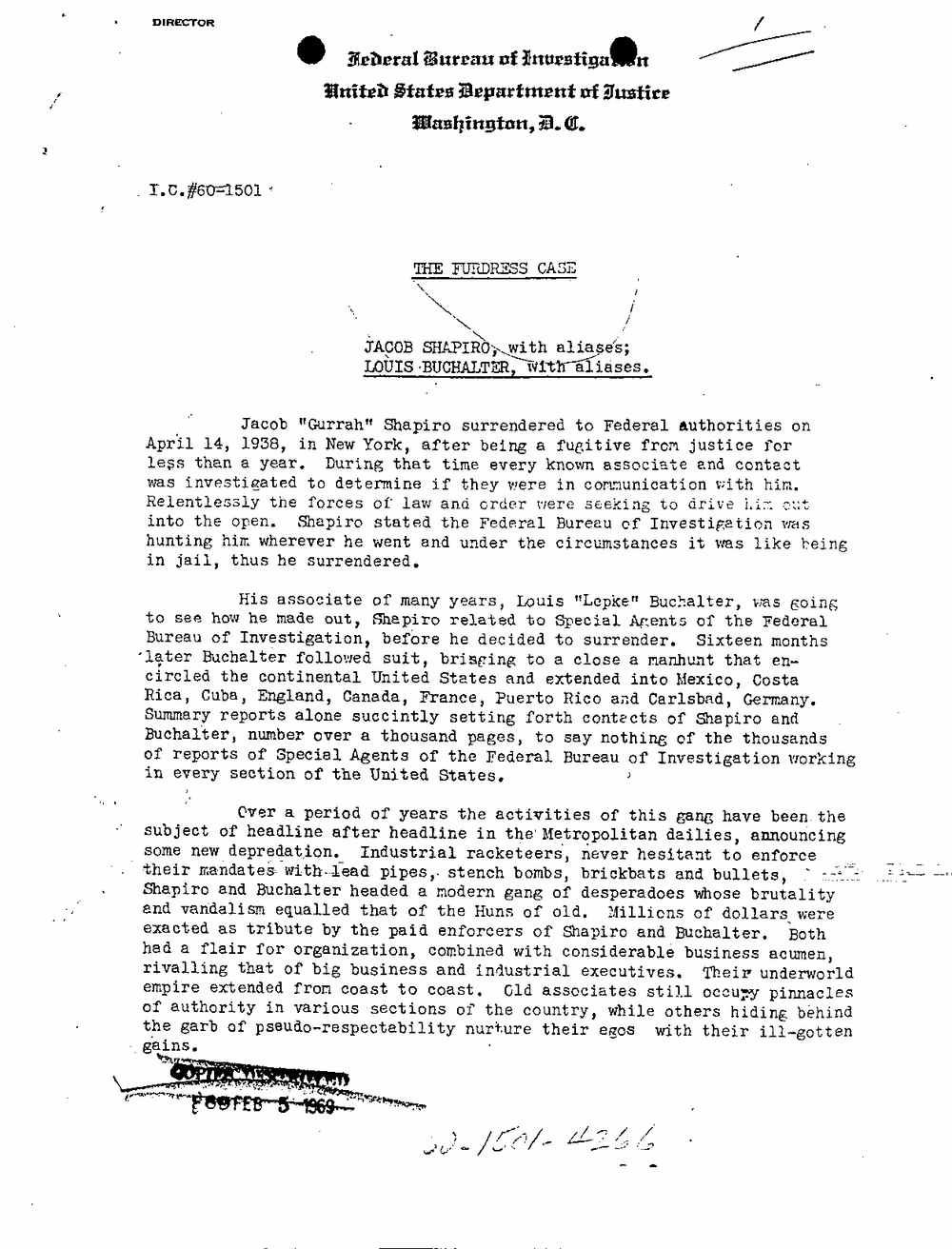
The FBI’s history page “Fur Dressers Case” is the Bureau’s narrative of its investigation of two combinations in the New York fur trade, the Protective Fur Dressers Corporation (rabbit-skin dressers) and the Fur Dressers Factor Corporation, both “created early in 1932.” It says the Bureau “began inquiring into the racketeering tactics of Buchalter and Shapiro in 1932” and that a federal grand jury in the Southern District of New York indicted 158 individuals on November 6, 1933. A later paragraph describes the same day’s return as two indictments of four counts each, naming 33 and 94 individuals and corporations, with “Both Shapiro and Buchalter” among the defendants.
The page quotes statements that witnesses gave to FBI agents, among them the Fur Dressers Factor Corporation’s general manager, who said he had asked the two men to take on “organization work, meaning rough stuff.” It lists the methods it attributes to the men they directed (“more than 50 anonymous telephone threats, 12 assaults, four stench bombings, 10 explosive bombings, one kidnapping, three acid throwings, and two cases of arson”), describes an attack on the Needle Trade Workers Industrial Union headquarters at 131 West 28th Street on April 24, 1933, in which “two men were killed and many injured,” and says the attackers were convicted of felonious assault in the state courts. These are the Bureau’s account and the witnesses’ statements, not findings of a court; the appeals court later held the proof against Buchalter insufficient in the rabbit-skin case (88 F.2d 625).
On the prosecutions, the page states that both men were convicted on all four counts on November 8, 1936, sentenced on November 12, 1936 to two years and $10,000 fines, and released on bond pending appeal; that on March 8, 1937 Shapiro’s judgment was affirmed and Buchalter’s reversed; that both failed to appear on July 6, 1937, when the Fur Dressers Factor case was called, and were declared fugitives; that Shapiro surrendered on April 14, 1938; and that “Shortly after he surrendered on August 24, 1939, Louis Buchalter was sentenced to prison on antitrust and narcotics charges. He was later tried and convicted on a state charge of murder. On March 4, 1944, he was executed at Sing Sing Prison.” It adds that Shapiro was sentenced on May 5, 1944 to 15 years to life “after being found guilty of conspiracy and extortion.”
The page is a later narrative written by the FBI, not a court record. It names private victims and witnesses; this archive does not repeat their names. A sentence placing “members of the Zwillman gang in Newark” at a 1932 plant bombing is the Bureau’s statement.