Record
Hearing
1950-12-18
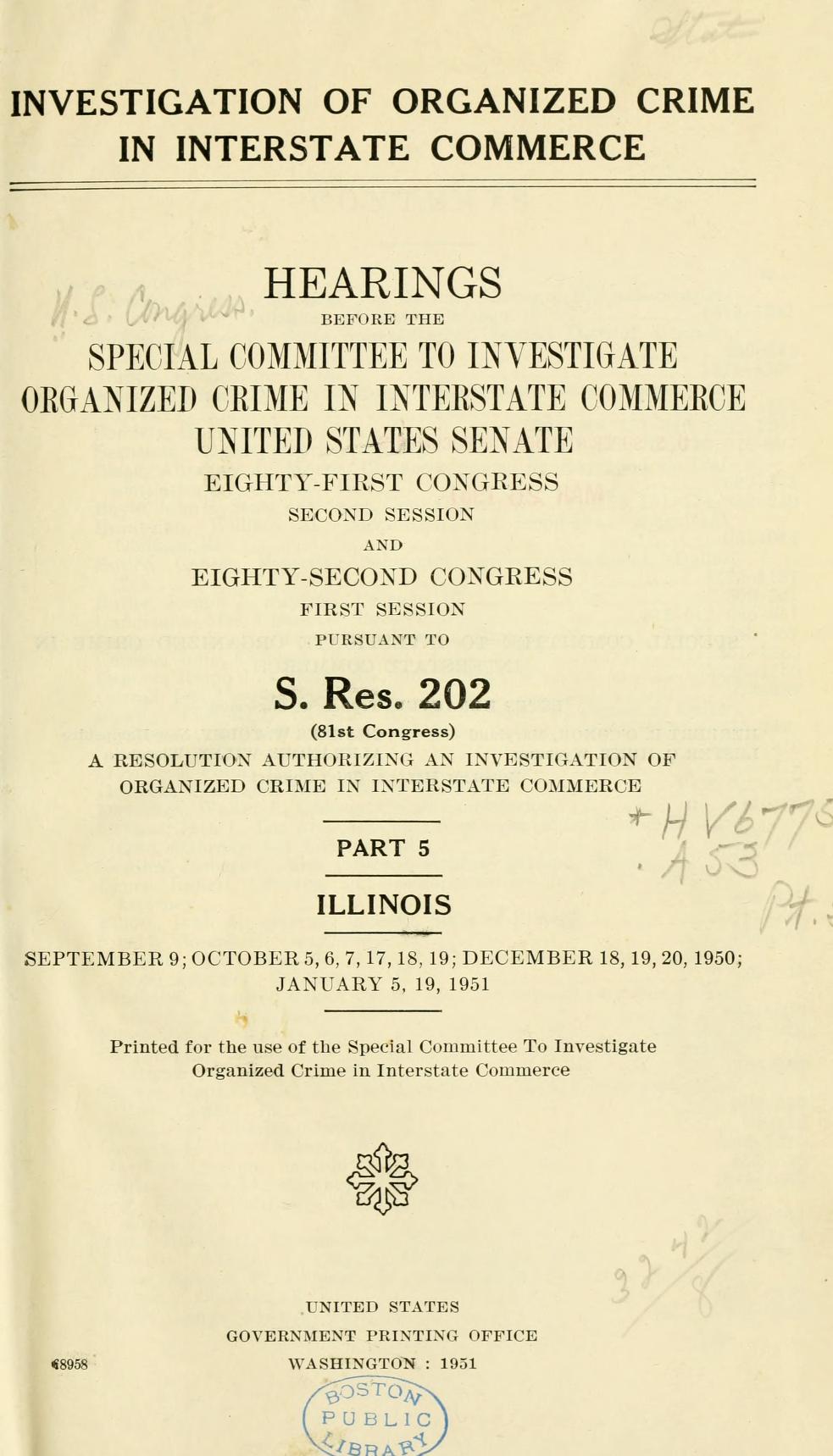
U.S. Senate Special Committee to Investigate Organized Crime in Interstate Commerce, printed hearings, Part 5: Illinois, via Internet Archive
Kefauver Part 5: wigwag testimony and Exhibits 51-52 on relaying race results from outside Garden State Park (18 December 1950)
A track-crew employee of a Baltimore news service testified that his job was "To get the race results out of the race track" by signalling from a tavern roof across from the Camden, N.J., track; a staff report describes a surveillance there on 2 November 1950.
- Date
- 1950-12-18
- Kind
- hearing
- Retrieved
- 2026-10-12
- Rights
- A hearing print of the United States Senate, published by the Government Printing Office. A work of the United States Congress, public domain under 17 U.S.C. § 105. The scan is the Internet Archive copy of the Boston Public Library's printed volume.
At the 18 December 1950 session (Part 5, pp. 875-889), a witness employed by the Howard Sporting News of Baltimore described his job as “To get the race results out of the race track.” Asked “You are a wig-wag man?” he said yes, and explained: “we call the race results. In other words, the line out, the prices on the board, and then we call the winner.” His last post before the subpoena was at the Garden State race track in Camden, New Jersey, on the roof of a bar called the Show Place, while a partner telephoned the results to a number in Baltimore.
Counsel offered “a batch of about 11 pictures” of the Show Place “showing the wig-wagging going on, on the roof” as Exhibit 51; they are “on file with the committee” and are not printed. Exhibit 52, a committee investigator’s interview of the partner dated November 6, 1950 (appendix pp. 1396-1397), was offered to show his employment “originally by Continental and then the switch-off to Howard Sports News.” It describes a surveillance on November 2, 1950 of “the Show Place Inn located across the highway from the track,” during which the investigator watched the two men relay the result of a race from the roof to the telephone booth.
The two crew members are named in the printed record. This page does not name them and does not copy their home addresses or the owner’s name. FCC chairman Wayne Coy had described the same method to the committee in June 1950.