Testimony of James H. Boyd, clerk of the Atlantic County Board of Freeholders, July 17, 1951 (Kefauver Committee, Part 18, p. 377)
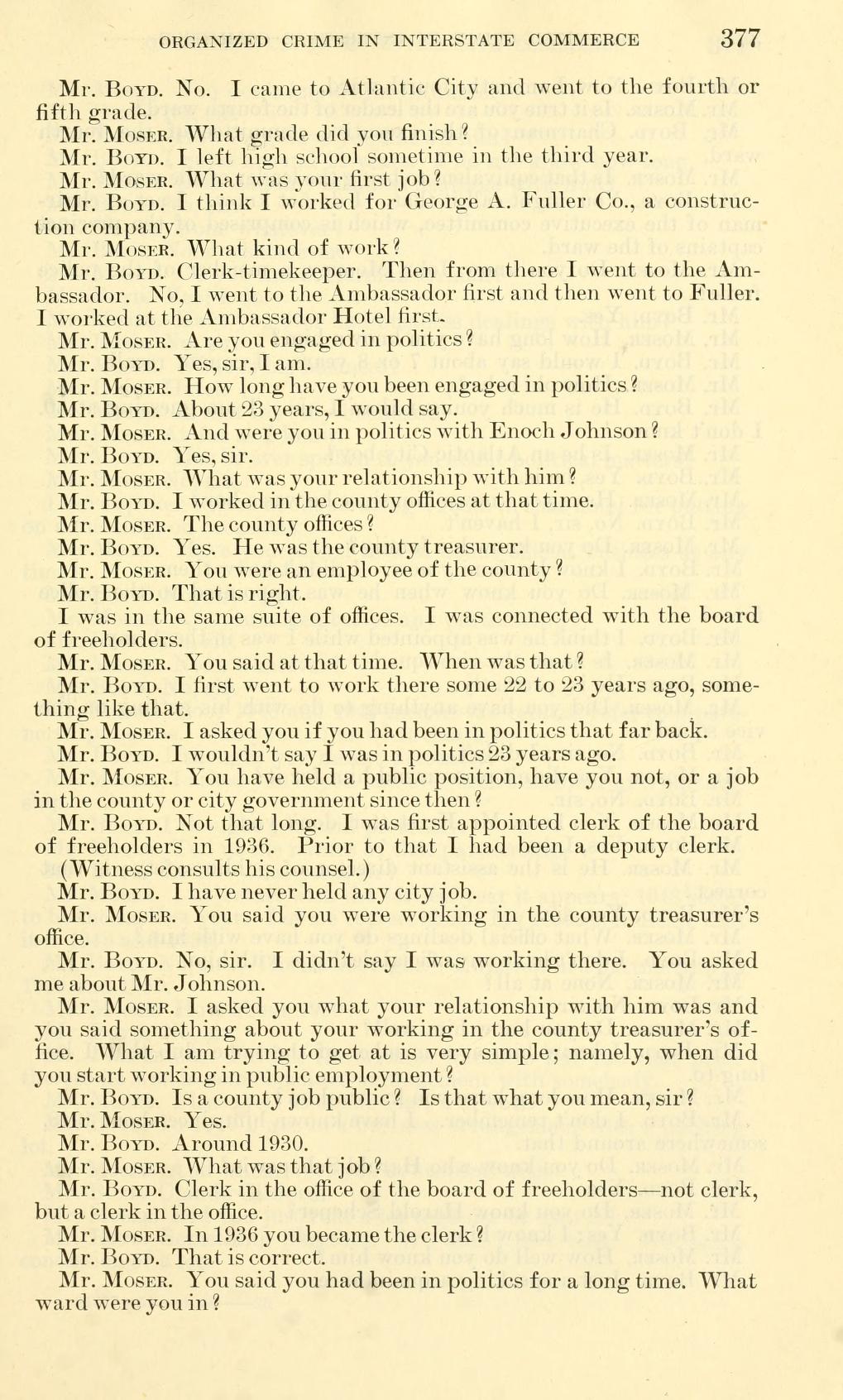
A county official tells the Kefauver Committee that he was "in politics with Enoch Johnson" and that Johnson "was the county treasurer" when he began working in the county offices some 22 or 23 years earlier.
- Date
- 1951-07-17
- Kind
- hearing
- Retrieved
- 2026-10-12
- Docket
- Investigation of Organized Crime in Interstate Commerce, Hearings before the Special Committee, 82d Cong., Part 18: New York and New Jersey, p. 377
- Rights
- A work of the United States Congress, printed by the Government Printing Office. Public domain in the United States under 17 U.S.C. § 105. The scan is of a GPO printing; Internet Archive marks it not in copyright. The stored page image was taken from the Internet Archive scan; quotations follow the Archive OCR, checked against the page image.
Printed in Part 18 of the hearings; the session heading before this testimony reads Tuesday, July 17, 1951, Atlantic City, executive session. The contents list gives Boyd at pages 187, 376 and 481. The stored image is page 377. Committee counsel is Mr. Moser.
Moser: “And were you in politics with Enoch Johnson?” Boyd: “Yes, sir.” Asked about the relationship, he says, “I worked in the county offices at that time,” and then: “He was the county treasurer.” Boyd says he was “connected with the board of freeholders,” that he first went to work there “some 22 to 23 years ago,” and that he “was first appointed clerk of the board of freeholders in 1936. Prior to that I had been a deputy clerk.” When Moser says he had been working in the county treasurer’s office, Boyd corrects him: “No, sir. I didn’t say I was working there. You asked me about Mr. Johnson.”
The statement that Johnson was county treasurer matches the Third Circuit’s description of the appellant in 129 F.2d 954, who “testified that he had occupied the position of county treasurer for many years.” This is a witness’s testimony, not a finding.