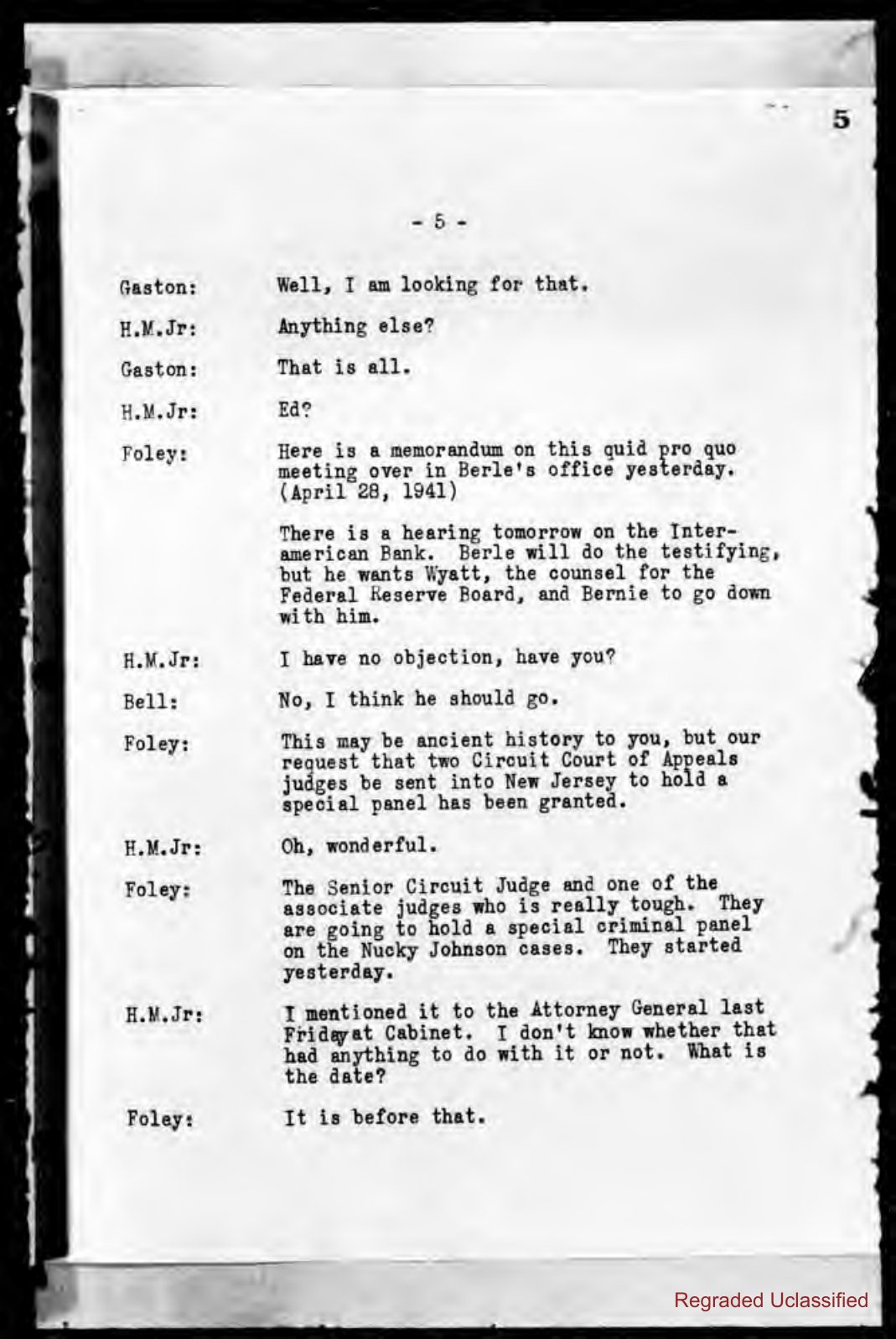
Typed transcript page numbered 5 of a Treasury conference: Foley tells H.M. Jr. that two circuit judges will hold a special criminal panel on the Nucky Johnson cases.
Open the full imageJPG, 1069 × 1597 px, 0.2 MB

Morgenthau Diaries, Volume 393: Treasury conference of April 30, 1941 on "the Nucky Johnson cases"

In a Treasury staff conference, general counsel Edward Foley reports that two circuit judges have been sent into New Jersey to hold "a special criminal panel on the Nucky Johnson cases," and Herbert Gaston says Nucky "really thought that they just couldn't get him."

Date
1941-04-30
Kind
case-file
Retrieved
2026-10-12
NAID
28276674
Rights
A record of the Office of the Secretary of the Treasury, a federal work in the public domain in the United States under 17 U.S.C. § 105, held by the Franklin D. Roosevelt Library (National Archives). The stored image is one page rendered from the NARA PDF. Third-party material bound into other diary volumes is not covered by this basis.

Volume 393 of the diaries of Treasury Secretary Henry Morgenthau, Jr. holds typed transcripts of his staff meetings. The stored image is page 5 of the conference transcript (page 8 of the NARA PDF). The speakers are labelled “H.M.Jr.” (Morgenthau), “Foley” (the general counsel, Edward Foley), “Gaston” and “Bell.”

Foley says: “This may be ancient history to you, but our request that two Circuit Court of Appeals judges be sent into New Jersey to hold a special panel has been granted.” He continues: “The Senior Circuit Judge and one of the associate judges who is really tough. They are going to hold a special criminal panel on the Nucky Johnson cases. They started yesterday.” On the next page Gaston says “Biddle did it,” and adds: “It is pretty doggoned important, because Nucky really thought that they just couldn’t get him, that he could control those courts.” Foley names Judge Biggs as “the Senior Circuit Judge in the Third Circuit” and a Judge Clarke as the other.

These are officials’ remarks in a meeting, not findings. The transcript gives no first name for “Nucky Johnson.” Judge Biggs wrote the Third Circuit’s 1942 opinion in United States v. Johnson. The PDF’s OCR is rough; the quotations here were checked against the page images.
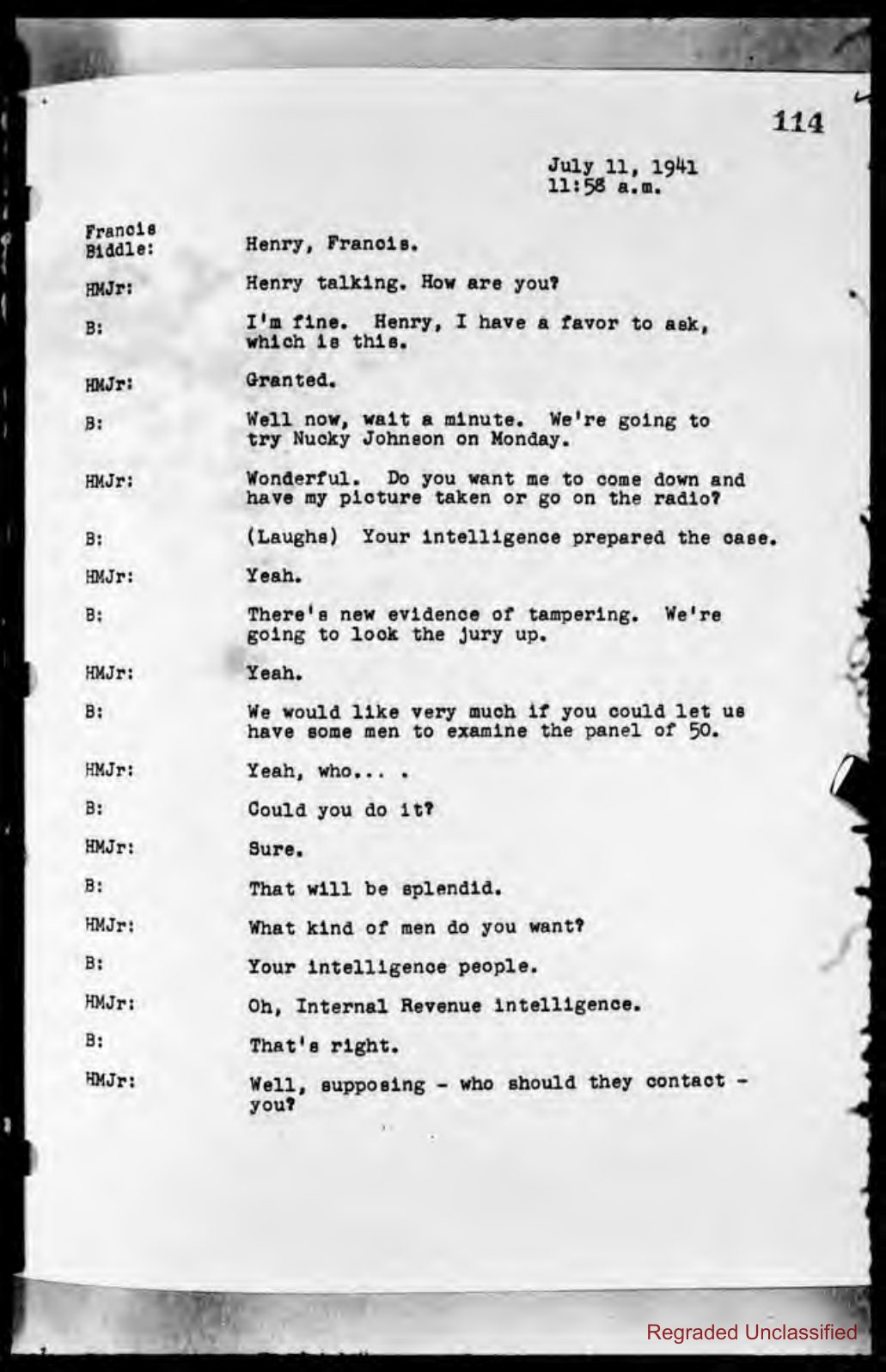
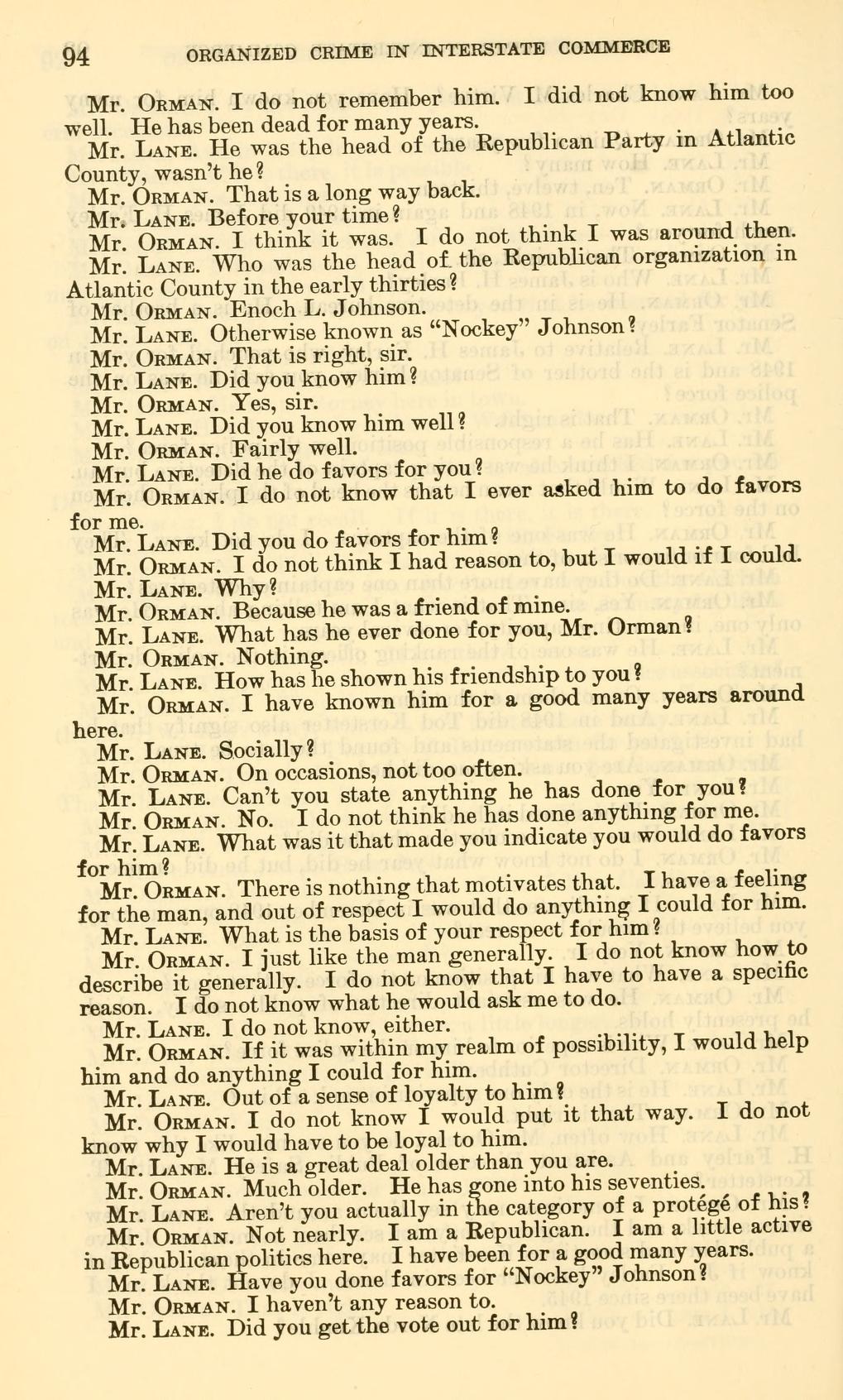
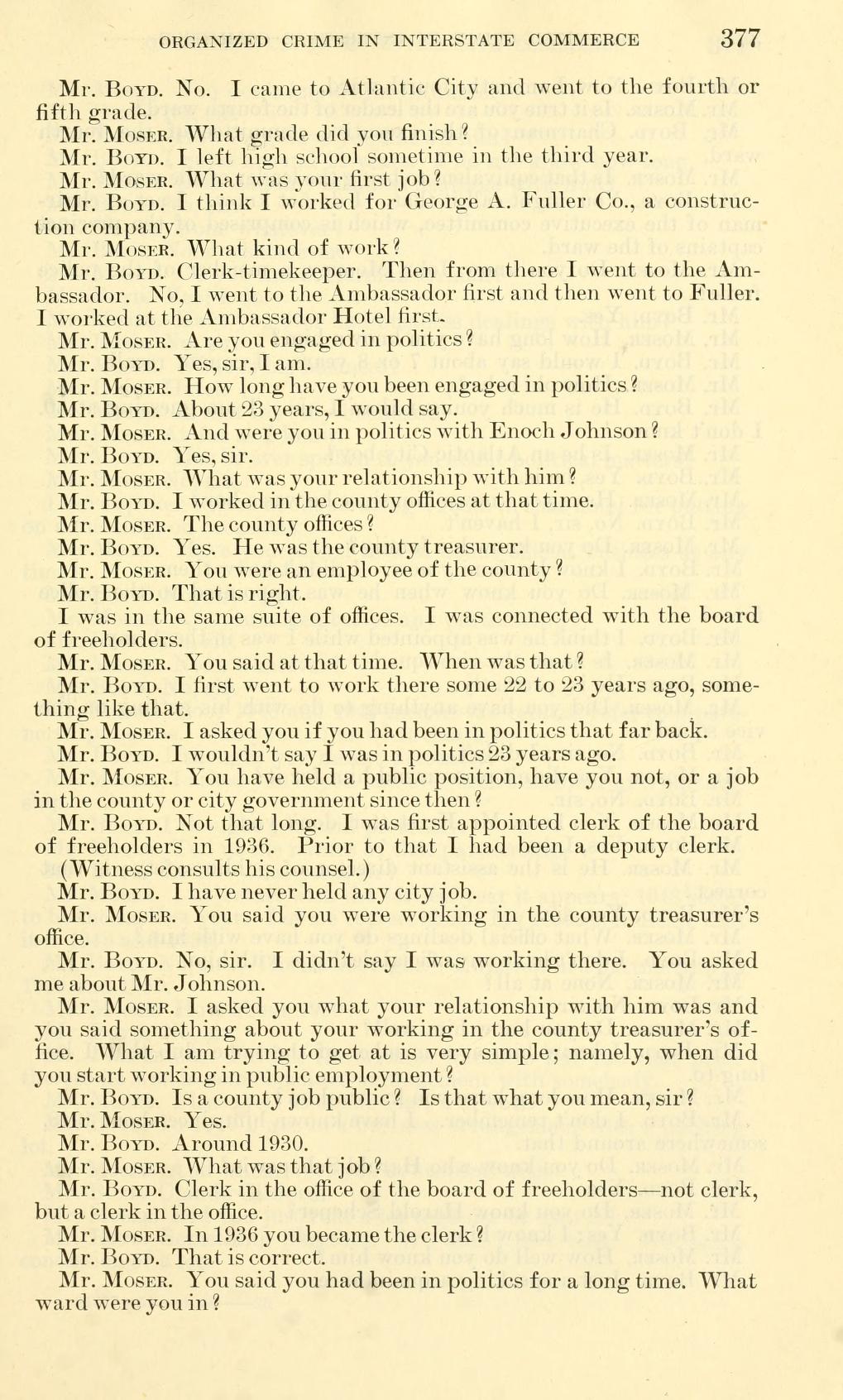
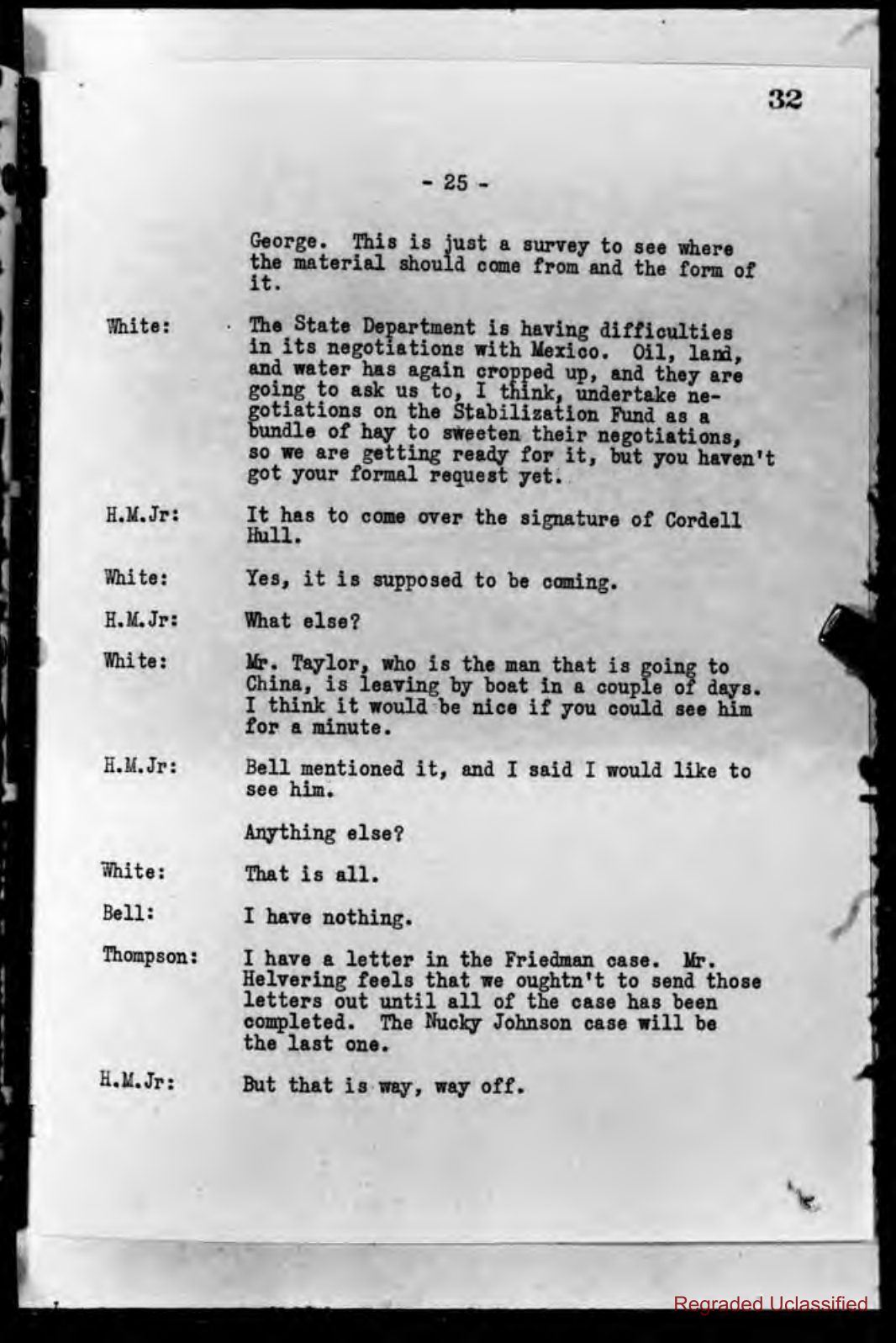
itemUnited States v. Johnson, 129 F.2d 954 (3d Cir. 1942)The Third Circuit affirms the income-tax conviction of an Atlantic County political leader named only as Johnson, reciting evidence that Atlantic City numbers banks paid him $825 a week in early 1935 and a pooled syndicate $1,200 a week from July 1935.itemJohnson v. United States, 318 U.S. 189 (1943)The Supreme Court affirms the tax-evasion conviction of "a political leader in Atlantic City and Atlantic County, New Jersey," holding that his objection to the prosecutor's comment on his claim of privilege had been waived at trial.itemMorgenthau Diaries, Volume 420: telephone calls of July 11, 1941 ("We're going to try Nucky Johnson on Monday")Francis Biddle tells Secretary Morgenthau by telephone that "We're going to try Nucky Johnson on Monday," reports "new evidence of tampering," and asks for Internal Revenue intelligence agents to examine the jury panel.itemTestimony of Herman Orman, Atlantic City, July 6, 1951 (Kefauver Committee, Part 18, pp. 78–94)Asked who headed the Republican organization in Atlantic County in the early 1930s, an Atlantic City witness answers "Enoch L. Johnson," agrees he was "otherwise known as 'Nockey' Johnson," and calls him a friend.itemTestimony of James H. Boyd, clerk of the Atlantic County Board of Freeholders, July 17, 1951 (Kefauver Committee, Part 18, p. 377)A county official tells the Kefauver Committee that he was "in politics with Enoch Johnson" and that Johnson "was the county treasurer" when he began working in the county offices some 22 or 23 years earlier.itemMorgenthau Diaries, Volume 400: Treasury conference of May 1941 ("The Nucky Johnson case will be the last one")In a May 1941 Treasury conference, an aide reports Commissioner Helvering's view that letters in the Friedman case should wait, adding "The Nucky Johnson case will be the last one"; Foley agrees it is "the last one of the cases."