Empty seats. A name is added only with a citation on this page.
- BossNot filled
- UnderbossNot filled
- ConsigliereNot filled
Key to statement kinds (defined in the text below)What the government established, as a court summarizes itCourt opinion, in passingChargeTestimonyChart exhibitFBI memo or history page
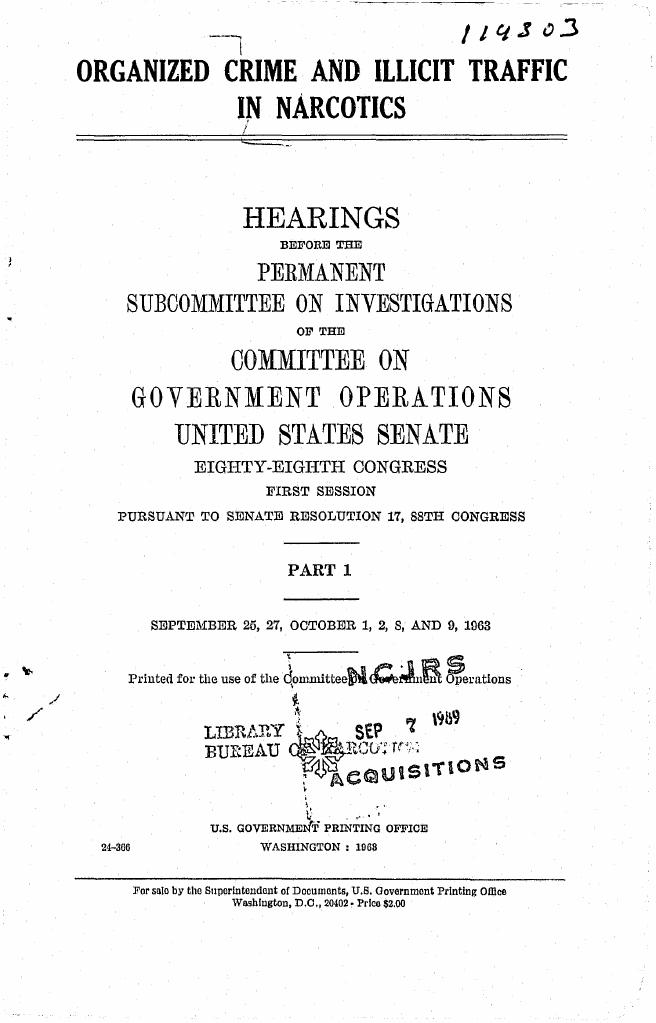
This page is a hub for the family the 1963 Senate record names for Carlo Gambino, and for the men earlier and later records place in its line. The chart above stays empty: no record filed here is a cited, separate decision to place a name in a seat. Each person page below quotes the strongest statement a record makes about that person, and those statements are of different kinds.
- What the government established, as a court summarizes it. An appeals court stating what the prosecution proved at trial. The court affirmed on that record, but the sentence describes the government’s proof.
- Court opinion, in passing. A court describing a witness, a victim or the case before it, rather than deciding who held a rank.
- Charge. An indictment, civil complaint or detention proffer, as a court summarized it. An allegation, not a finding.
- Testimony. Sworn testimony as printed: Joseph Valachi and NYPD Deputy Chief Inspector John Shanley in 1963, FBI officials in 1988, and trial witnesses as a court summarized them. A witness’s “yes” to counsel’s question counts as testimony; the question alone does not. Quotations from the 1963 hearings correct obvious errors in the scan’s text layer; the person pages note each correction.
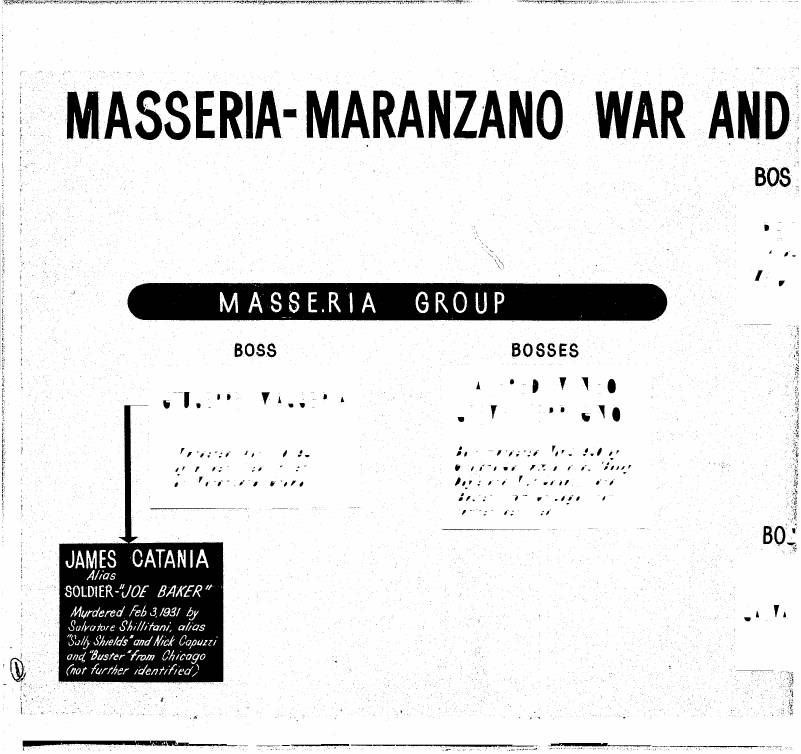
- Chart exhibit. A name printed on the 1963 subcommittee’s Exhibit 8 or Charts A to E. A chart entry is the committee’s or the police department’s summary; it never fills a role or a seat here.
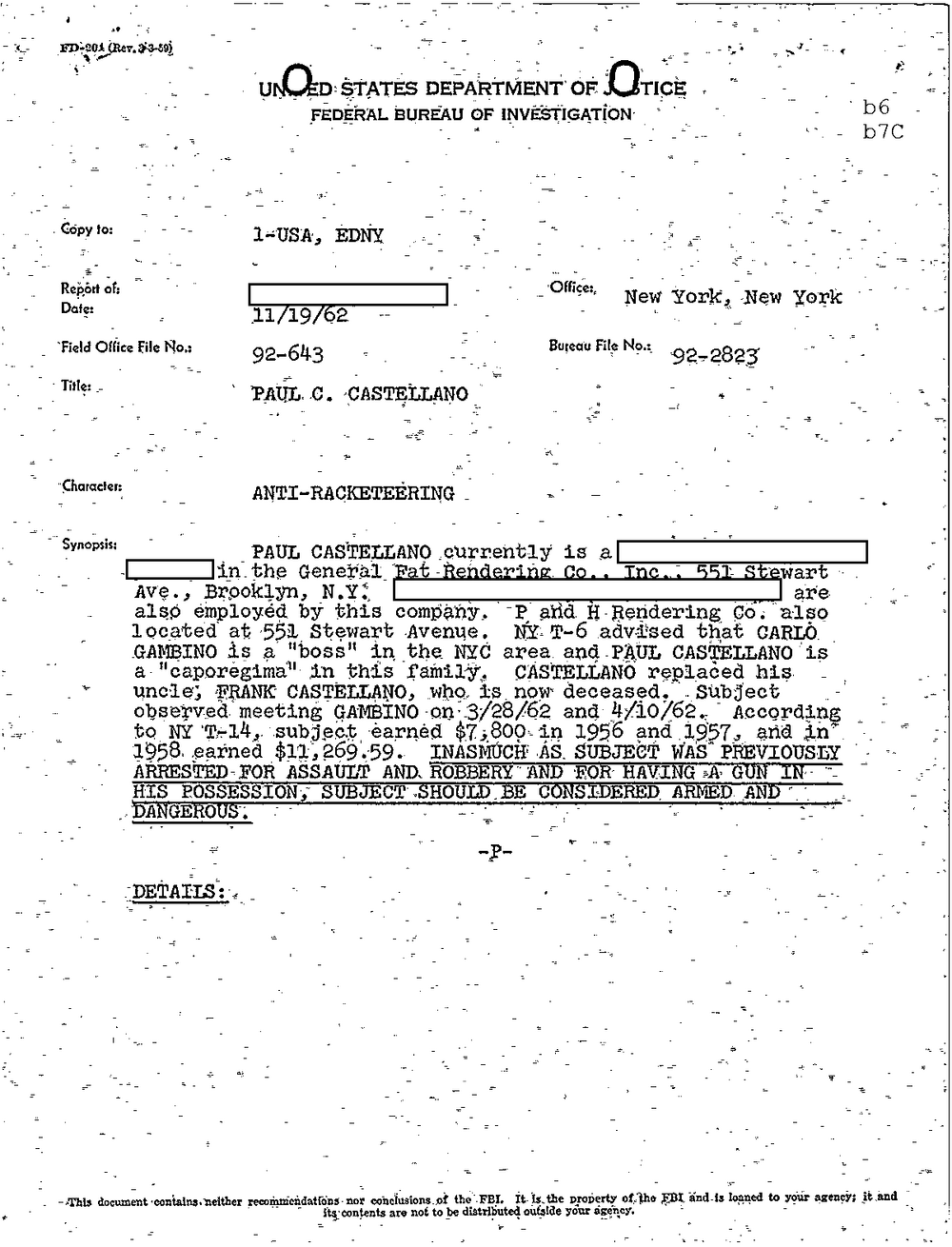
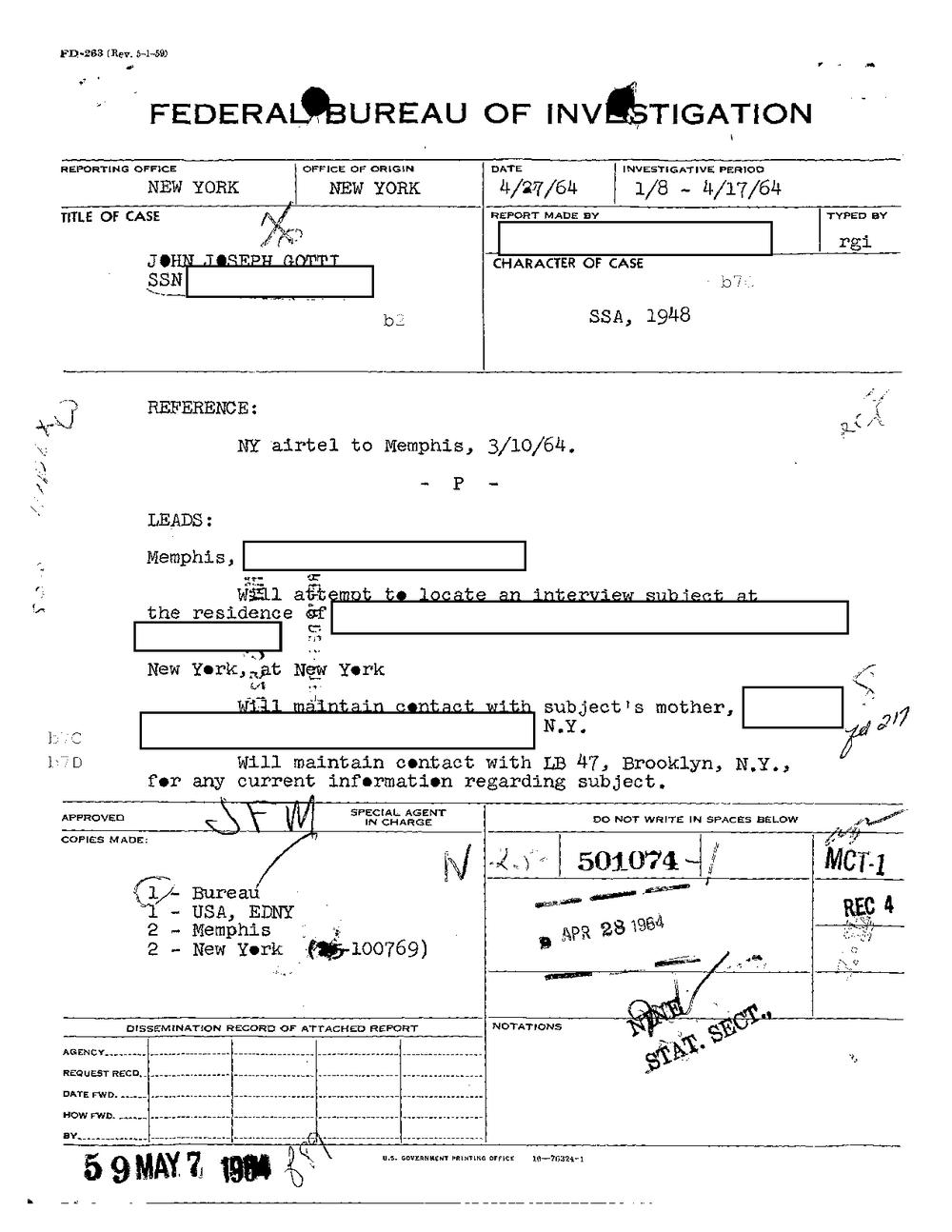
- FBI memo or history page. The Bureau’s own memoranda, reports and teletypes, often relaying informants, and its later history essays.
The person pages
The order is roughly that of the records’ dates. It is not a succession chart.
- Vincent Mangano and Philip Mangano: counsel asked whether “the predecessors of Carlo Gambino and his family were Philip and Vincent Mangano?” and Shanley answered “That is correct.” Testimony (NYPD, 1963).
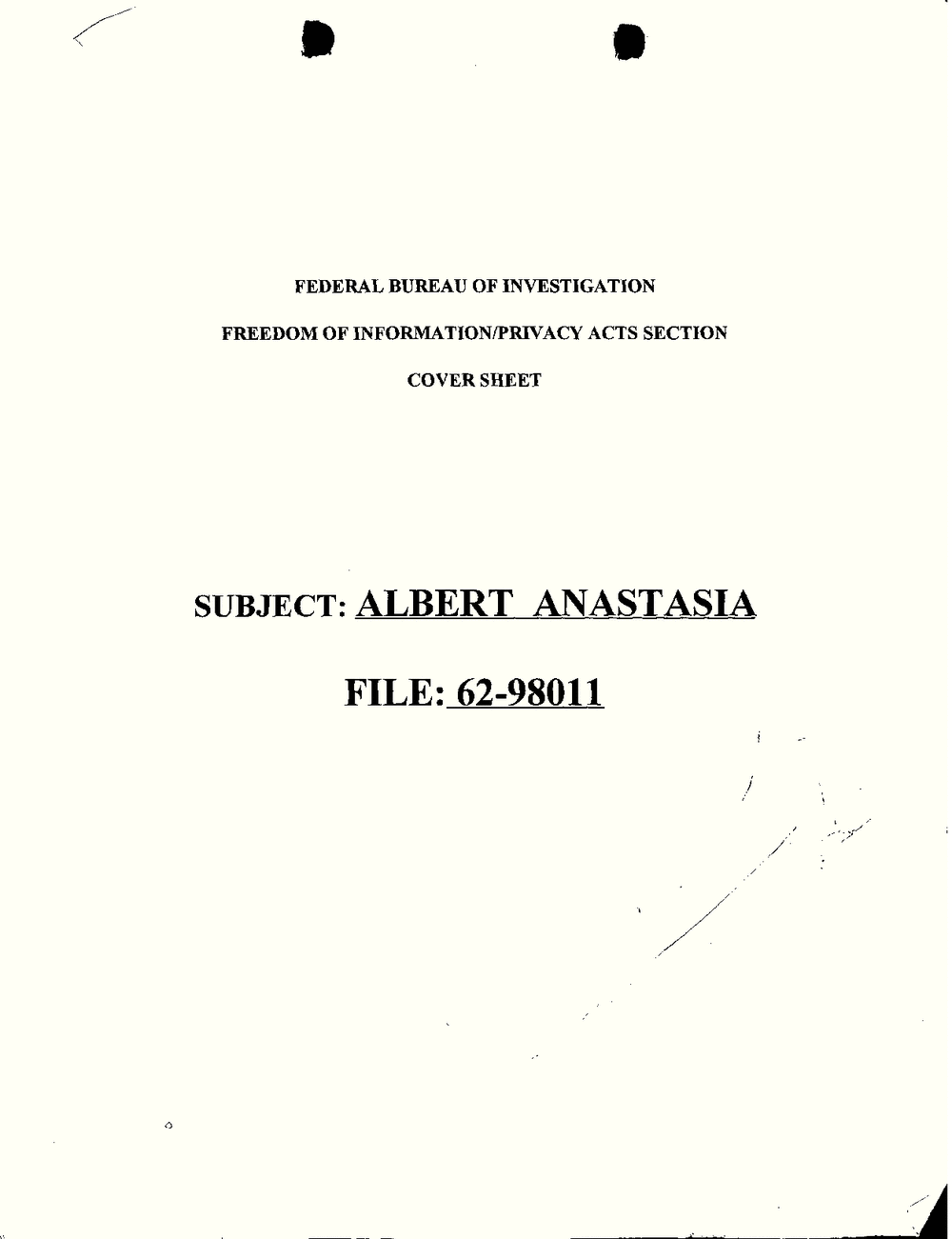
- Albert Anastasia: “And Albert Anastasia was the last predecessor to Gambino?” “That is correct.” Testimony (NYPD, 1963). A 1950s FBI memorandum describes him only as a waterfront racketeer.
- Carlo Gambino: “Carlo Gambino is considered to be the boss.” Testimony (NYPD, 1963). A 1962 FBI report relays an informant who named him a “boss.” FBI memo.
- Frank Scalice: asked whether Scalice was “underboss of the Gambino family,” Valachi answered “Yes.” Testimony (1963).
- Joseph Biondo: “The underboss is mentioned as Joe Biondo,” and he was Scalice’s successor. Testimony (NYPD, 1963).
- Paul Castellano: “Paul Castellano, boss of the Gambino family, was also named a defendant, but was murdered prior to trial.” Court opinion, in its account of the Commission case (1989). A 1962 FBI report relays an informant who called him a “caporegima.” FBI memo.
- Aniello Dellacroce: “Gambino family underboss Aniello Dellacroce,” in 1979. What the evidence showed, as the Second Circuit summarizes it (1989). The FBI history page’s “Gambino boss Aniello Dellacroce” conflicts with that and is not used.
- Thomas Bilotti: killed with Castellano on December 16, 1985. Court opinion. No court record gives him a title; “his number two in command” is the FBI history page’s phrase.
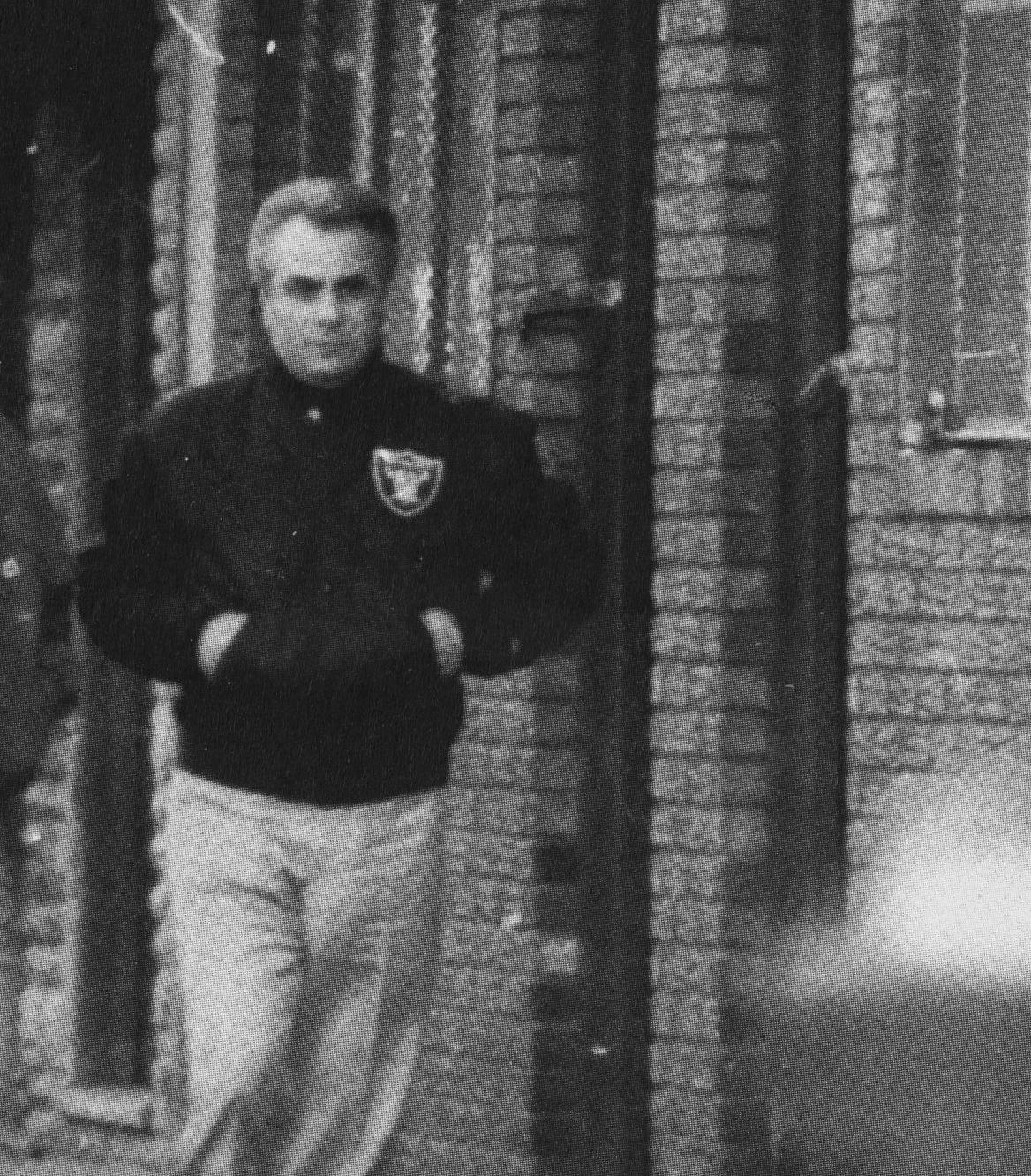
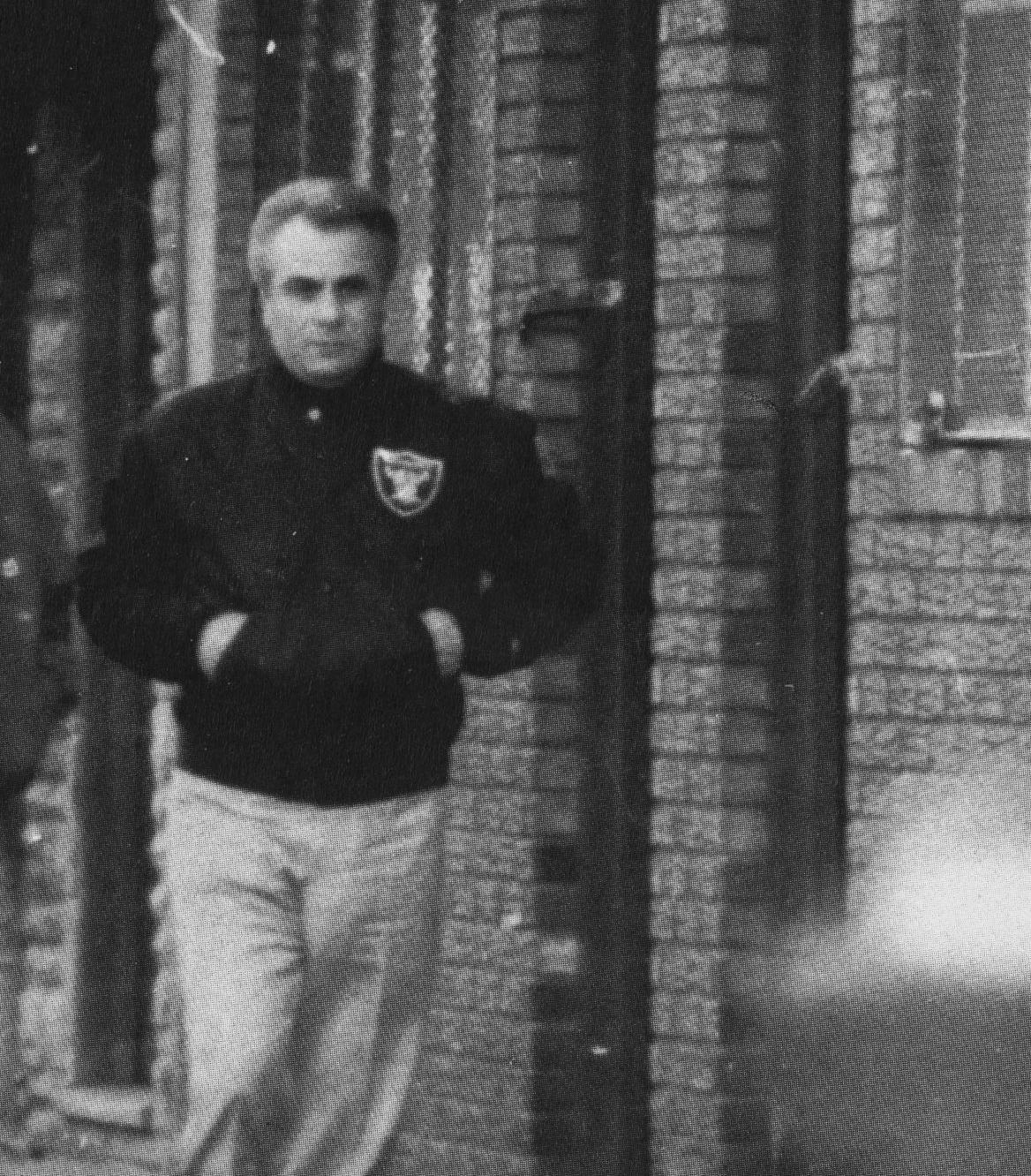
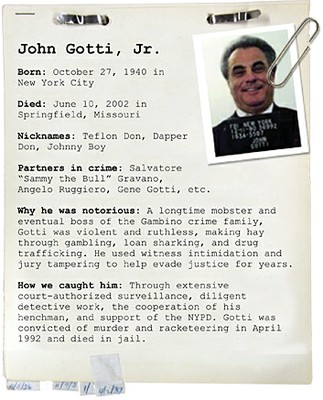
- John Gotti: “Gotti was charged as the head of the organization.” Charge, as the Second Circuit summarized it (1993); the conviction was affirmed. The FBI history page says he “took over as head of the Gambino family” in 1985.
- Frank Locascio: “The government established at trial that Locascio’s function as underboss was to advise Gotti.” What the government established, as the court summarizes it (1993).
- Salvatore Gravano: “the former Gambino family underboss.” Court opinion, describing a witness (1999). He was charged in 1991 as “consigliere.” Charge.
What the chart still waits for
The seats are Boss, Underboss and Consigliere. The statements above that put one of those titles on a named man for this family come from the 1963 testimony (Gambino as boss; Scalice and then Biondo as underboss), from the Commission appeal (Castellano as boss, Dellacroce as underboss), and from the Gotti appeal (Gotti charged as head, Locascio’s function as underboss established at trial, Gravano charged as consigliere). Each holds for its own period, and none is yet a separate, cited decision on this page. A name goes into a seat only by such a decision.
The Five Families section’s other pages are Genovese, Lucchese, Colombo, Bonanno and the Commission.