Empty seats. A name is added only with a citation on this page.
- BossNot filled
- UnderbossNot filled
- ConsigliereNot filled
Key to statement kinds (defined in the text below)What the government established, as a court summarizes itCourt opinion, in passingChargeTestimonyChart exhibitFBI recordDOJ release
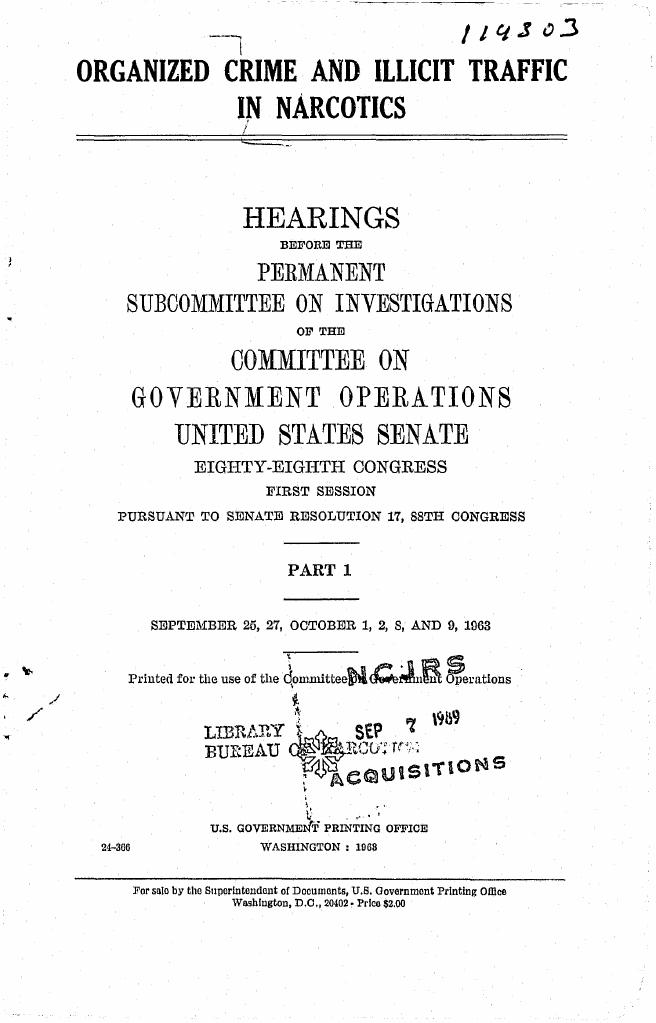
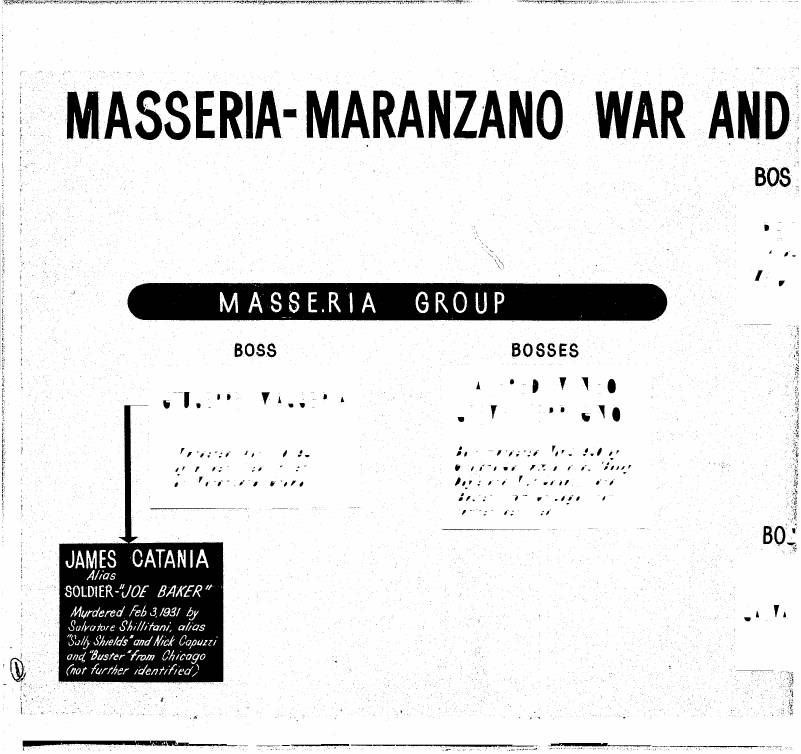
This page is a hub for the family the 1963 Senate record places under Joseph Bonanno “in the other part of Brooklyn,” and for the men later records place in it. The chart above stays empty: no record filed here is a cited, separate decision to place a name in a seat. Each person page below quotes the strongest statement a record makes about that person, and those statements are of different kinds.
- What the government established, as a court summarizes it. An appeals court stating what the prosecution proved at trial. The court affirmed on that record, but the sentence describes the government’s proof.
- Court opinion, in passing. A court describing a witness, a victim or the case before it, rather than deciding who held a rank.
- Charge. An indictment, civil complaint or detention proffer, as a court summarized it. An allegation, not a finding.
- Testimony. Sworn testimony as printed: Joseph Valachi and NYPD Deputy Chief Inspector John Shanley in 1963, FBI officials in 1988, and trial witnesses as a court summarized them. A witness’s “yes” to counsel’s question counts as testimony; the question alone does not. Quotations from the 1963 hearings correct obvious errors in the scan’s text layer; the person pages note each correction.
- Chart exhibit. A name printed on the 1963 subcommittee’s Exhibit 8 or Charts A to E. A chart entry is the committee’s or the police department’s summary; it never fills a role or a seat here.
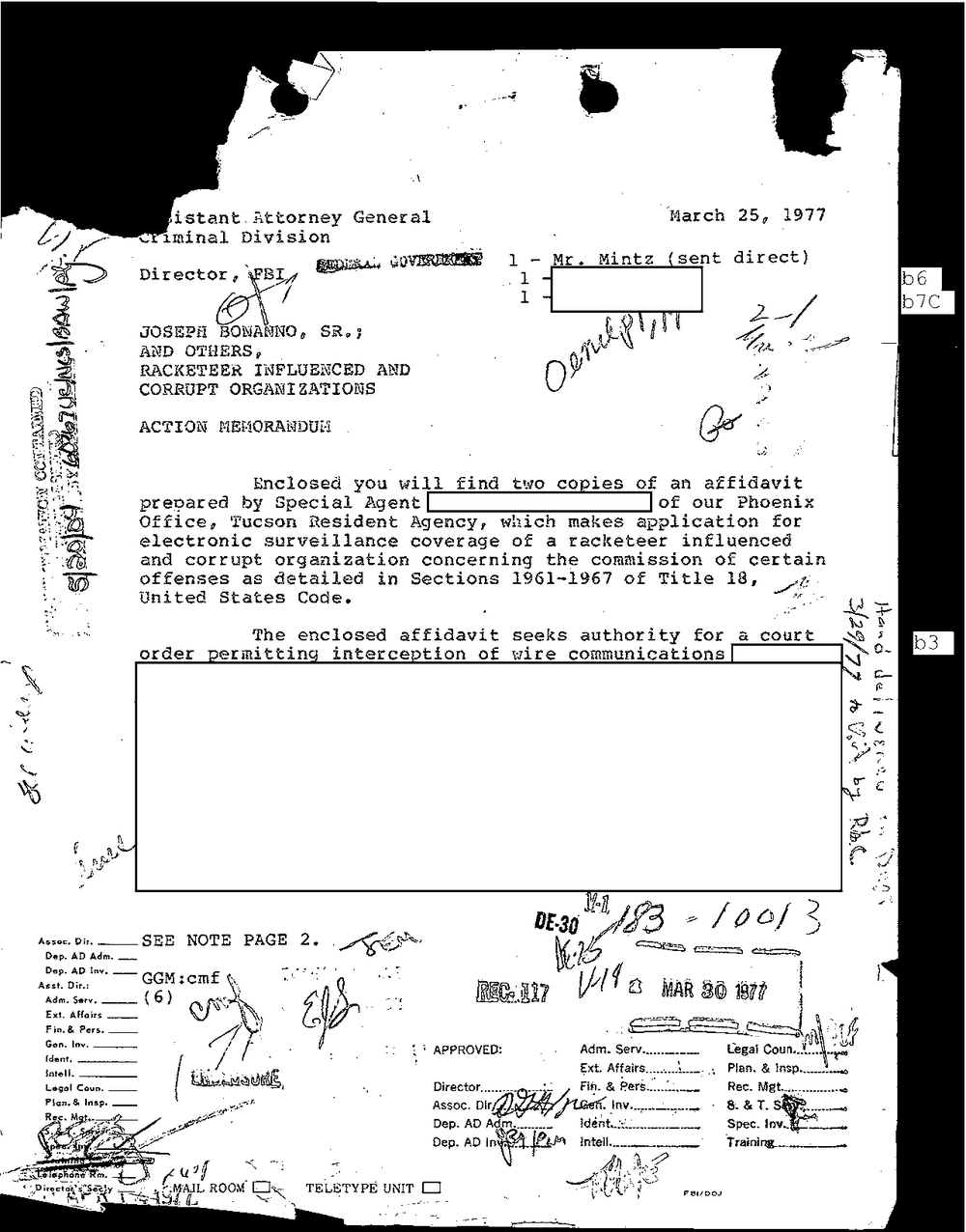
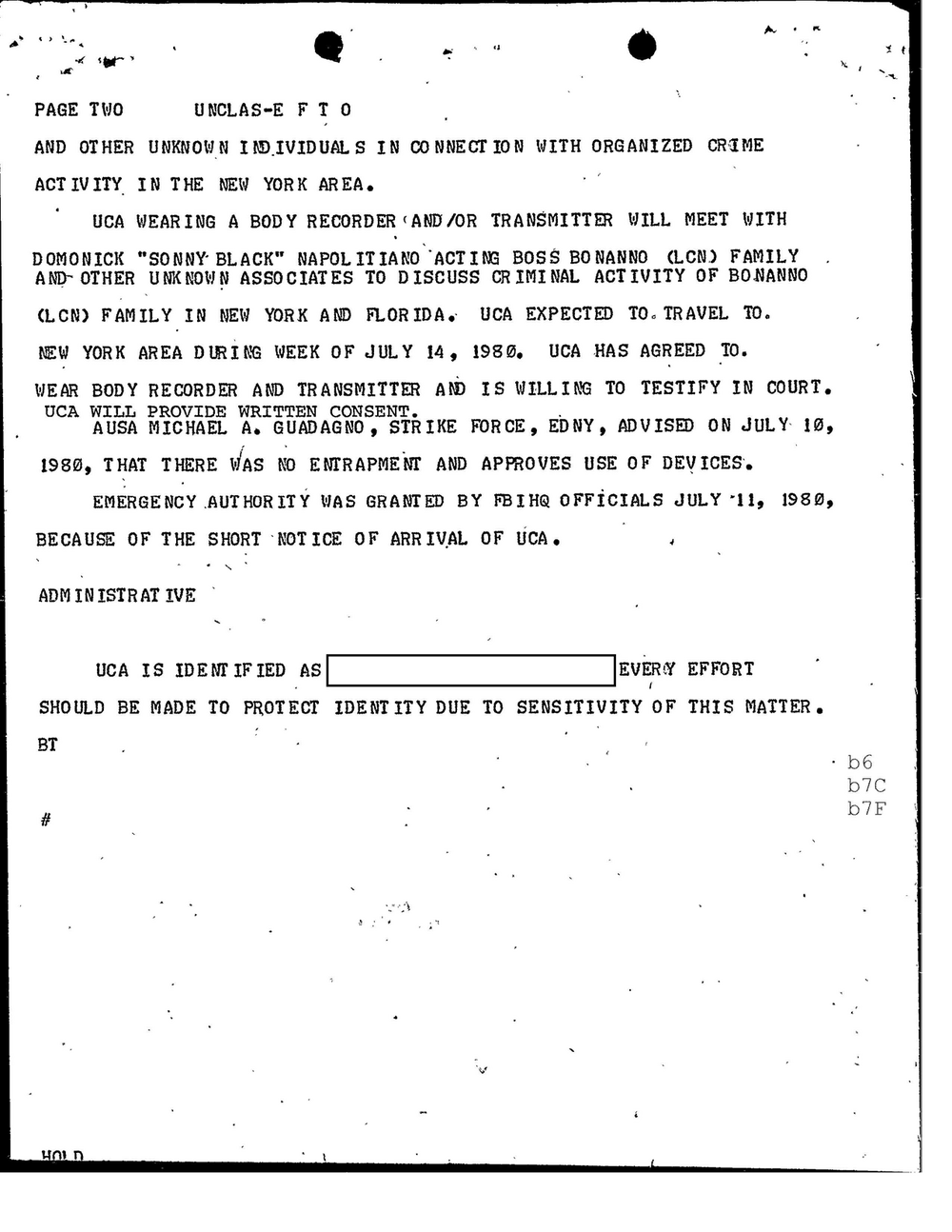
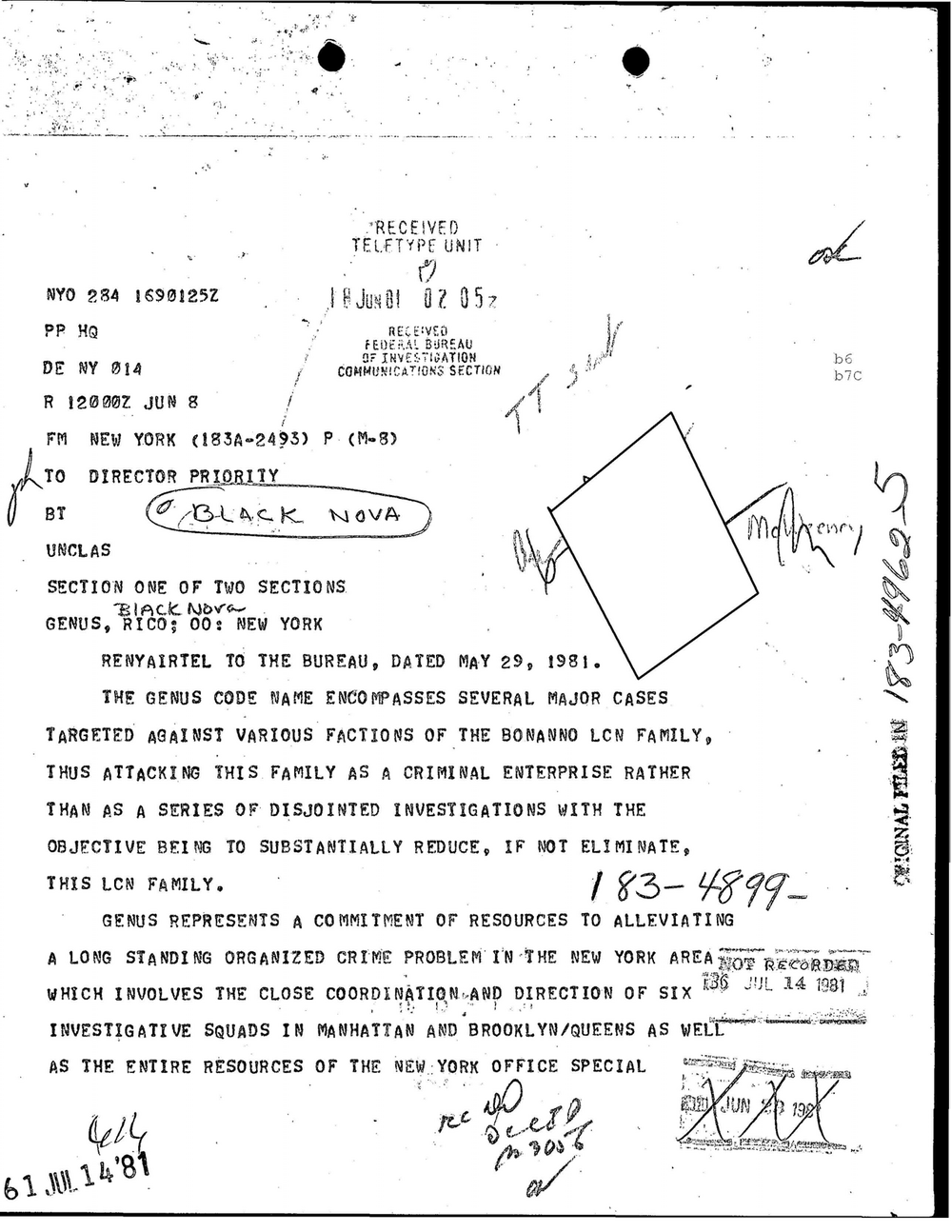
- FBI record. A teletype, memorandum or report in an FBI file, or an FBI announcement. It reports what the Bureau or its sources believed at the time. The FBI’s labels for the same man often disagree with each other.
- DOJ release. A U.S. Attorney’s press release. It reports the government’s position.
The person pages
The order is roughly that of the records’ dates. It is not a succession chart.
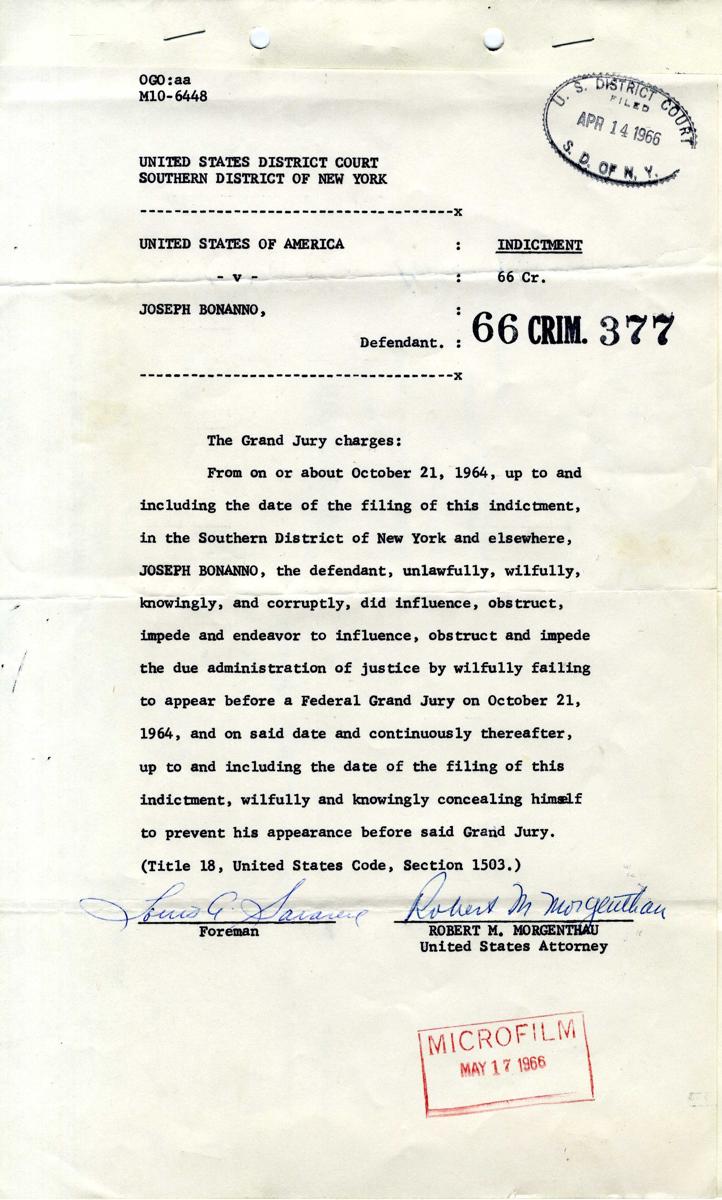
- Joseph Bonanno: “In the other part of Brooklyn, it is Joe Bonanno.” Testimony (Valachi, 1963). The government’s 1987 civil complaint alleged he “remained its boss until October 21, 1964”; the court dismissed the complaint as to him. Charge.
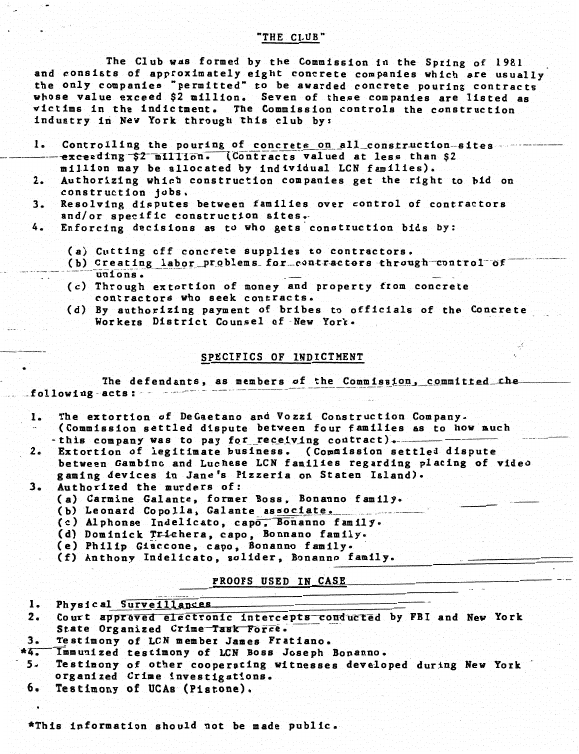
- Carmine Galante: “the violent elimination of Galante as boss of the Bonanno family was related to the Commission function of resolving leadership disputes within a family.” Court opinion, in its account of the evidence (1989). The 1963 chart’s entry for him is a chart exhibit and is not used.
- Philip Rastelli: “the Commission actively reorganized the Bonanno family under Rastelli.” What the evidence showed, as the Second Circuit summarizes it (1989). The 1987 complaint alleged he was “currently the Boss.” Charge.
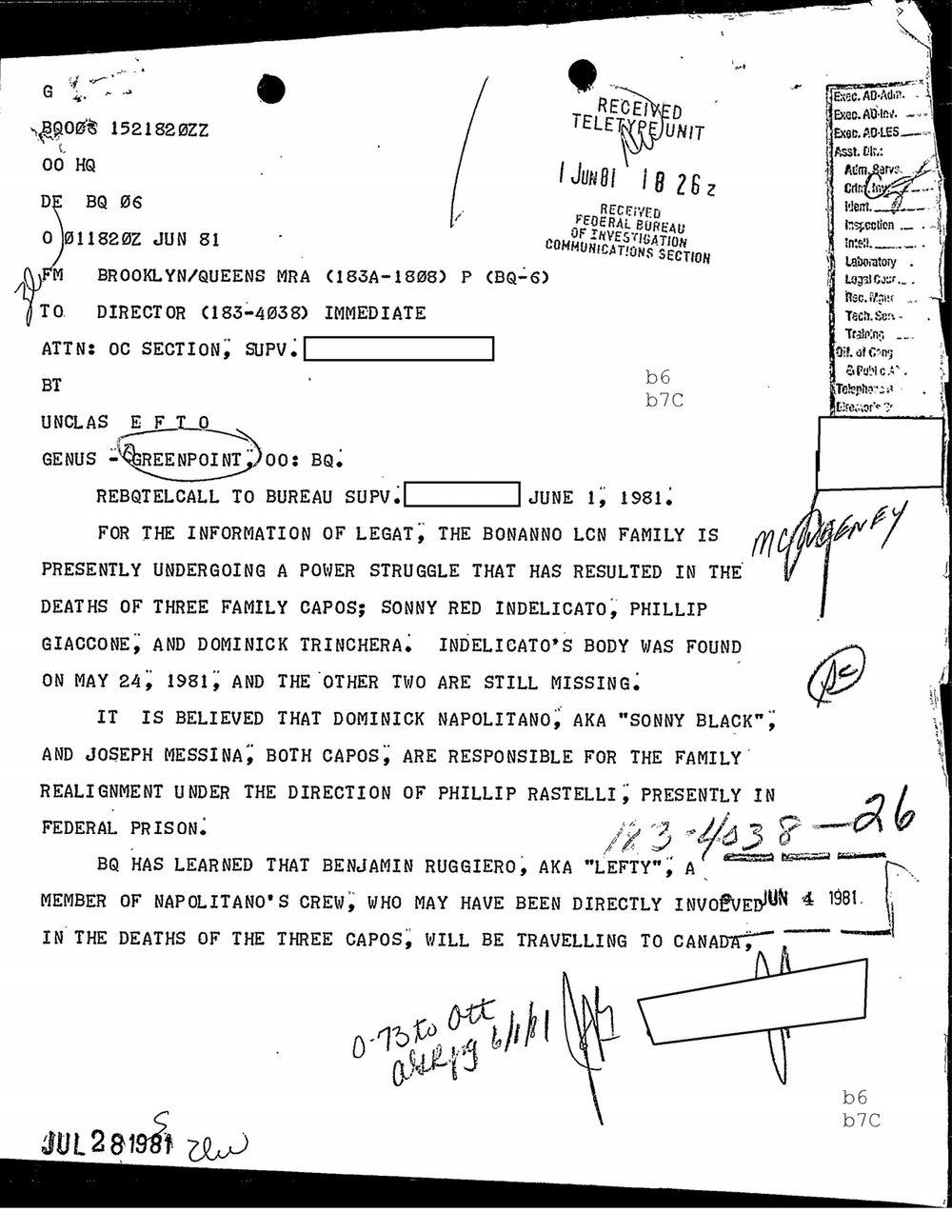
- Dominick Napolitano: “The evidence at trial revealed that Ruggiero was a member of the ‘crew’ captained by Napolitano.” Court opinion, describing the trial evidence (Eleventh Circuit, 1985). The 1982 indictment, as that court summarizes it, called him and Joseph Messina two “captains.” Charge. The FBI’s 1980 teletypes call him “acting boss” on one page and “acting underboss” on another, and its 1981 teletypes call him a capo. FBI record.
- Benjamin Ruggiero: “a member of the ‘crew’ captained by Napolitano.” Court opinion, describing the trial evidence (1985). Judge Chin calls him “Bonanno Family soldier ‘Lefty’ Ruggiero” (1998). The Seventh Circuit reports that he “described himself as a member of the Bonanno crime family of New York.” The FBI called him “acting ‘capo’” (1981) and Director Webster “a capo” (1983). FBI record.
- Joseph Messina: one of two “captains” in the 1982 indictment. Charge, as the Eleventh Circuit summarizes it. An FBI airtel of 1986 calls him “acting head of the Bonanno family.” FBI record.
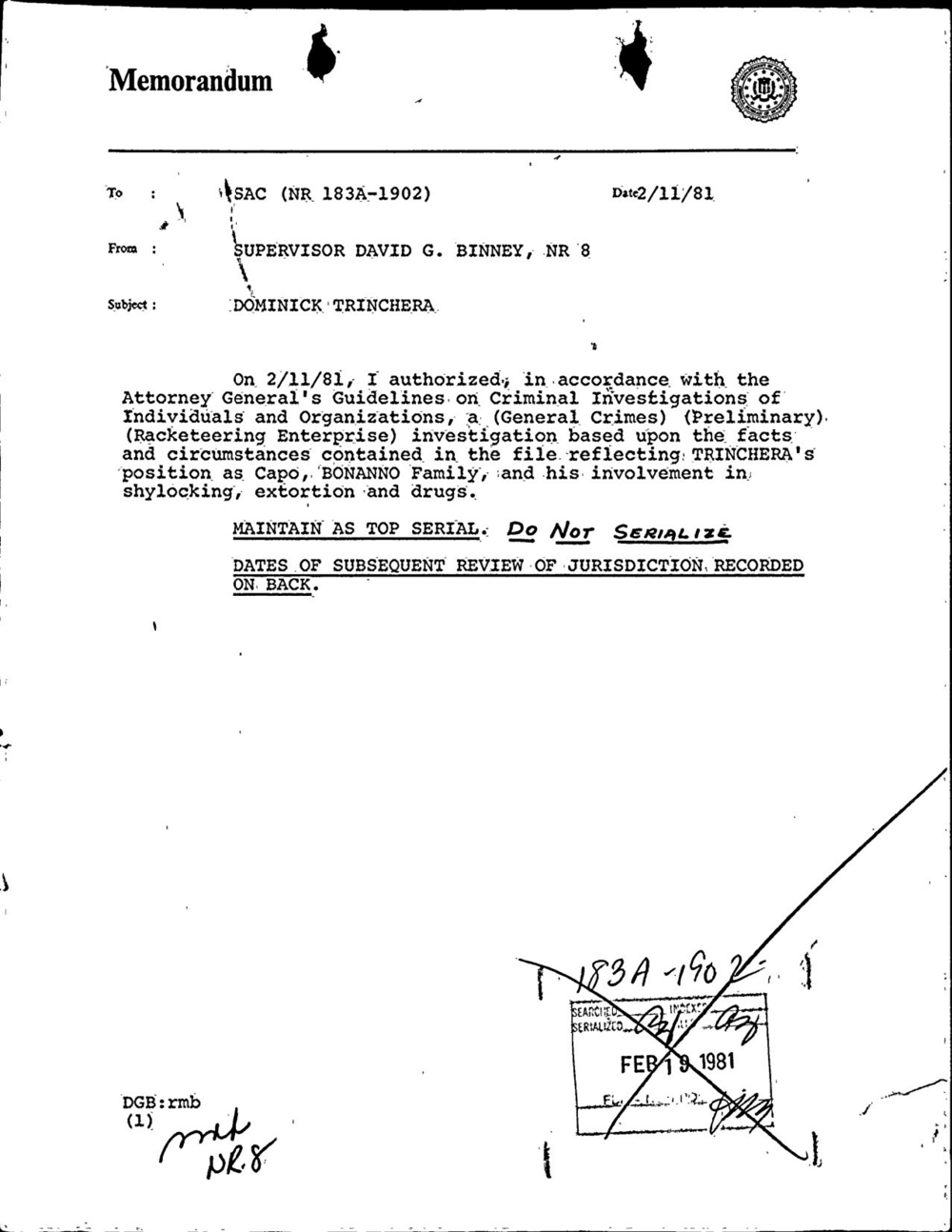
- Alphonse Indelicato, Dominick Trinchera and Philip Giaccone: the three “captains” whose murders in May 1981 the 1982 indictment charged. Charge, as summarized (1985). The en banc Second Circuit says Anthony Indelicato’s “father was a capo,” calls Giaccone “another Bonanno family capo,” and says Trinchera was among the soldiers later “promoted to the rank of capo.” What the evidence showed, viewed for the government (1989).
- Anthony Indelicato: “a member of the Bonanno family, who was approved by the Commission for promotion to the rank of ‘capo’.” What the government established (1989).
- Joseph Massino: “the then-incarcerated official boss of the Bonanno crime family.” Court opinion, in its account of the conduct charged (2010). “Bonanno family boss Joseph Massino.” DOJ release (2006). The 1987 complaint called him underboss. Charge.
- Anthony Urso: “who led the crime family from January 2003 to January 2004.” DOJ release (2006); no court record opened.
- Vincent Basciano: “Basciano’s January 2004 assumption of the role of acting boss.” Court opinion (2010). DOJ release (2006): “who assumed control thereafter.”
Four more person pages carry no family or role line: James Episcopia, Nicholas Santora and Anthony Rabito, defendants in the 1982 case, and Salvatore Vitale. The FBI’s reports call Episcopia “a Captain,” and a 2007 release describes the charges against Santora and Rabito as naming them “acting underboss” and “acting consigliere.” Those are an FBI label and an allegation, and they stay in the events. The records of the Brasco investigation and the cases that followed are gathered in Donnie Brasco and the Bonanno cases.
What the chart still waits for
The seats are Boss, Underboss and Consigliere. The statements above that put one of those titles on a named man for this family come from Valachi’s testimony (Joseph Bonanno), the Commission appeal (Galante and Rastelli as rival bosses in 1979), the government’s 1987 civil complaint (Rastelli as boss, Massino as underboss), the Second Circuit in 2010 (Massino as official boss, Basciano as acting boss), and U.S. Attorney’s releases. The Commission appeal also says that “Due to internal instability, the Bonanno family was denied a seat on the Commission during this period.” The en banc Second Circuit’s account of the Commission-case evidence (865 F.2d 1370, 1989) begins “In 1979, the boss of the Bonanno family was Carmine Galante,” and it names “Stefano Canone, the counselor of the Bonanno family.” That is the first court statement filed here that names a counselor. Other records put titles on men without a court behind them: the FBI’s 1985 Commission announcement (“Philip Rastelli, Boss, Bonnano Family”), Pistone’s 1988 testimony (Nicky Marangello “at the time was the underboss,” and Rastelli “became the boss”), and the FBI’s 1980 and 1981 teletypes on Napolitano. None of these is yet a separate, cited decision on this page. A name goes into a seat only by such a decision.
The Five Families section’s other pages are Genovese, Gambino, Lucchese, Colombo and the Commission.