Abner Zwillman
Newark figure whose 1939 contempt sentence for refusing to name his Prohibition-era business associates was reversed in 1940, who was named in the Supreme Court's 1952 Rutkin opinion as a recipient of a 1943 Browne Vintners payment, and whom the FBI watched under its "Top Hoodlum" program until 1959.
- Aliases
- Abe Zwillman, Abraham Zwillman, Longy Zwillman, Longie Zwillman, Longey Zwillman, George Long, A. Long, A. Spitzel
- Rights
- Biography on this page is limited to what the cited federal records state.
On the record
- 27 July 1904 — FBI Newark summary memorandum of June 7, 1950 (Vault Part 01): born in Newark on this date. A 1957 Newark report (Part 03) says the Newark birth record had been changed and that the date officially considered is July 27, 1905 (jumbled OCR). The two FBI documents differ, so no birth date is entered above.
- 1926–1930 — Vault Part 01, page 51: arrests in Newark from December 1926 recorded under the name George Long and as Abe Zwillman (FBI identification record as summarized in the 1950 memo).
- 1931 — Treasury agent Edwin A. Baldwin, Kefauver testimony (1951): Zwillman filed "about three delinquent returns in the year 1931" and told him, "I saw what happened to Al Capone." A witness's recollection.
- August 1939 — United States v. Zwillman, 108 F.2d 802 (1940): refused to tell a New York grand jury who his business associates were from 1928 to 1932; held in contempt and sentenced to six months. The Second Circuit reversed on January 15, 1940.
- 11 May 1943 — Rutkin v. United States, 343 U.S. 130 (1952): "Reinfeld paid $358,000 to Zwillman and Stacher representing their conceded interest in the proceeds of Browne Vintners stock." The Court's statement of facts; surname only.
- 11 July 1950 — Kefauver Committee, Part 7: a New York police lieutenant shows the committee photographs of "the residence of Abner Zwillman, known as Longie Zwillman, East Orange, N.J." and his summer home at Deal. Police testimony.
- 1951 — Kefauver Committee hearings: Part 12's contents list includes "Zwillman, Abner" among its witnesses; in Part 18 Joseph Stacher calls him a boyhood friend, a Newark commissioner says he knew him "as a bootlegger," and the committee's counsel says it found he owned Barium Steel stock.
- 1956 — FBI Vault Parts 02 and 03: tried in federal court at Newark from January 19, 1956 on charges of evading income tax for 1947 and 1948; "the jury failed to agree and was dismissed February 29, 1956." FBI summaries.
- 1958 — Vault Part 04: the Newark office asks to place a transmitter in the car that carried him and a microphone at a Newark beverage company, writing that his "operations are extremely circumspect." FBI requests.
- January–February 1959 — Vault Parts 05 and 06: FBI memoranda report an overheard conversation and an informant's report that jurors in the 1956 trial had been approached, and a February 16, 1959 press release on "Abner 'Longie' Zwillman, et al., Bribery." Allegations; no outcome is recorded in the pages read.
No family or role is given. The FBI called him “a notorious racketeer and one of the most important top hoodlum figures” in its Newark division, and the Treasury agent Baldwin called him a “kingpin” of the “Reinfeld syndicate”; those are an agency’s and a witness’s characterizations, not findings, and “top hoodlum” was the name of an FBI program. The opinions of 1940 and 1952 print only the surname; the Vault file and the Kefauver testimony supply the first name.
The FBI file is read mostly from a poor OCR, and Part 06 is largely unreadable. The aliases above are the names the FBI’s 1950 and 1955 memoranda list. No opened record documents his death. The 1935 shooting of Dutch Schultz in Newark appears in his file only as context and is described on the New York 1930s pages, not here.
Records
 itemFBI Vault, Abner Zwillman, Part 01: Newark and New York files, 1935 to 1956First part of the FBI's released Zwillman file, 140 pages: 1935 memoranda on a federal judge's complaint about Newark racketeering, a June 1950 summary memorandum on Zwillman built from informants of varying reliability, and 1951 to 1956 "Top Hoodlum Coverage" memoranda. Read from a poor OCR.
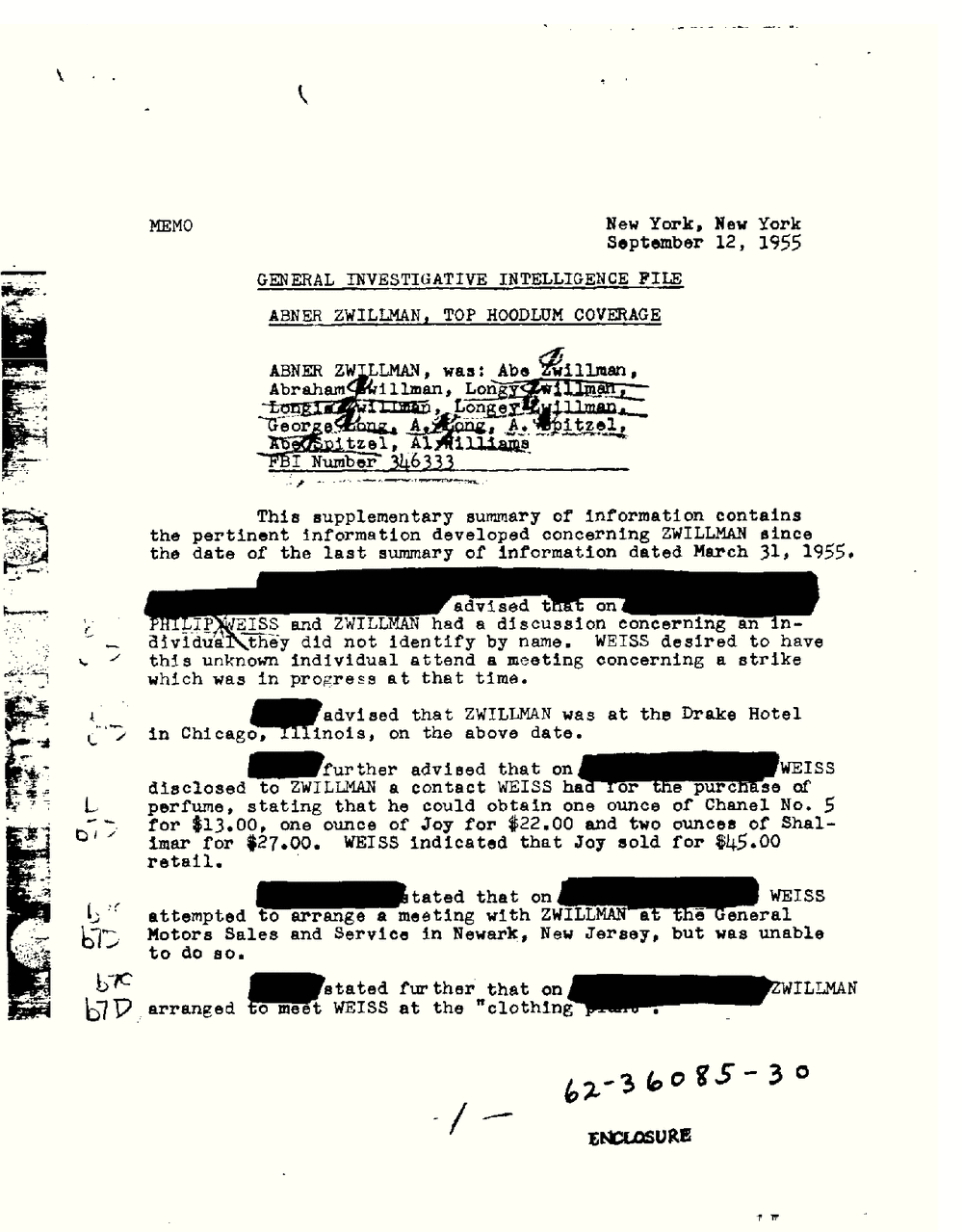 itemFBI Vault, Abner Zwillman, Part 02: "Top Hoodlum Coverage" memoranda, 1955 to 1956Second part of the FBI's released Zwillman file, 141 pages of New York and Newark memoranda headed "General Investigative Intelligence File, Abner Zwillman, Top Hoodlum Coverage," including the Newark office's note that his 1956 income-tax trial ended when the jury failed to agree.
 itemFBI Vault, Abner Zwillman, Part 03: Newark report, December 1957 to early 1958A Newark anti-racketeering report on Zwillman: his background, residences and businesses, associates he acknowledged in a 1938 interview and in 1951 testimony, and the status of his income-tax case after the 1956 hung jury. Read from a poor OCR.
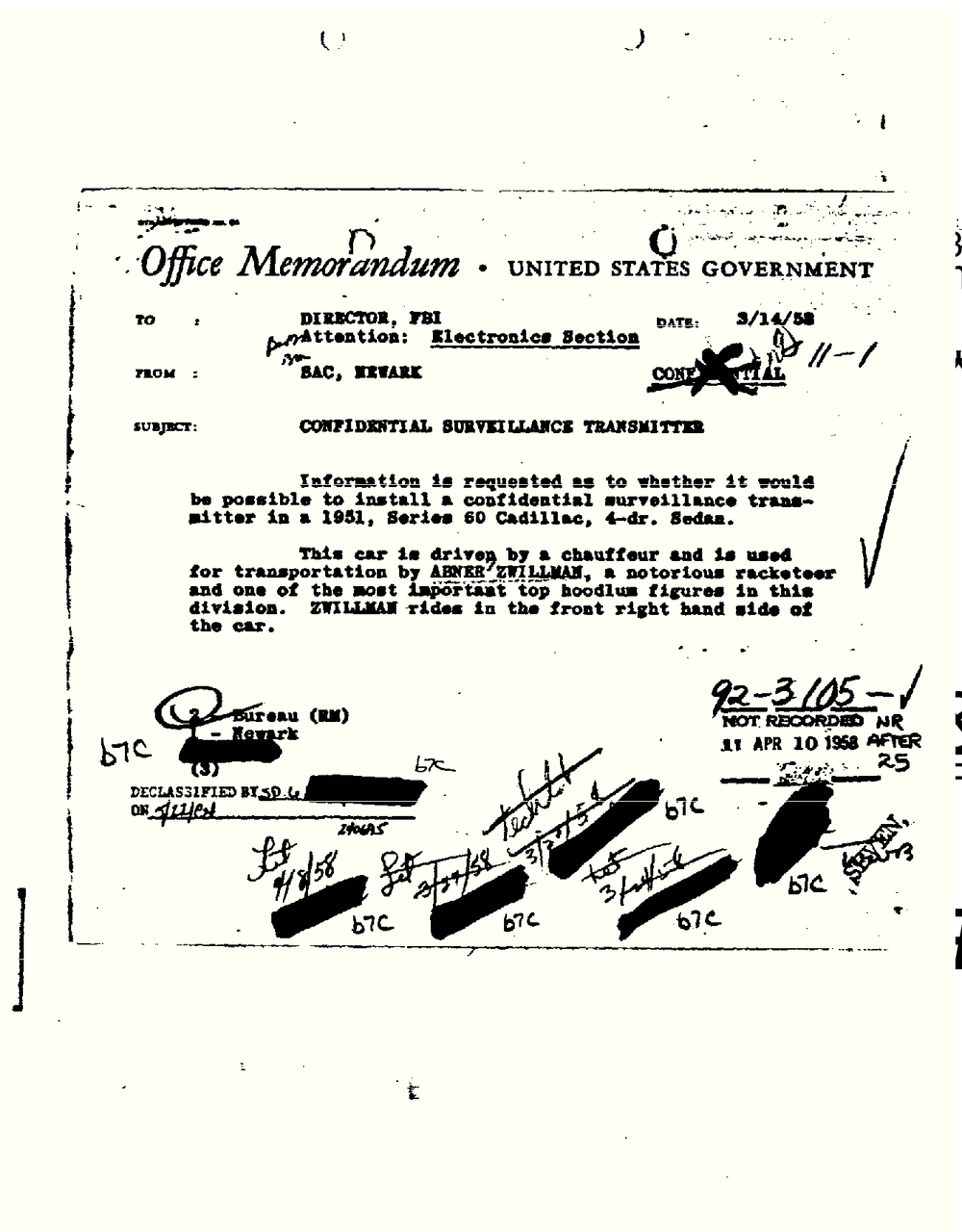 itemFBI Vault, Abner Zwillman, Part 04: Newark requests for technical surveillance, 1958Newark memoranda of 1958 asking FBI headquarters for a "confidential surveillance transmitter" in the car that carried Zwillman and for a microphone at a Newark beverage company, on the stated ground that his operations "are extremely circumspect."
 itemFBI Vault, Abner Zwillman, Part 05: microphone memoranda of January 1959 on the 1956 juryFBI memoranda of January 1959 reporting that a microphone installed in a Newark beverage company office picked up a conversation indicating that jurors in Zwillman's 1956 tax trial had been approached; the Justice Department asks the Newark office to investigate.
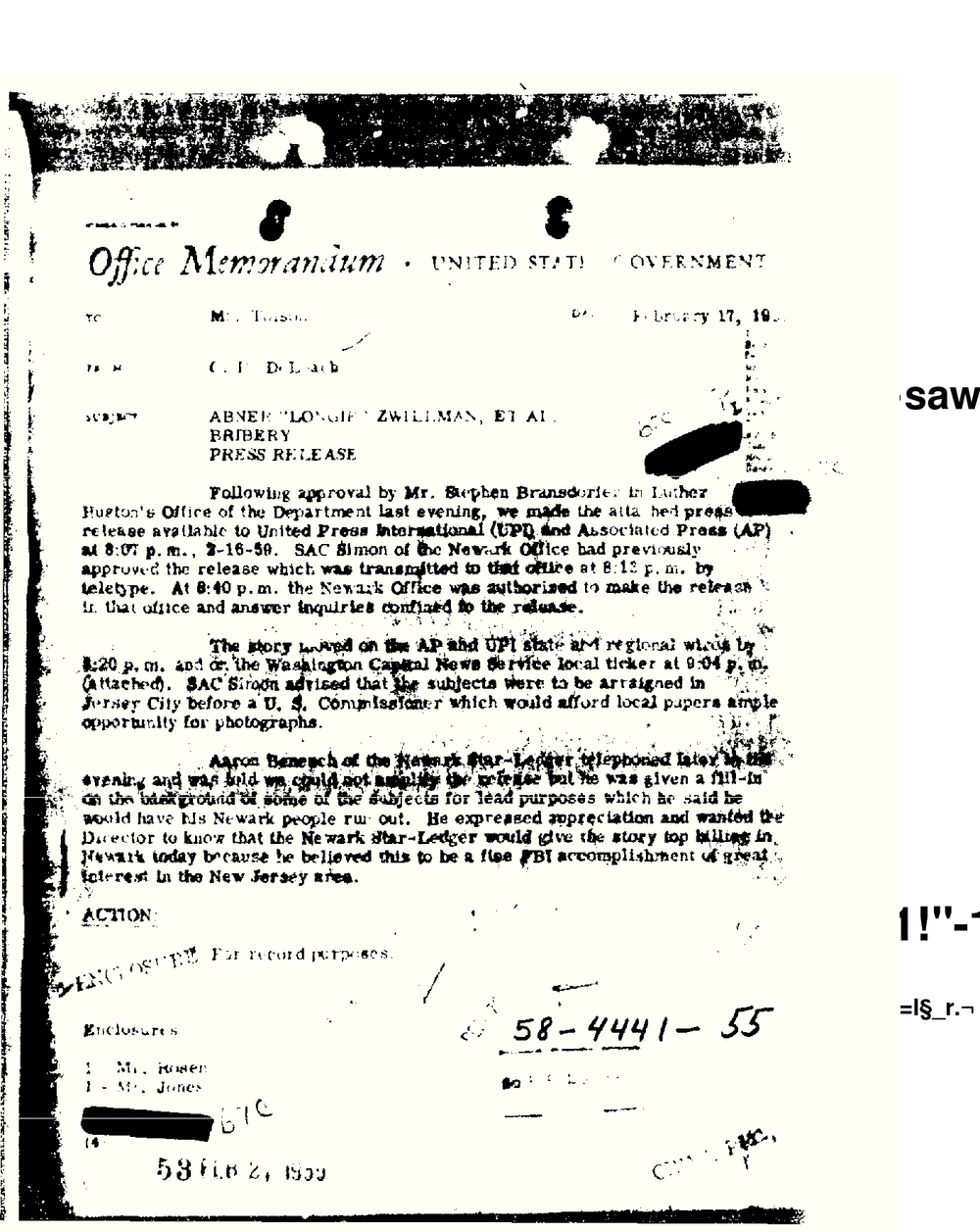 itemFBI Vault, Abner Zwillman, Part 06: "Bribery" and "Obstruction of Justice" memoranda, 1959FBI memoranda of 1959 headed "Bribery" and "Obstruction of Justice" about the jury in Zwillman's 1956 tax trial. The first page reports that a press release on "Abner 'Longie' Zwillman, et al." was given to the wire services on February 16, 1959. Most of the OCR is unreadable.
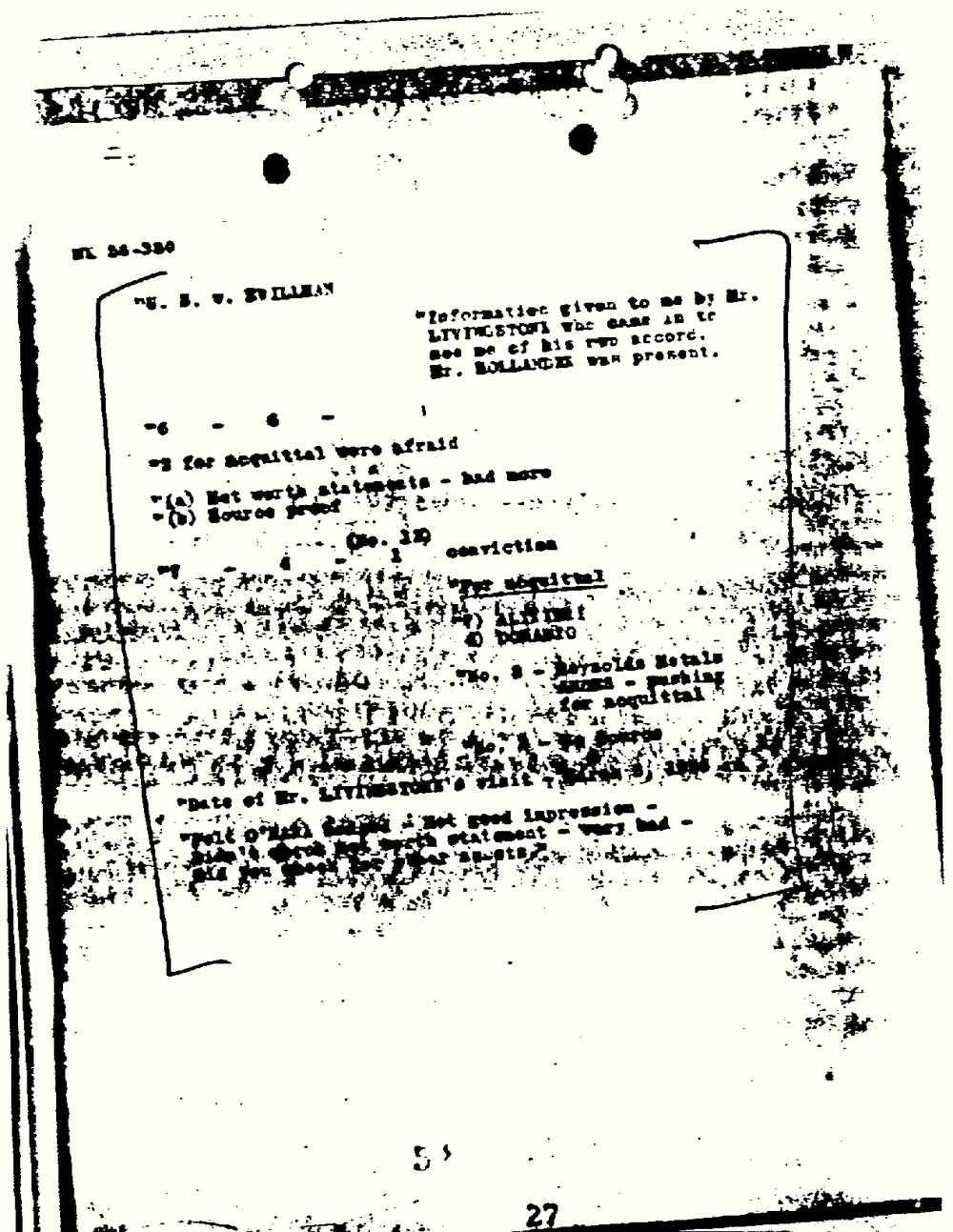 itemFBI Vault, Abner Zwillman, Part 07 (Final): a page of notes headed "U.S. v. Zwillman"The last part of the FBI's released Zwillman file is a single scanned page of notes marked "U.S. v. Zwillman," recording information given by a visitor about votes "for acquittal" and "conviction." It is undated and only partly legible.itemUnited States v. Zwillman, 108 F.2d 802 (2d Cir. 1940)The Second Circuit reverses a six-month contempt sentence imposed on Zwillman for refusing to tell a New York grand jury in August 1939 who his business associates were from 1928 to 1932, holding that the answers might have tended to incriminate him.itemRutkin v. United States, 343 U.S. 130 (1952)The Supreme Court holds that money obtained by extortion is taxable income. Its statement of facts recites that on May 11, 1943 Joseph Reinfeld paid $358,000 to Zwillman and Stacher "representing their conceded interest in the proceeds of Browne Vintners stock."
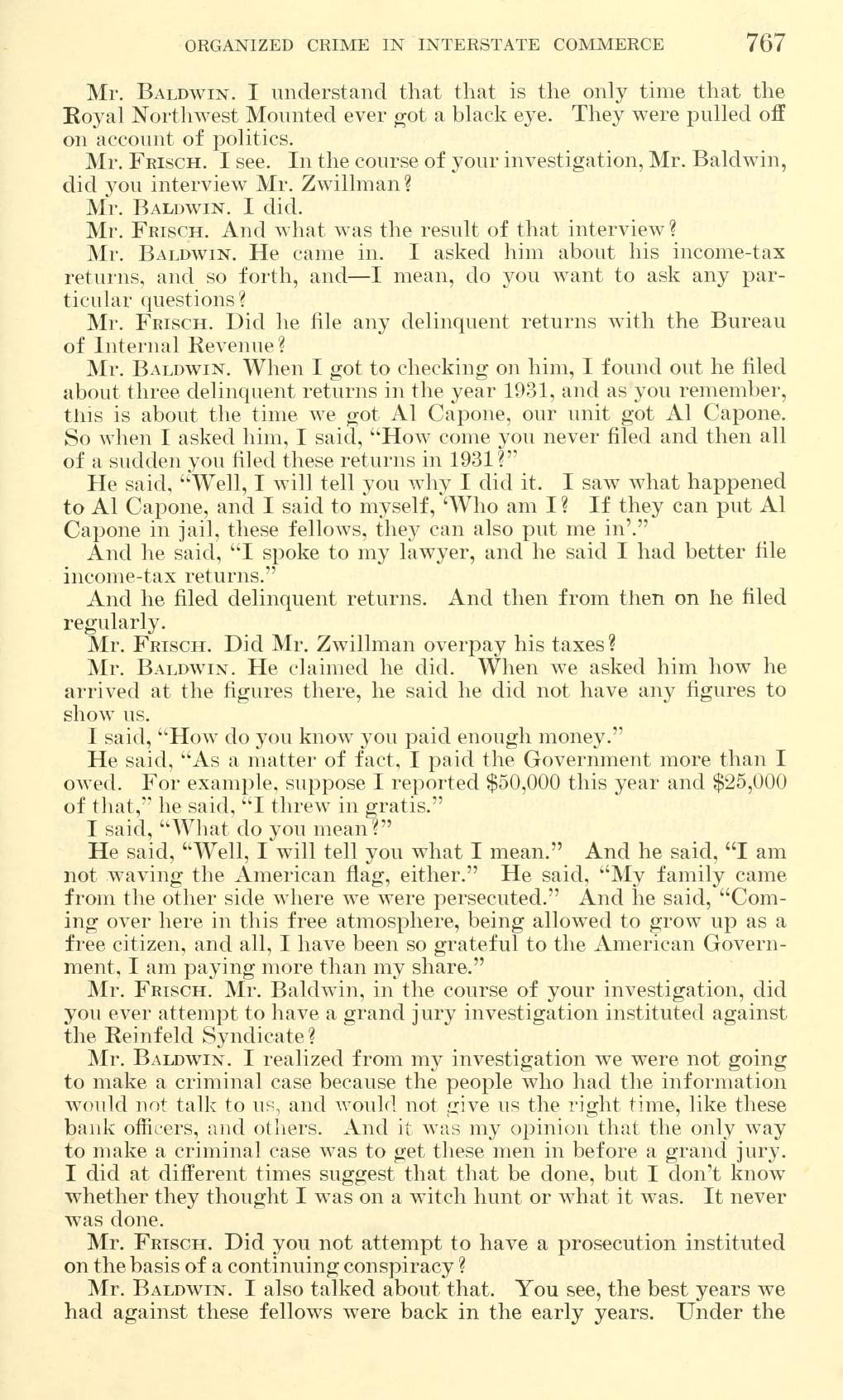 itemTestimony of Edwin A. Baldwin, retired Treasury intelligence agent, August 16, 1951 (Kefauver Committee, Part 18, pp. 761–771)A retired Treasury Intelligence Unit agent tells the Kefauver Committee about his 1926–1933 investigation of the "Reinfeld syndicate" and Abner Zwillman's tax returns, including Zwillman's account of why he filed delinquent returns in 1931: "I saw what happened to Al Capone."
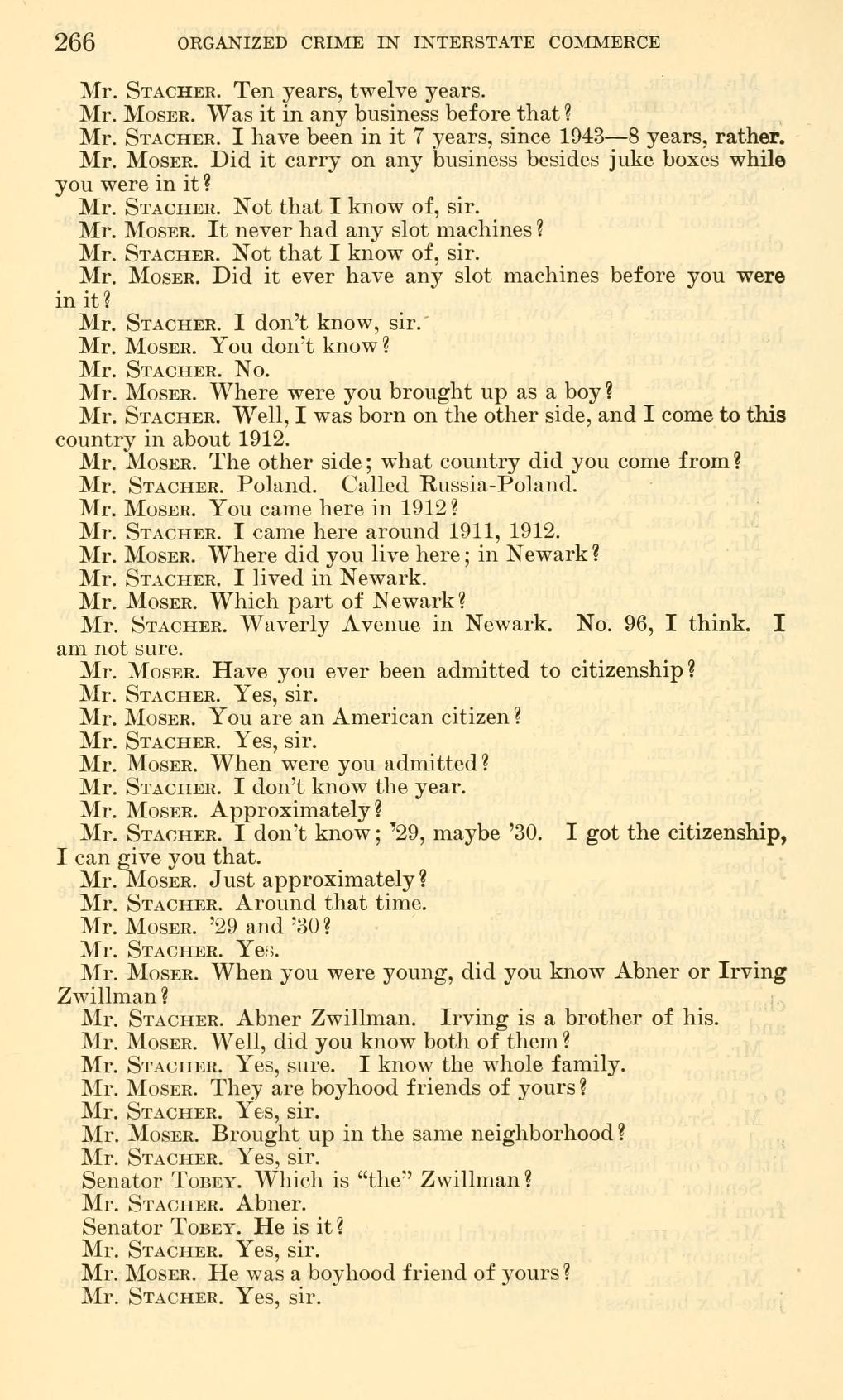 itemTestimony of Joseph Stacher, Newark, July 11, 1951 (Kefauver Committee, Part 18, pp. 260 ff.)Joseph Stacher, giving his aliases as Doc Harris, Doc Rosen and Doc Stacher, tells the Kefauver Committee in Newark that Abner Zwillman was a boyhood friend who lived "around the corner."
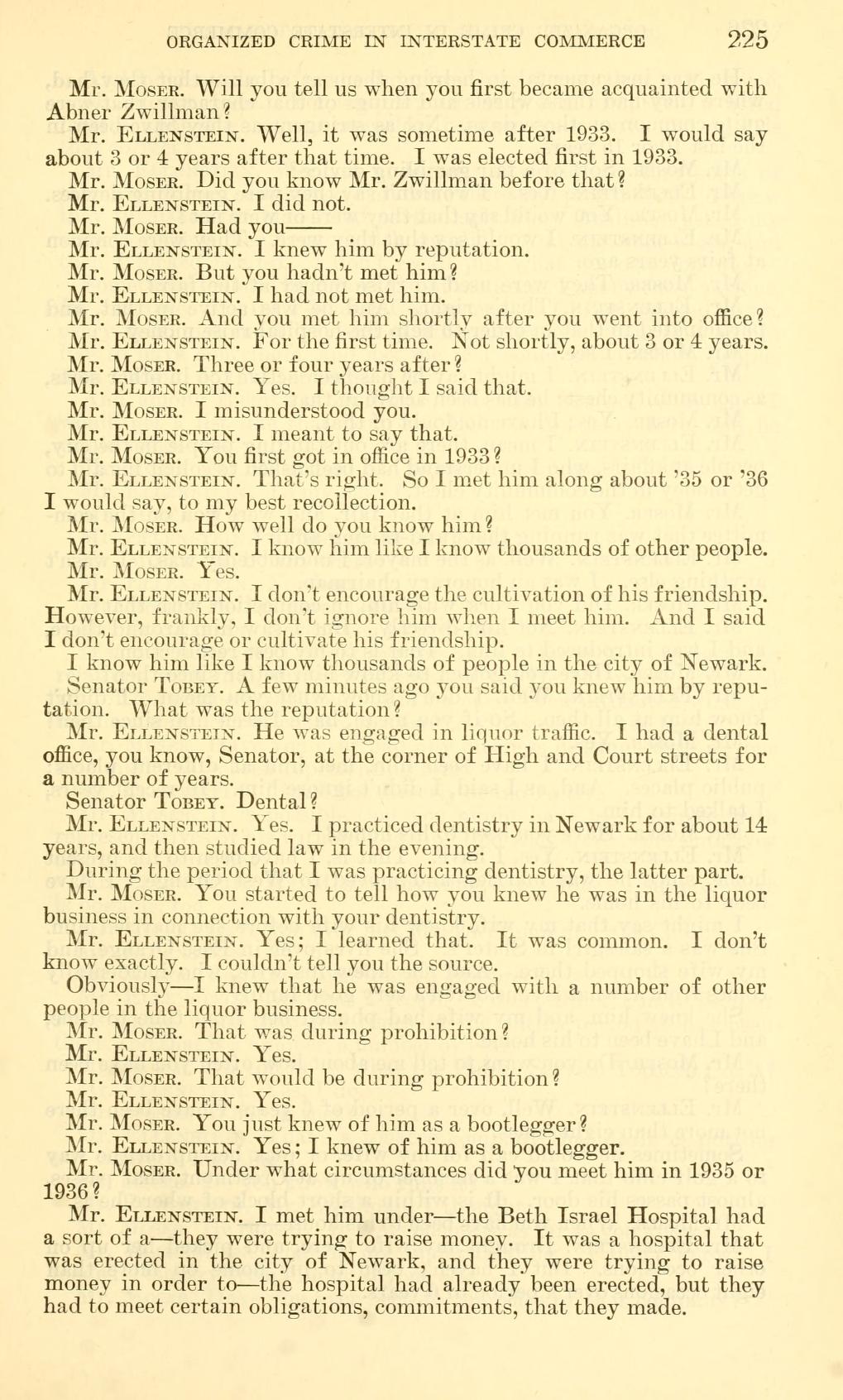 itemTestimony of Meyer C. Ellenstein, Newark city commissioner, July 11, 1951 (Kefauver Committee, Part 18, pp. 219 ff.)A Newark city commissioner, first elected in 1933, tells the Kefauver Committee he knew Abner Zwillman by reputation, "as a bootlegger," before meeting him about 1935 or 1936.
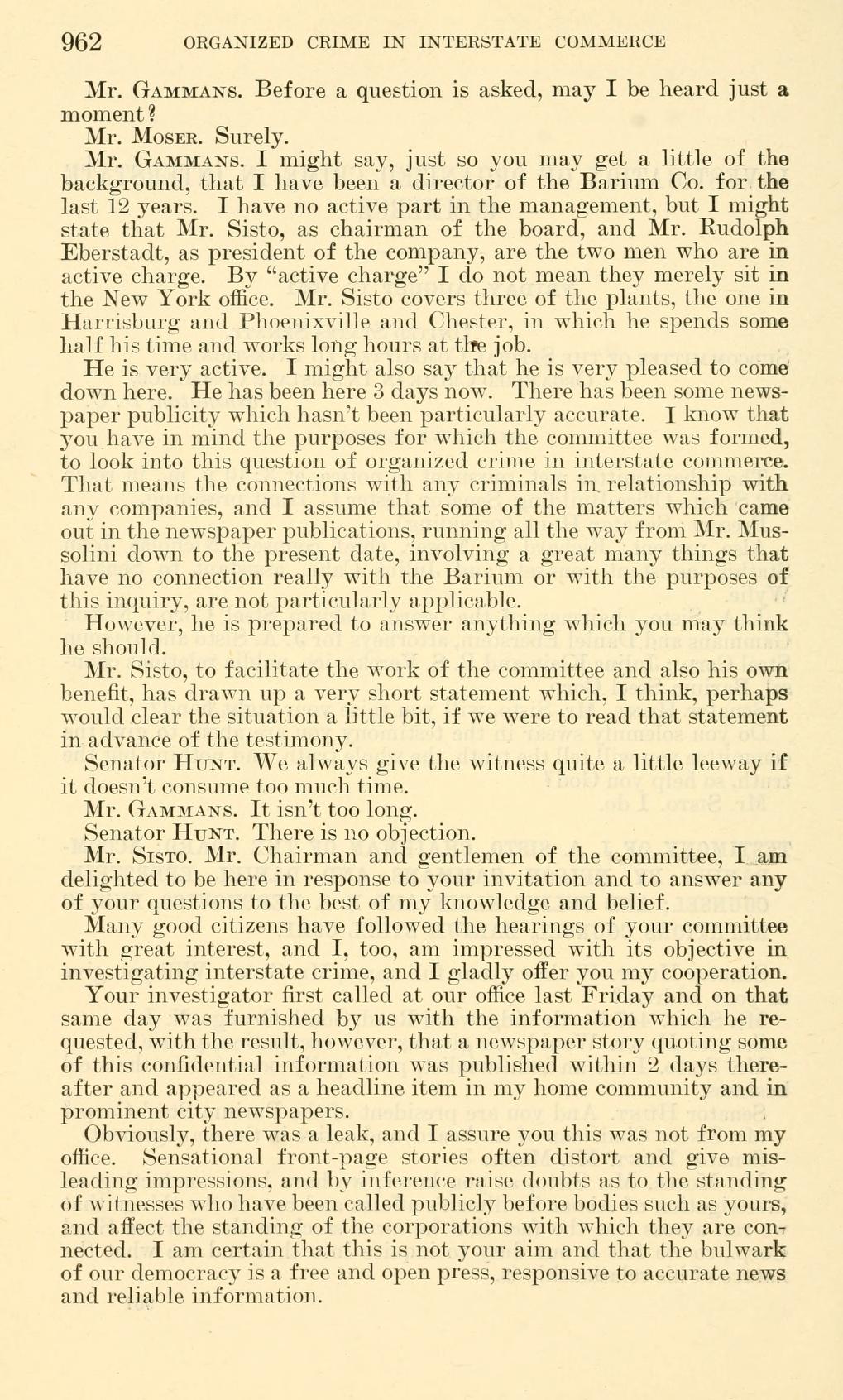 itemTestimony of J. A. Sisto, Barium Steel Corp., August 17, 1951 (Kefauver Committee, Part 18, pp. 961 ff.)The chairman of the Barium Steel Corporation appears before a Kefauver subcommittee, whose counsel says the committee, "investigating Abner Zwillman's affairs," found that Zwillman owns stock in the company.
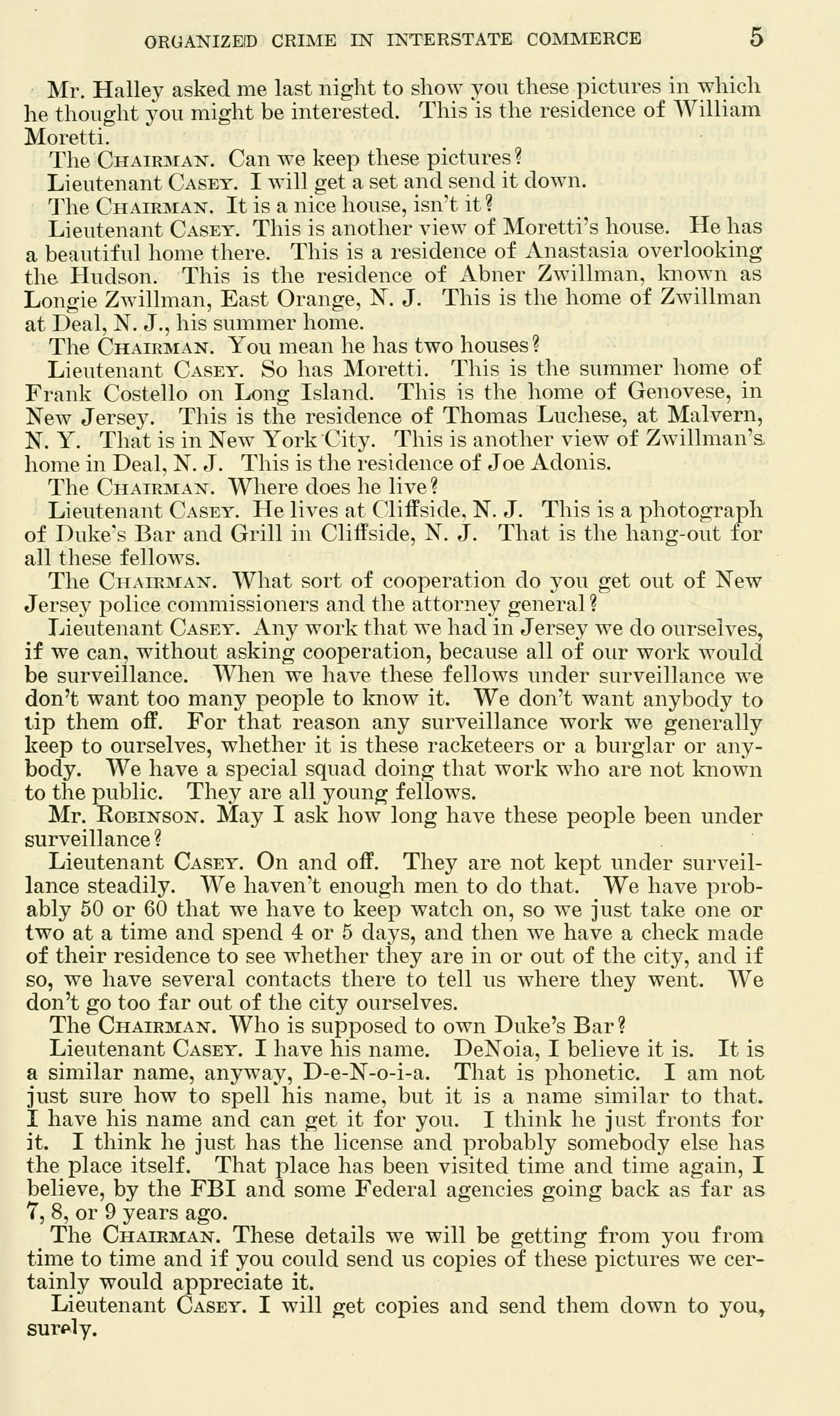 itemTestimony of Lt. Walter Casey, New York City Police Department, July 11, 1950 (Kefauver Committee, Part 7, pp. 1–6)At the committee's first New York-New Jersey session, a police lieutenant hands over photographs of houses, among them "the residence of Abner Zwillman, known as Longie Zwillman, East Orange, N.J.," his summer home at Deal, and Joe Adonis's residence at Cliffside.
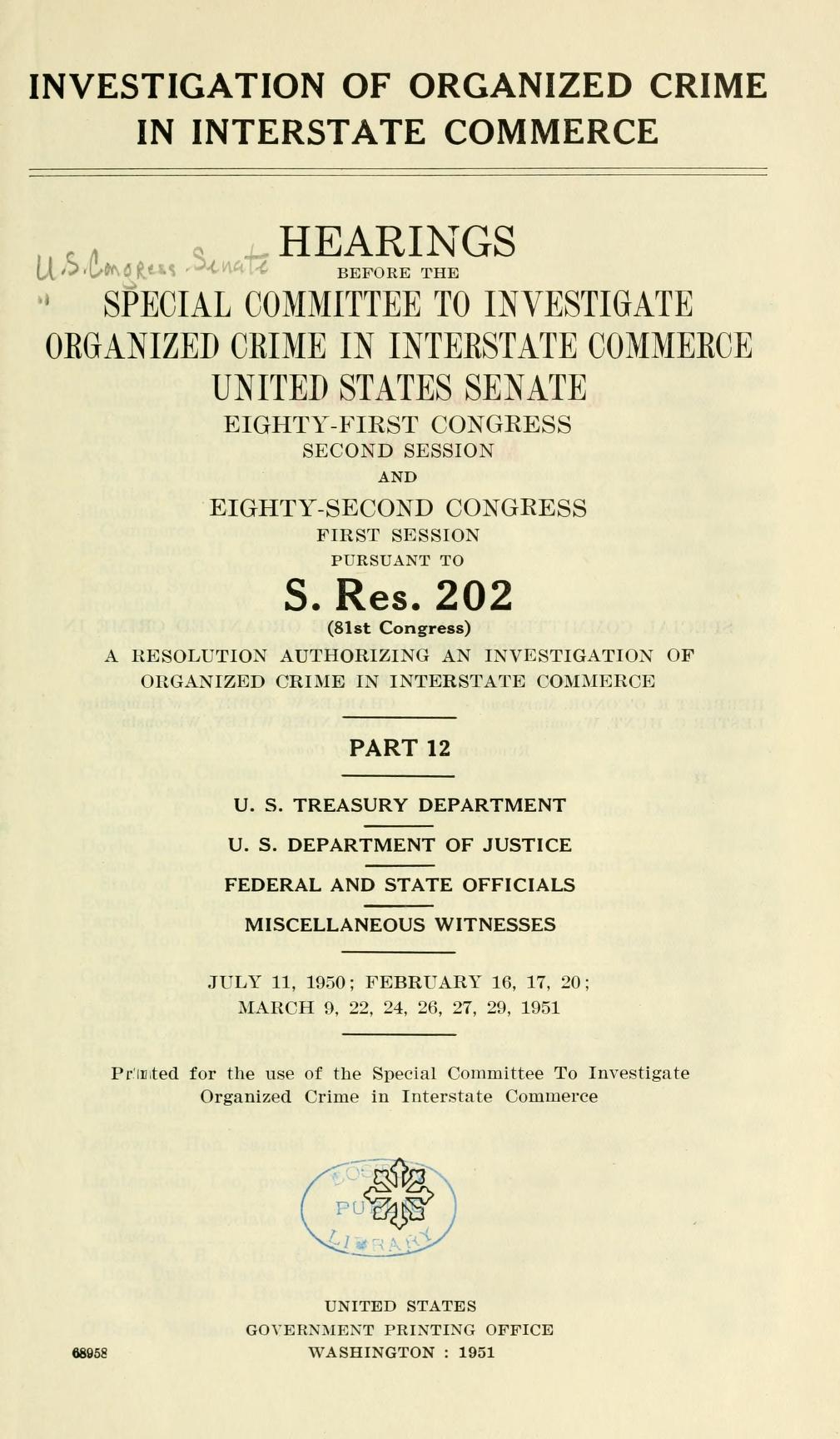 itemKefauver Committee hearings, Part 12: Treasury, Justice, and miscellaneous witnesses (1950–1951)Printed hearings of the Senate Special Committee to Investigate Organized Crime in Interstate Commerce, Part 12, Treasury, Justice, and miscellaneous witnesses: sessions in Washington, July 1950 to March 1951.itemFur Dressers Case (FBI history page)The FBI's own account of its 1932 to 1939 antitrust investigation of the Protective Fur Dressers Corporation and the Fur Dressers Factor Corporation, in which Louis Buchalter and Jacob Shapiro were named defendants, through Buchalter's surrender on August 24, 1939.