Every account on this page is one of three kinds: Joseph Valachi’s sworn testimony to the Senate Permanent Subcommittee on Investigations in October 1963, thirty-two years after the events; police records read aloud into that same hearing record by a New York police sergeant, or printed in it as exhibits, together with a New Jersey official’s testimony from his state’s records; and the FBI’s own later statements, made in memoranda and on its web pages long after 1931. None of them is a court finding, and no one was convicted of any of the killings described here. The newspaper pages of 1930 and 1931 that reported these killings are still to be filed. Four 1931 pages on the Masseria and Maranzano killings are held back until their rights are checked, and no 1930 page could be opened when this section was researched.
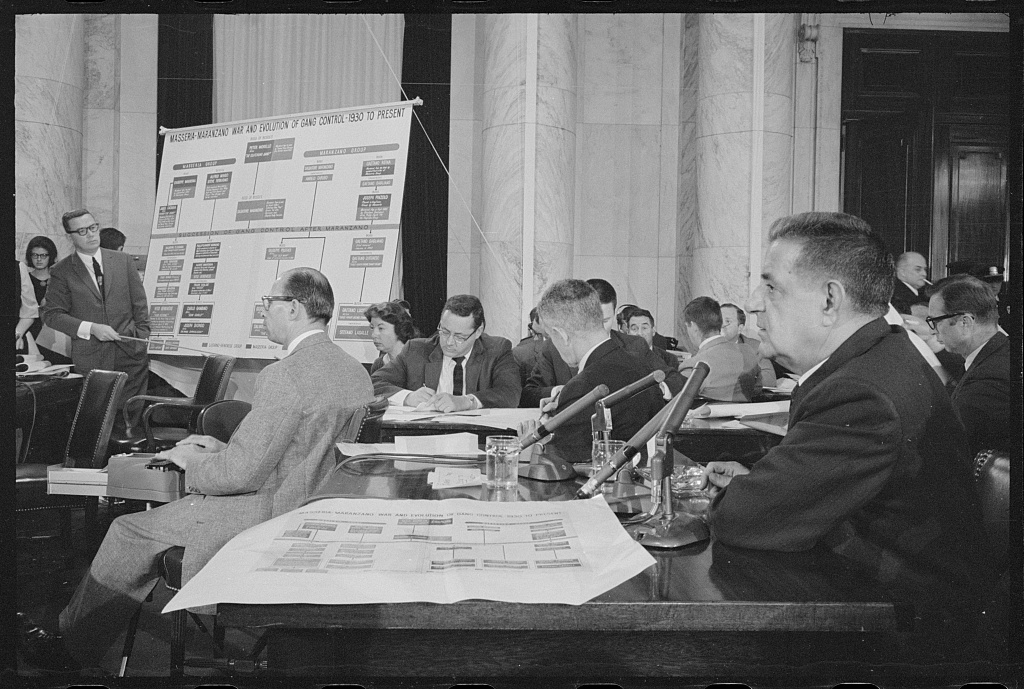
Each hearing record below is a page range of Part 1 of “Organized Crime and Illicit Traffic in Narcotics,” cited by its printed page and stores the page images. The days as a whole are filed as October 1 and October 2, and the staff chart presented on October 1 as Exhibit 8. See also the Valachi section and New York, 1930s.
The name
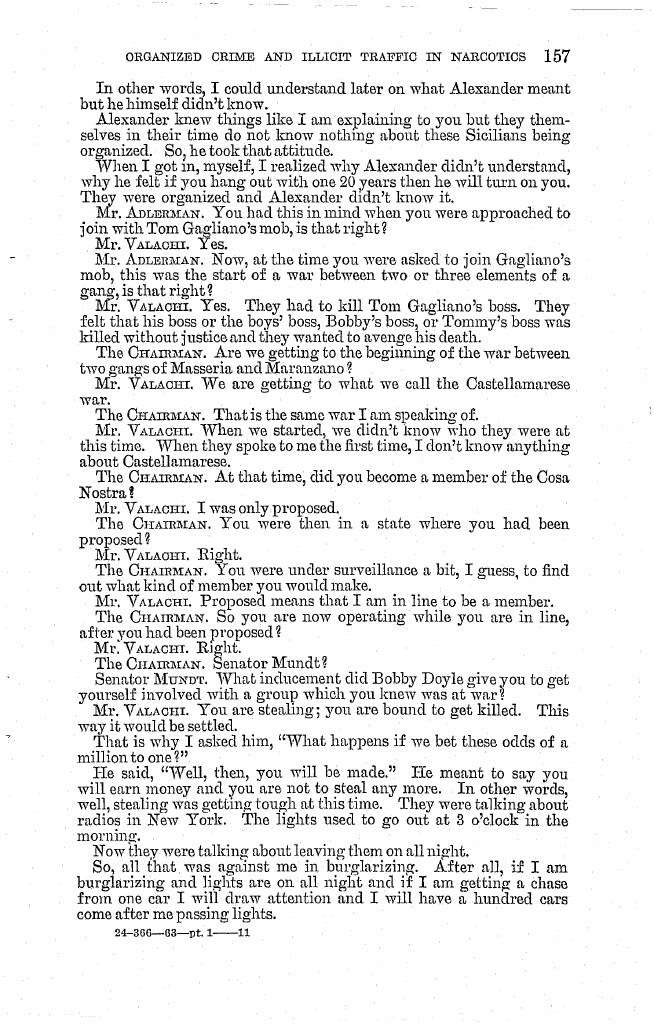
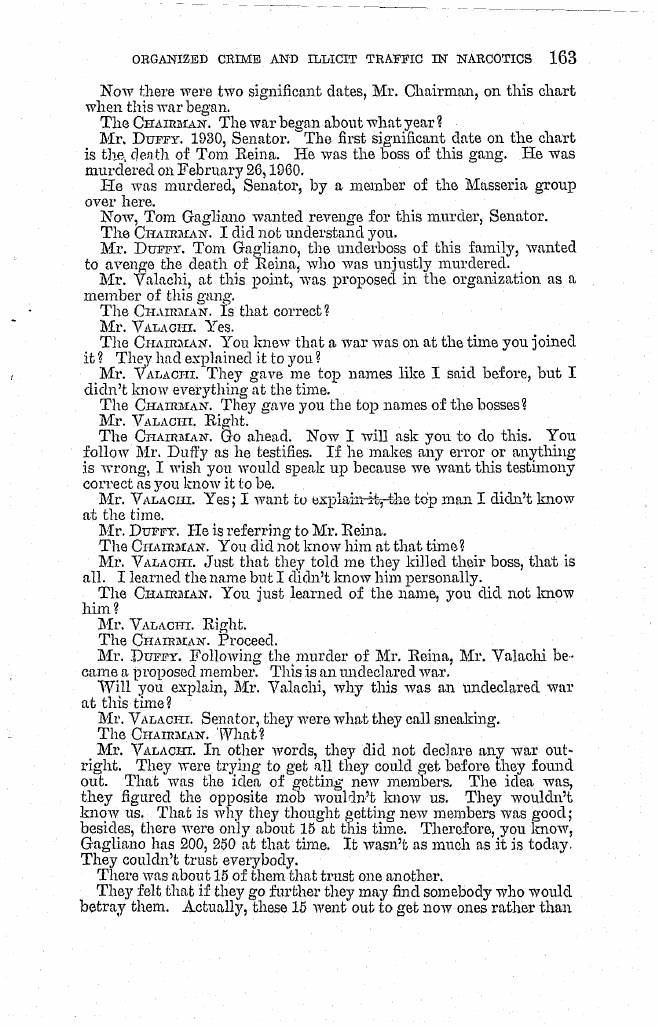
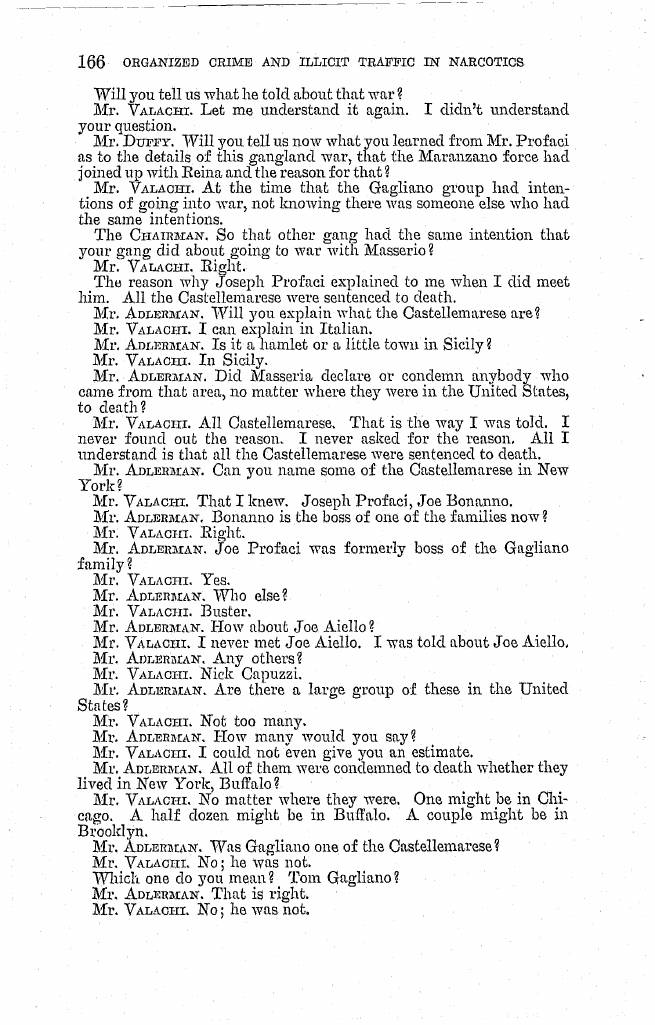
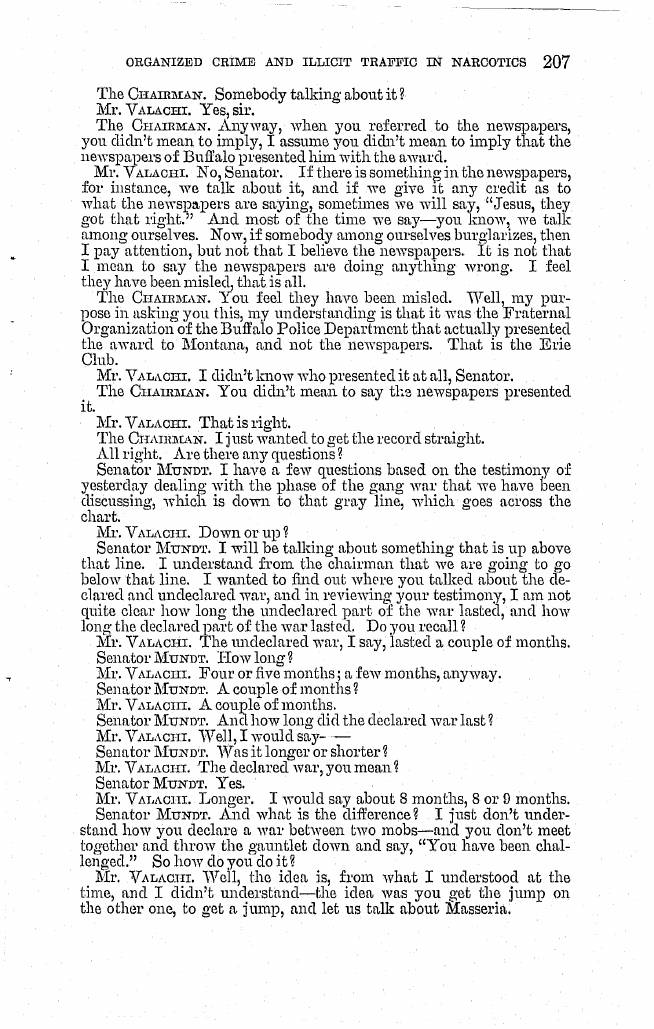
Asked by the chairman whether they were coming to “the beginning of the war between two gangs of Masseria and Maranzano,” Valachi answered: “We are getting to what we call the Castellamarese war” (pp. 156–157). Staff counsel LaVern Duffy called “The Castellemerese war” “another name for the war that took place during 1930, 1931” (printed p. 162, with Exhibit 8). Valachi explained the name a few pages on: Joseph Profaci had told him that Masseria had condemned everyone from Castellammare, a town “In Sicily”: “All the Castellemarese were sentenced to death. … I never found out the reason” (pp. 166–168). He named Profaci and Joe Bonanno as Castellammarese, said Maranzano was one, and said Tom Gagliano was not. The spellings are the transcript’s.
The killings of 1930, as the police records give them
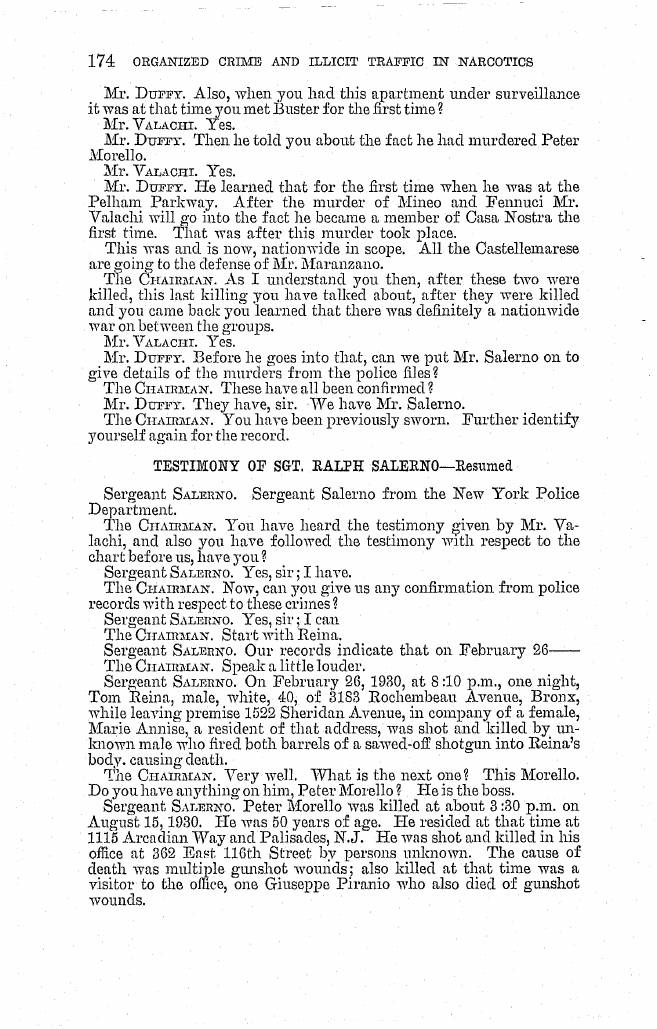
On October 1, 1963, Sergeant Ralph Salerno of the New York Police Department read the department’s entries into the record (pp. 174–179). He said the district attorneys had limited what he could disclose, and every case was still open.
- Tom Reina, 26 February 1930. Shot at 8:10 p.m. “while leaving premise 1522 Sheridan Avenue” in the Bronx, by an unknown man with both barrels of a sawed-off shotgun. Duffy’s own date for the killing is printed “February 26, 1960” (printed p. 163); the page image shows the error is in the print, and the police record’s year, 1930, is used here (pp. 163–165). Duffy called Reina “the boss of this gang” and said he was killed “by a member of the Masseria group.” Valachi said the war began “sneaking,” undeclared.
- Peter Morello and Giuseppe Piranio, 15 August 1930. Morello, 50, “was shot and killed in his office at 362 East 116th Street by persons unknown” at about 3:30 p.m.; a visitor, Piranio, was also killed. Valachi said he was told the gunman was a man known as “Buster” of Chicago, acting for “the Maranzano group.”
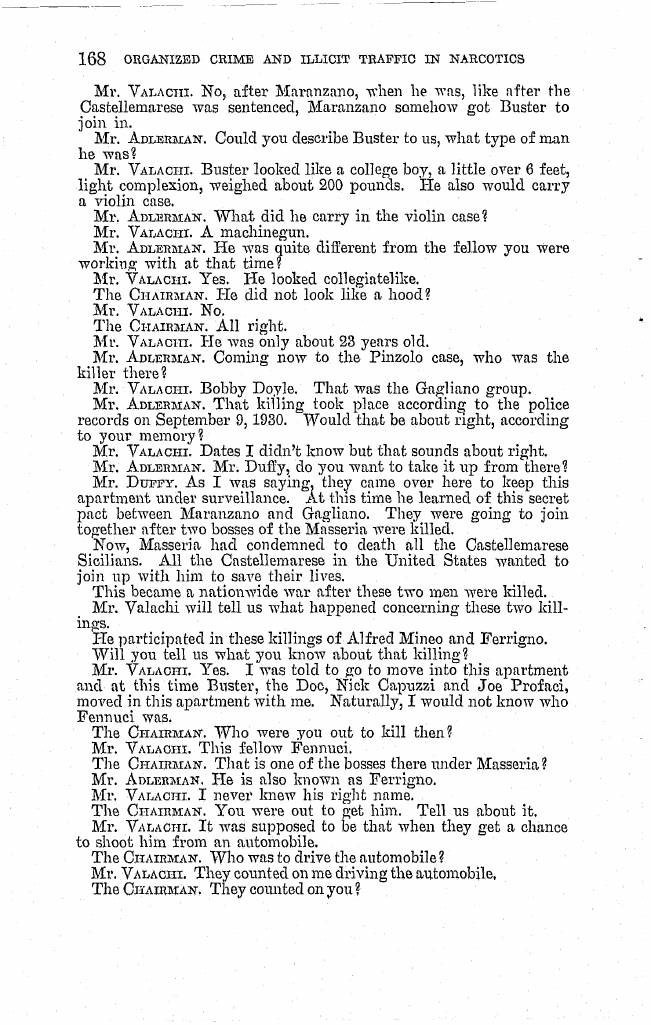
- Joseph Pinzolo, 9 September 1930. Found dead at 9 p.m. “on the floor of his office, which is in suite 1007 in the Brokaw Building at 1487 Broadway.” The lessee was Thomas Lucchese, who “was arraigned in homicide court” two days later; the grand jury “failed to return an indictment.” The FBI identification record lists the September 1930 homicide arrest as dismissed on February 26, 1931. Valachi said a man named Bobby Doyle, “not Lucchese,” told him he had done it.
- Stephen Ferrigno and Manfredi (Alfred) Mineo, 5 November 1930. Shot at 2:45 p.m. “while leaving Ferrigno’s apartment at 75 Pelham Parkway,” by “persons unknown who were occupying apartment C-1 at 760 Pelham Parkway South,” through closed windows. Valachi, who said he had watched the apartment for two months and was away that day, gave the place as “750 Pelham Parkway” (pp. 168–174). He said the killing turned an undeclared war into a declared one (pp. 207–209).
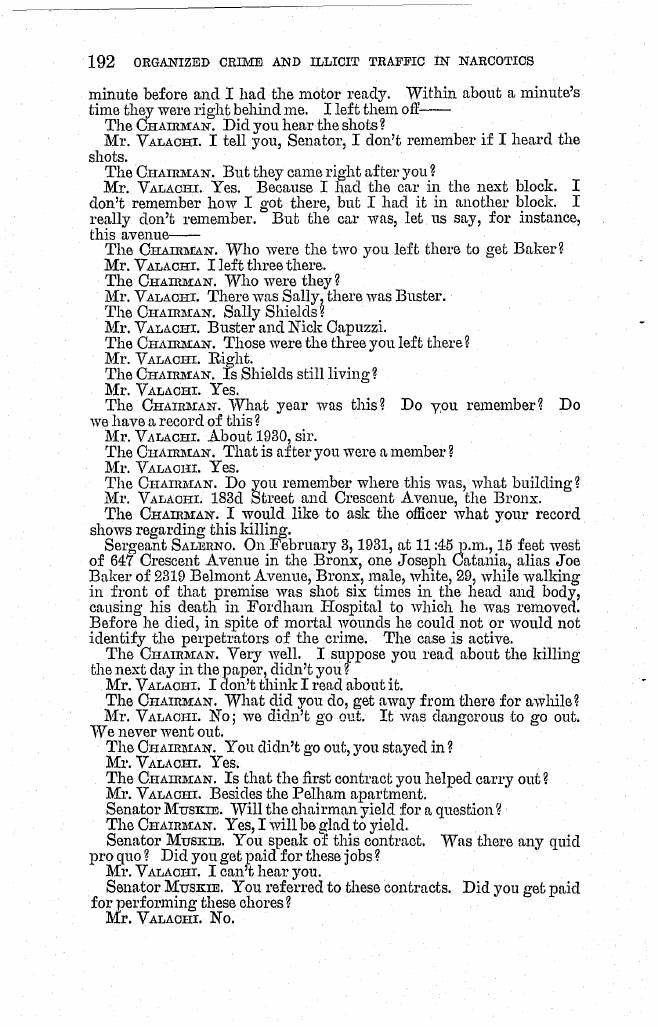
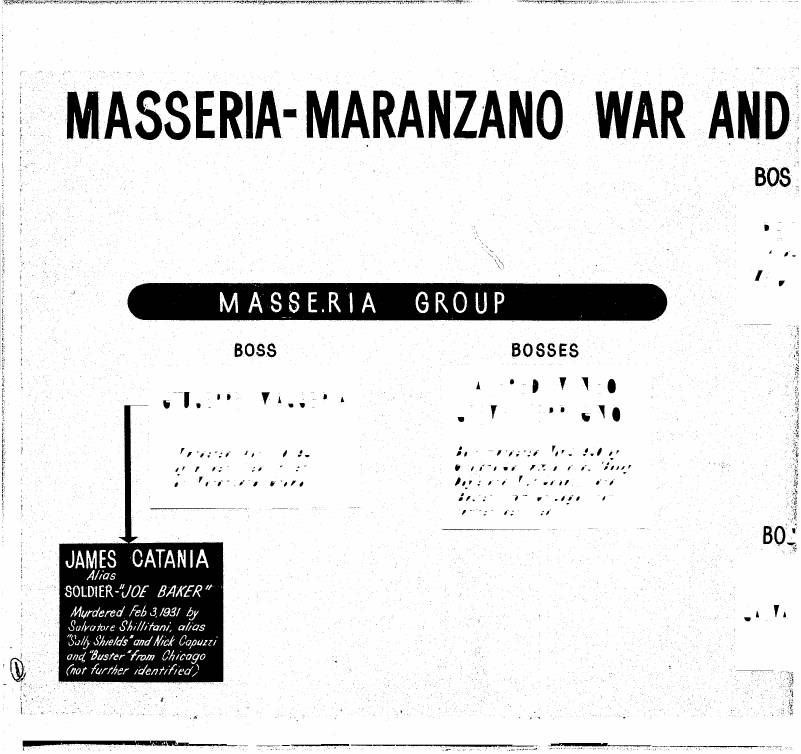
- Joseph Catania (“Joe Baker”), 3 February 1931. Shot six times “15 feet west of 647 Crescent Avenue in the Bronx”; he died in Fordham Hospital without naming anyone. Valachi said Maranzano had told him, “If I don’t get Joe Baker, I will never make peace,” and that he drove the car (pp. 188–192).
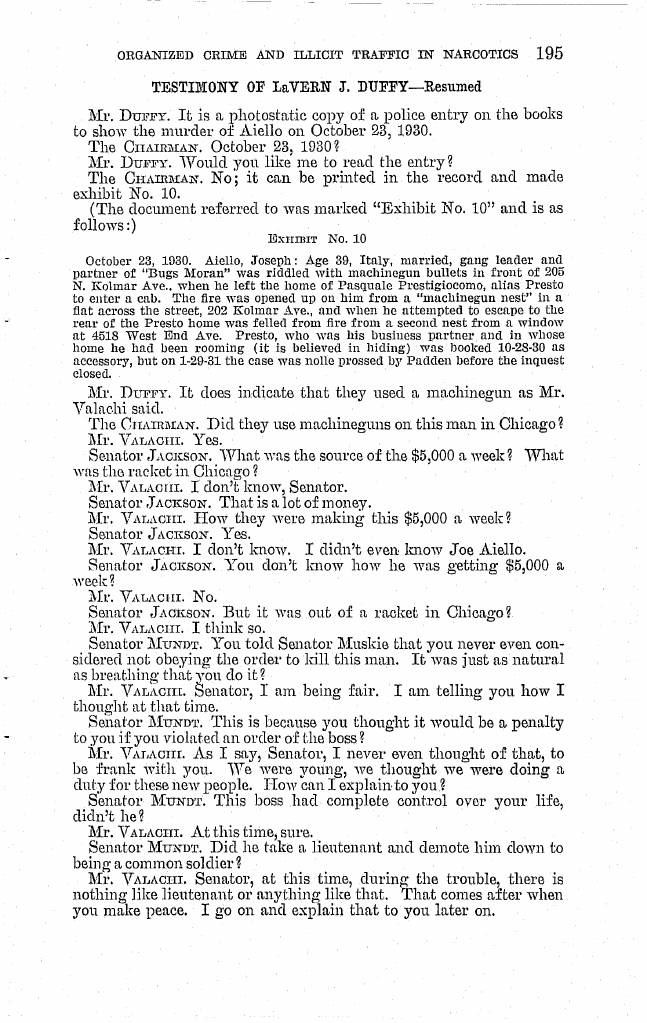
- Joseph Aiello, Chicago, 23 October 1930. Exhibit No. 10, a Chicago police entry, records that Aiello, 39, “gang leader and partner of ‘Bugs Moran’,” “was riddled with machinegun bullets in front of 205 N. Kolmar Ave.” from a “machinegun nest” across the street. Valachi said Aiello had sent money to the Maranzano side and was “the one” it lost: “They told me Al Capone got him. I only can tell you what they told me at the time” (pp. 193–195).
The war funds and the offer of peace
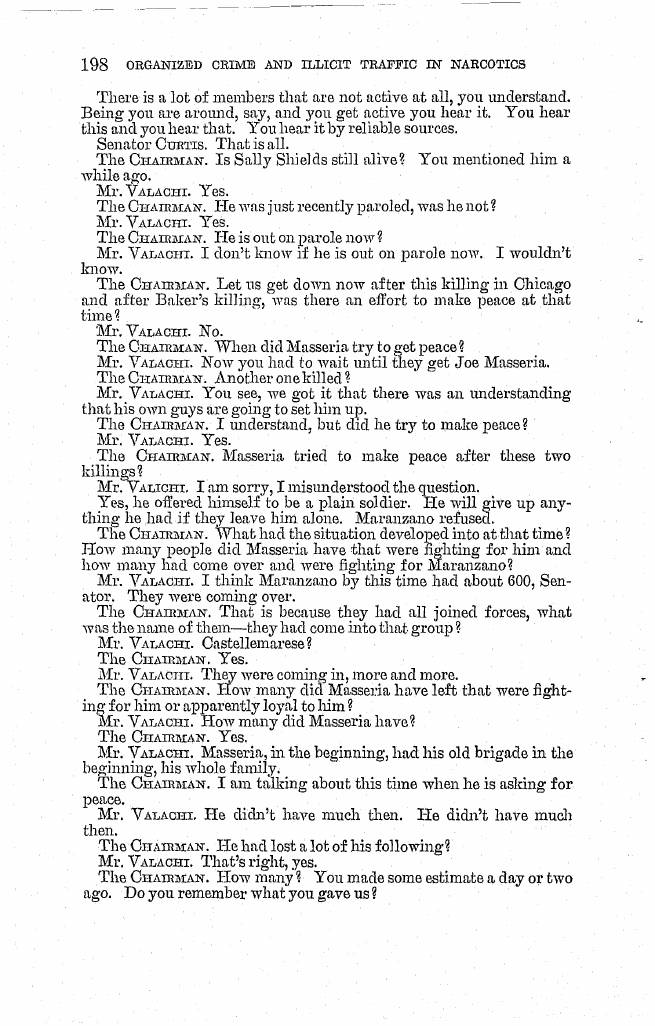
Valachi testified that Tom Gagliano spent “$140,000 out of his pocket,” that “$5,000 a week” came from Steve Magaddino in Buffalo and $5,000 a week from Joe Aiello in Chicago, and that the men doing the fighting got “$25 a week … between four of us” (pp. 193–195). The Buffalo money is also quoted on the Stefano Magaddino page. Near the end, he said, Masseria “offered himself to be a plain soldier. … Maranzano refused,” and Maranzano’s side had grown to “about 600” (pp. 198–199). These figures are his.
Masseria at 2715 West 15th Street, Coney Island, 15 April 1931
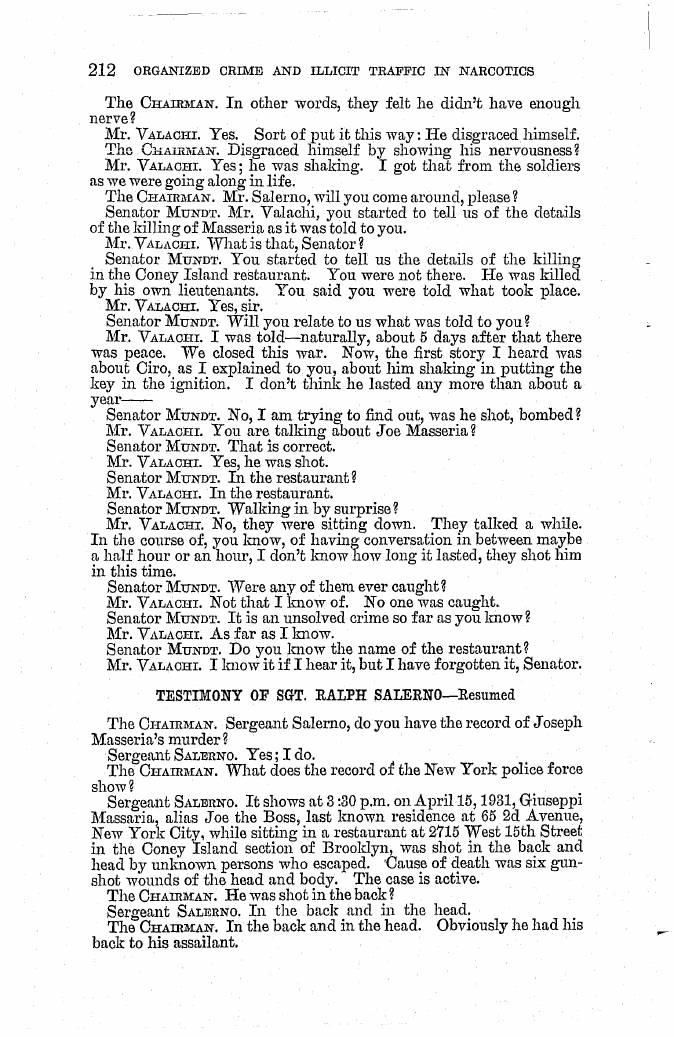
Sergeant Salerno read the police record: “at 3:30 p.m. on April 15, 1931, Giuseppi Massaria, alias Joe the Boss, … while sitting in a restaurant at 2715 West 15th Street in the Coney Island section of Brooklyn, was shot in the back and head by unknown persons who escaped.” There was never evidence, he said, “that could be presented to a grand jury” (pp. 210–213). The record does not name the restaurant. Valachi was not there; he testified he was told that Masseria’s own men, “Charley, Lucky, and Vito,” with Ciro Terranova and others, had set him up “with the pretense that they were going to get Maranzano.”
The Washington Avenue meeting and the banquet
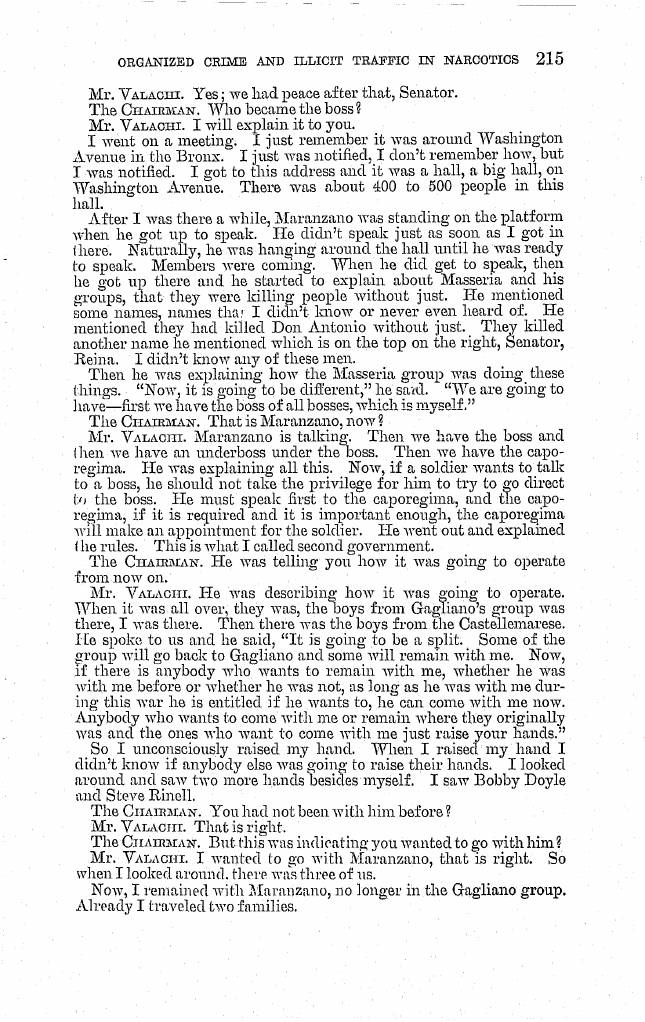
Valachi described a meeting of 400 to 500 people “in a big hall, on Washington Avenue” in the Bronx, a week or two after the peace, at which Maranzano said: “first we have the boss of all bosses, which is myself.” Asked who the other bosses were, he recalled what he heard announced there, and then a five-night banquet he understood took in $115,000 (pp. 214–218). He gave the score of the war as “we lost 1 and they lost from 40 to 60.” His list of bosses is one witness’s memory and is not copied onto any chart.
The Park Avenue plan and the killing of Maranzano, 10 September 1931
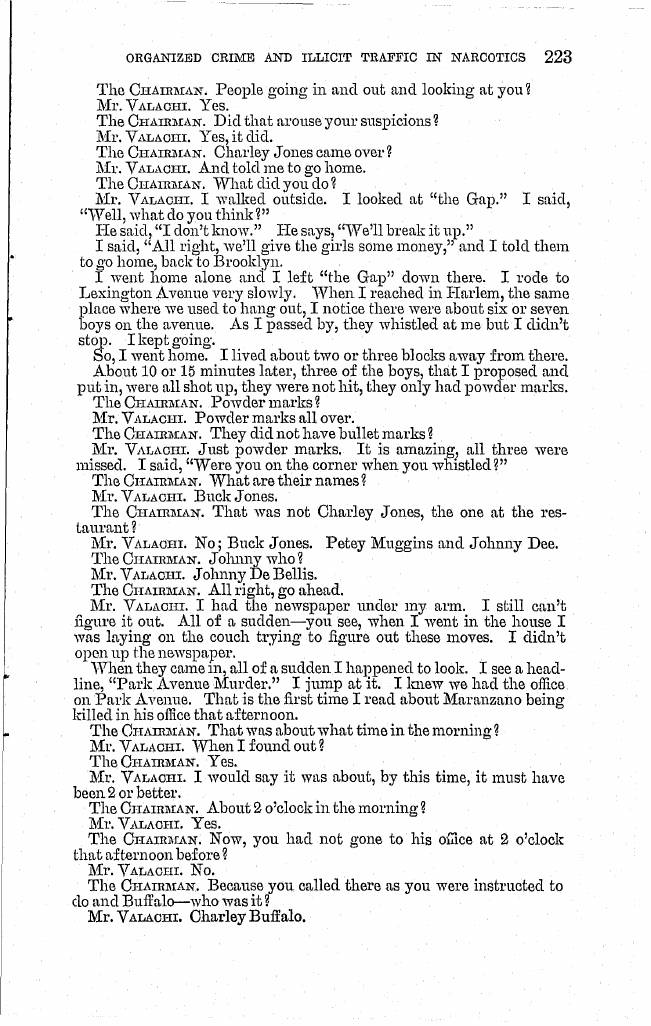
Valachi testified that Maranzano told him “We have to go to the mattress again,” gave him a list of names, and was to meet Genovese and Luciano at his office at 2 o’clock the next day; Valachi was told by phone not to come, and learned of the killing from a newspaper headline, “Park Avenue Murder” (pp. 220–224). The headline itself is not filed.
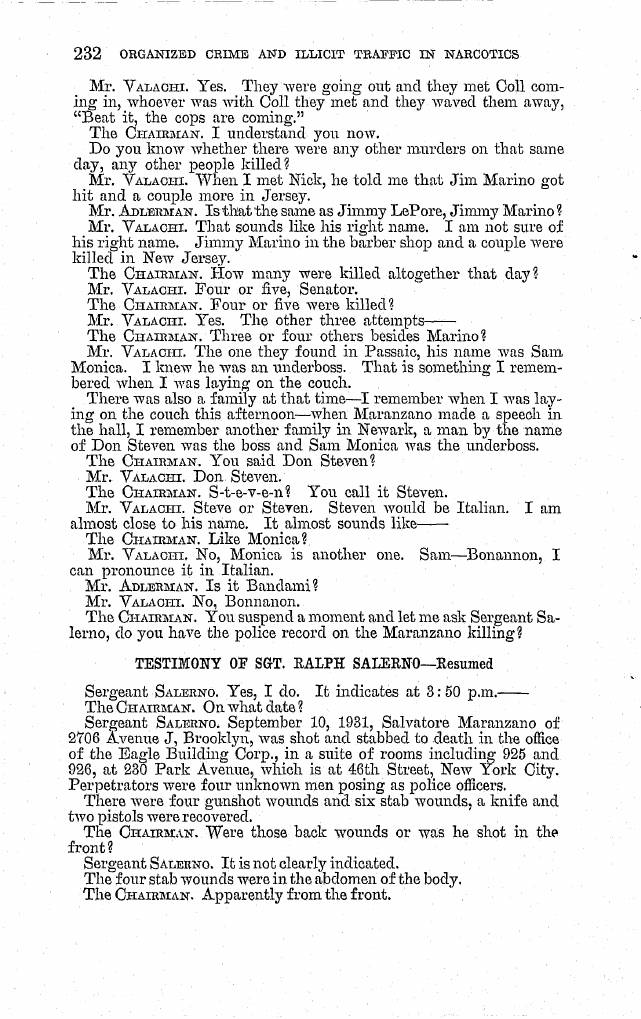
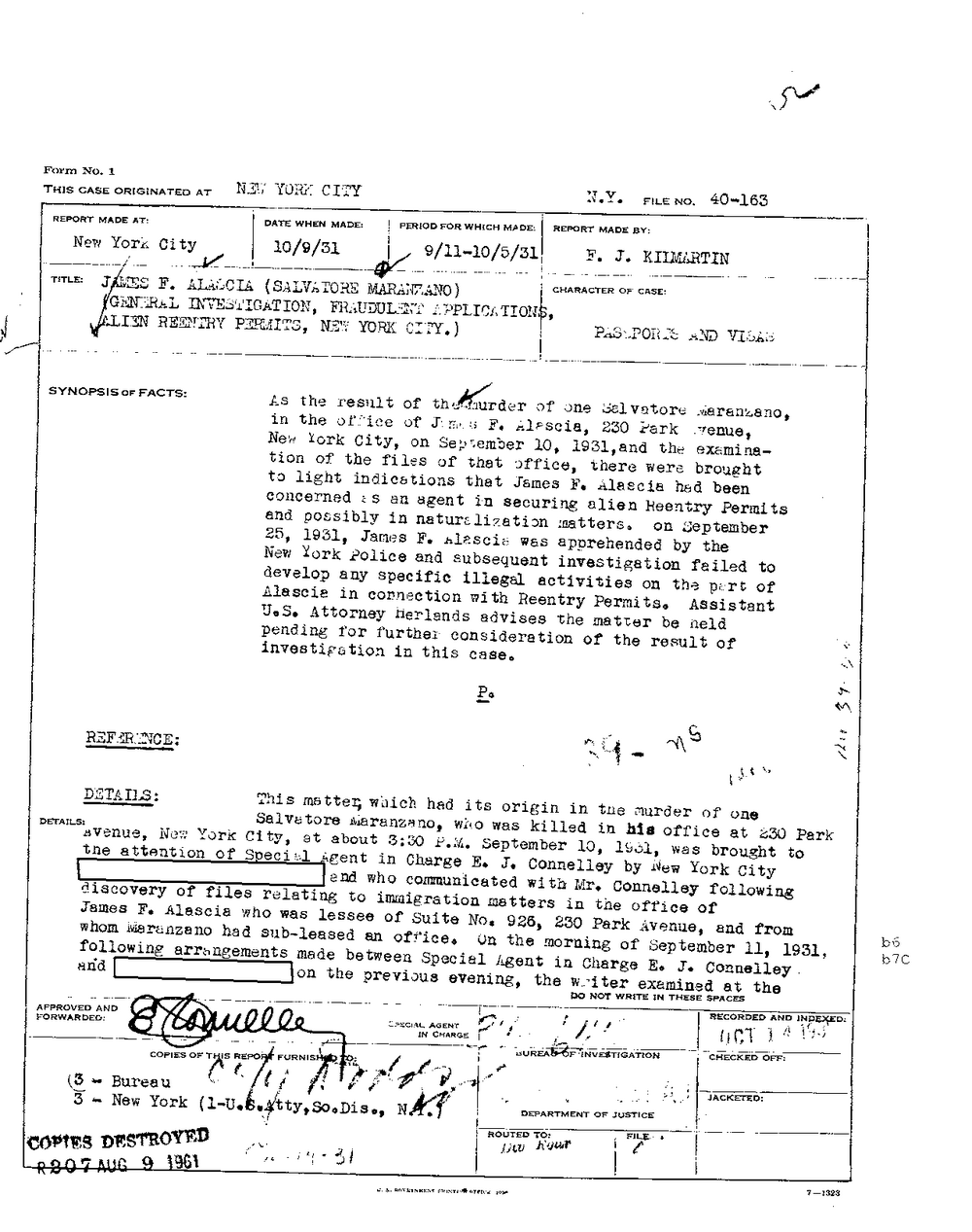
The police record, as Salerno read it: “September 10, 1931, Salvatore Maranzano … was shot and stabbed to death in the office of the Eagle Building Corp., in a suite of rooms including 925 and 926, at 230 Park Avenue, which is at 46th Street, New York City. Perpetrators were four unknown men posing as police officers” (pp. 227–233). No one was indicted. The FBI’s history page says instead that Luciano sent “five men dressed as police officers” (FBI history page), and a source quoted by the FBI’s Legal Attache in Rome in 1965 spoke of “two killers” (Legat Rome, 1965). The record does not settle the number; all three are given as printed. A 1931 Bureau of Investigation report in the Maranzano file concerns papers taken from the office afterward.
James Le Pore, the same day
Salerno read a second record for September 10, 1931: at 5:45 p.m., “James Le Pore, also known as Jimmy Marino, … while standing in the doorway of a barbershop at 2400 Arthur Avenue in the Bronx was shot six times in the head and body.” The case “has never been solved.” Valachi said he was told “Jim Marino got hit and a couple more in Jersey” (pp. 227–233).
“Boss of bosses” abolished
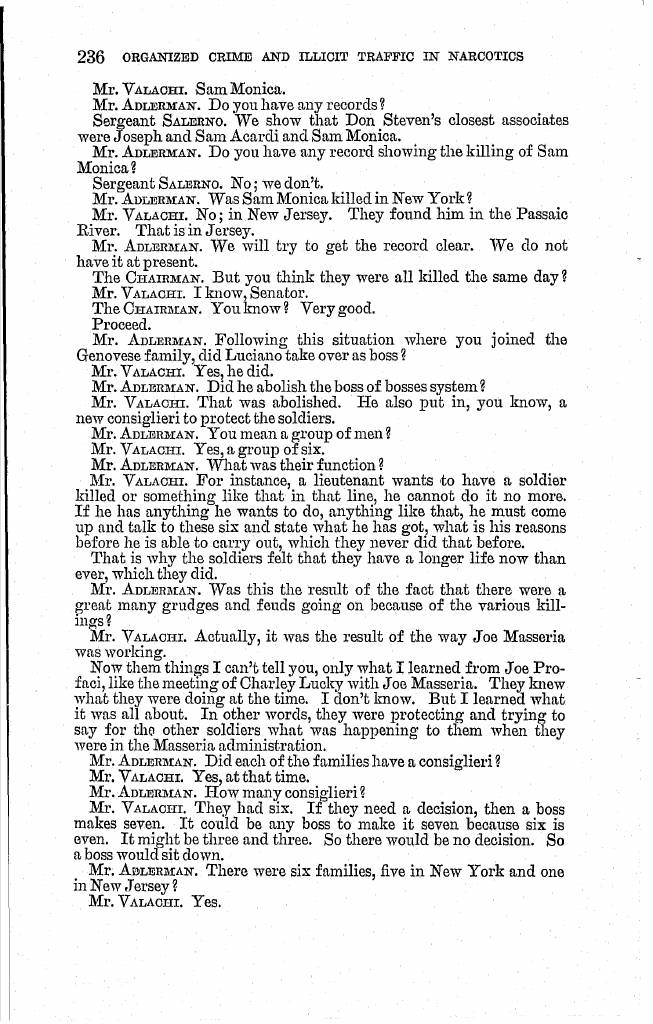
Valachi testified that after Maranzano’s death Luciano took over as boss, that the “boss of bosses” system “was abolished,” and that a group of six consiglieri was set up, “the result of the way Joe Masseria was working.” He spoke of a meeting of bosses in Chicago at which Luciano and Genovese had to justify the killing, and said “the books were closed in about 1931” (pp. 236–239). These are his words; the archive does not date the founding of the Commission from them.
The New Jersey bodies, 13 September 1931
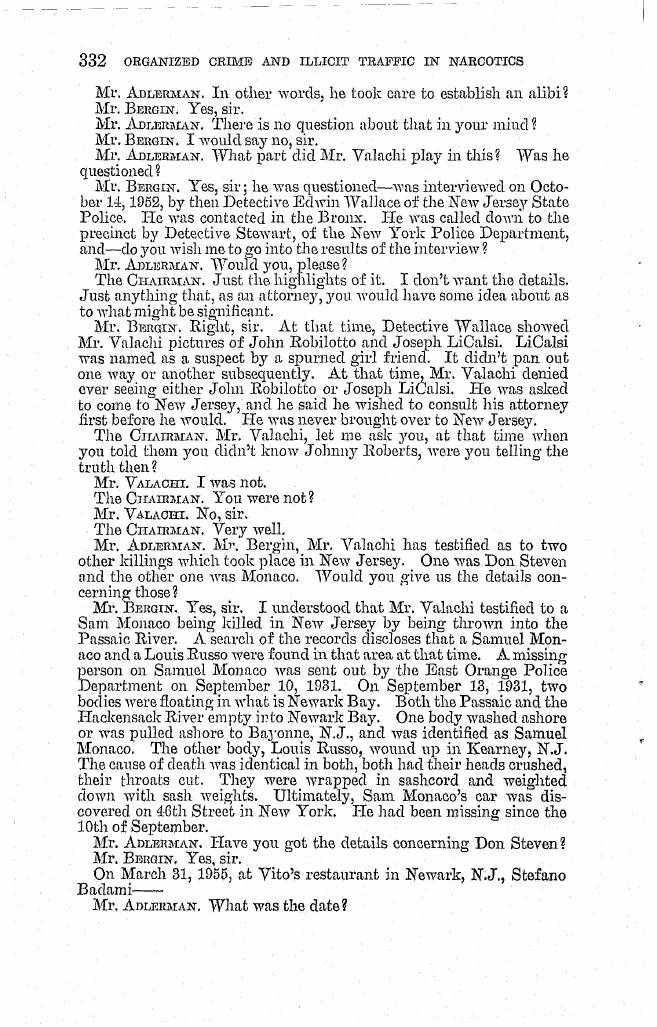
John J. Bergin, New Jersey’s assistant attorney general, testified on October 9 from his state’s records that Samuel Monaco was reported missing by the East Orange police on September 10, 1931, and that on September 13 “two bodies were floating in what is Newark Bay”: Monaco, ashore at Bayonne, and Louis Russo, at Kearny, “their heads crushed, their throats cut,” weighted with sash weights. Monaco’s car was found on 46th Street in New York (pp. 332–333). Valachi had called him “Sam Monica.” Bergin did not say who killed them.
The FBI’s later statements
- An older FBI overview says “The murder of faction leader Joseph Masseria brought an end to the gang warfare” and that Maranzano “was murdered within six months”; the current history page says “less than five months later.” By the police dates the interval is just under five months.
- A 1974 FBI memorandum, dismissing a book sold as Luciano’s memoirs, states that “most of the information gathered to date by the Bureau indicates” that Luciano “created the concept of the La Cosa Nostra ruling Commission in 1931.” It is the Bureau’s 1974 summary, not a record made in 1931.
- A 1965 Legal Attache letter records a source’s claim that Luciano and Genovese “engineered the murder of JOE MASSERIA and later of SALVATORE MARANZANO”; the Bureau called the source’s knowledge “very limited.”
- The FBI identification record of Thomas Lucchese lists the 1930 homicide arrest and its dismissal.
- Two pages from the Bonanno file: a 1964 teletype in which Bill Bonanno, asked about the date of Maranzano’s death, said “must have been around that time” of his father becoming “the boss”; and a 1979 airtel summarizing Joseph Bonanno’s seized handwritten notes on the war. The 1979 notes are memoir drafts, and this archive takes no fact from them.
People
Person pages built from these records: Joseph Masseria, Salvatore Maranzano, Tom Reina, Peter Morello, Joseph Pinzolo, Stephen Ferrigno, Alfred Mineo, Joseph Catania, Joseph Aiello, Samuel Monaco, Ciro Terranova, Gaetano Gagliano, Gaetano Lucchese, Charles Luciano and Joseph Valachi. A role appears on a person page only as a quoted statement with its kind (testimony, counsel’s statement, staff chart, police entry, FBI essay). No name goes on a family chart from these records; the charts on the Five Families pages keep every seat “Not filled.”
Not filed yet
- Newspaper pages of 1930 on the Reina, Morello, Pinzolo, Aiello and Ferrigno–Mineo killings: Chronicling America did not answer during research. The 1931 pages on Masseria and Maranzano are held until their rights are checked, and pages on Catania, Le Pore and the New Jersey bodies have not been found.
- The NYPD files themselves, and Exhibits 9 and 12 (the police records of Lucchese and of “Bobby Doyle”), which the subcommittee took “for reference” and did not print.
- Any court record of these killings. No opinion found recounts them.
- Photographs: no unrestricted photograph of Masseria, Maranzano or the other men killed has been found.
- James Le Pore has no person page: one record names him.