This section files the federal laws that prosecutors used against organized crime, and the court opinions that read them, in the words of the records themselves. Statutes are taken from the printed United States Statutes at Large, as the Library of Congress and govinfo serve it; the amendments from the House Document printing of the Constitution; the Senate resolutions from the printed hearings; and the opinions from CourtListener’s text. Each page quotes the operative words and says what was not read. An agency history page, where one is cited, is labelled as the agency’s account, not the law.
A statute page describes the text as enacted. Many of these sections were later amended, renumbered or construed by the courts; a page notes a later change only where a filed record shows it. Nothing here is legal advice.
Before Prohibition
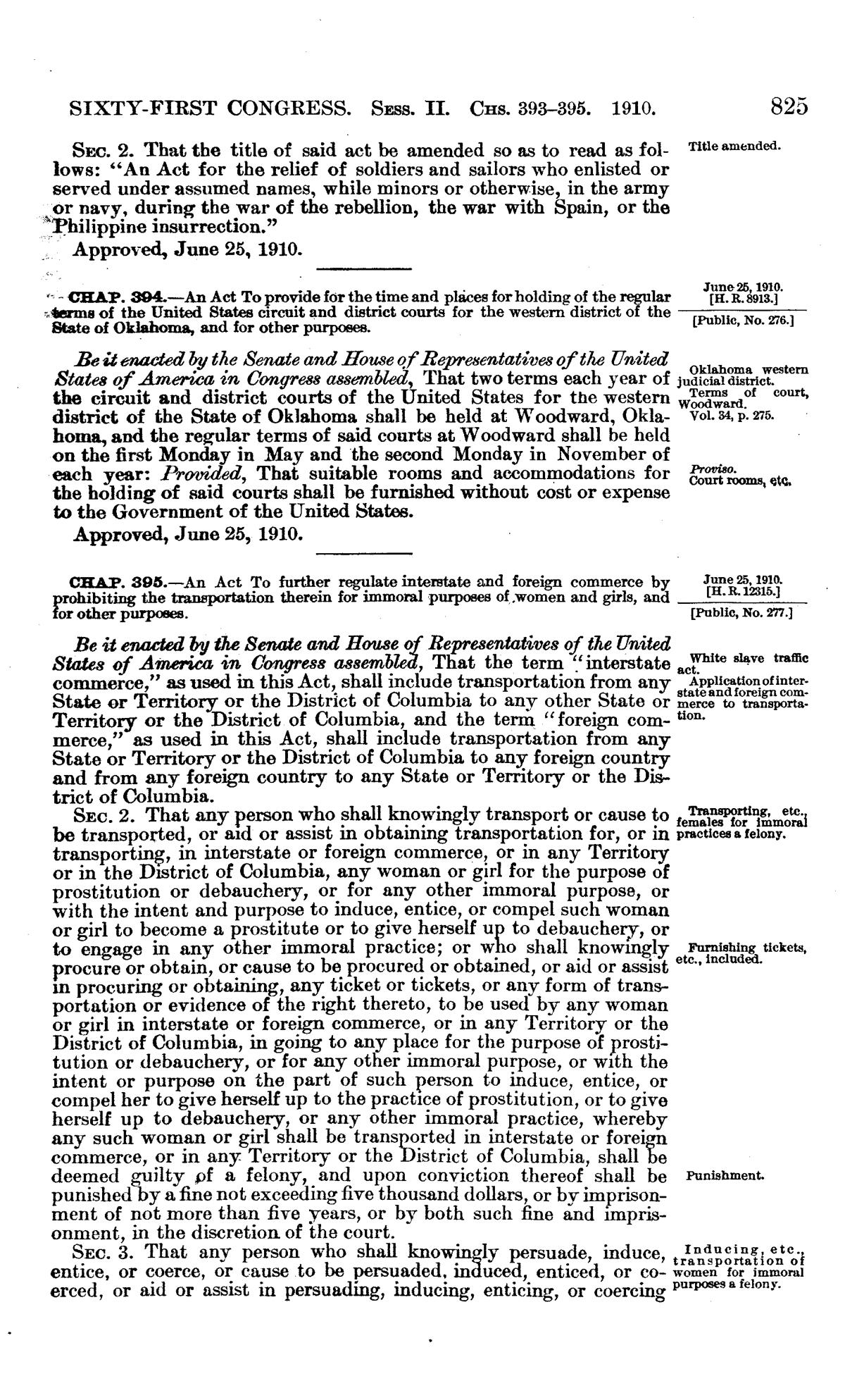
- Mann Act, 1910: 36 Stat. 825, which made it a felony to transport a woman or girl in interstate or foreign commerce for prostitution or any other immoral purpose.
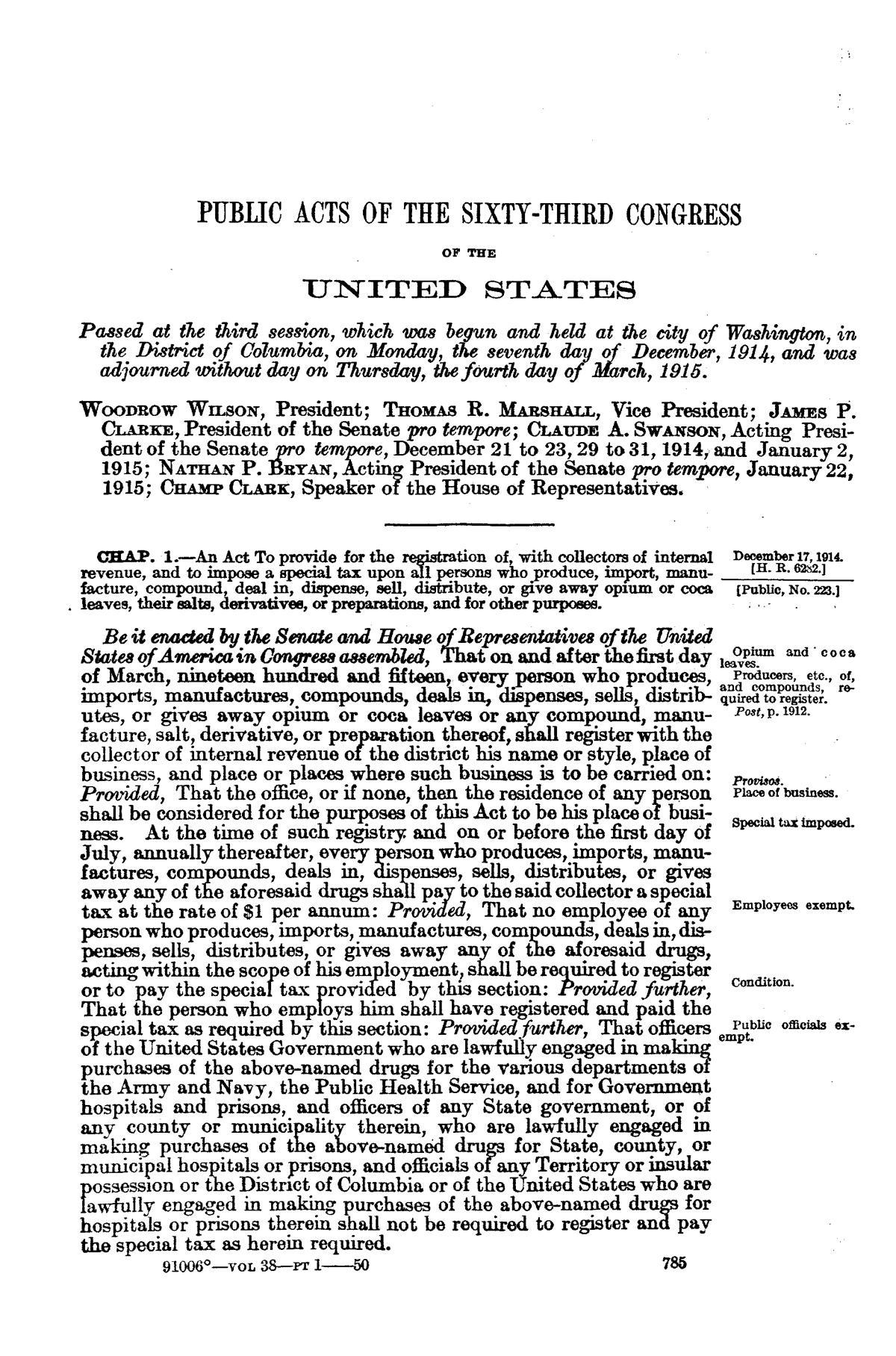
- Harrison Narcotics Act, 1914: 38 Stat. 785, which required everyone dealing in opium or coca leaves to register with the collector of internal revenue and pay a special tax. The Statutes at Large margin gives December 17, 1914; an unopened National Archives snippet gave December 27.
Prohibition, 1919 to 1933
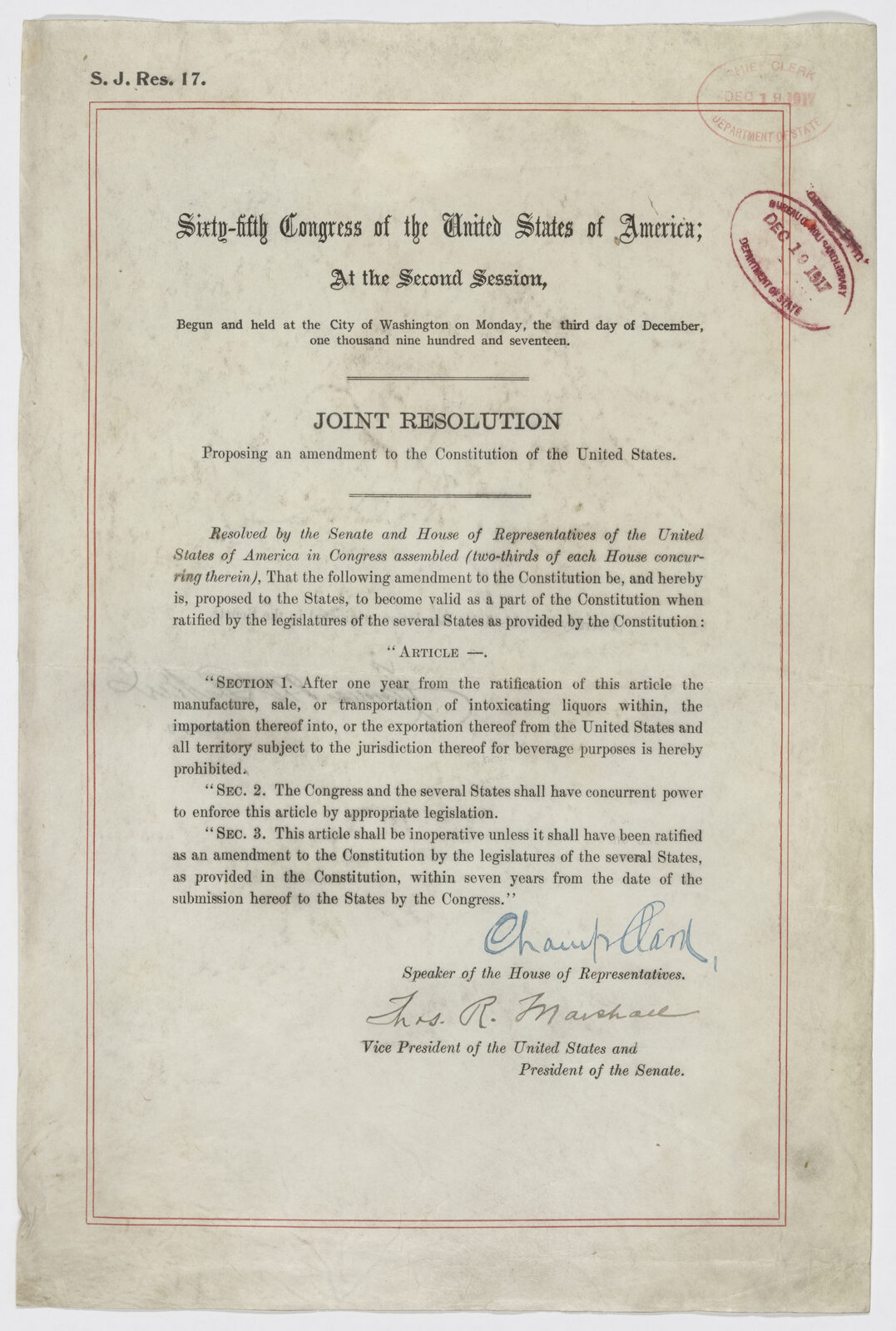
- Eighteenth Amendment: the constitutional ban on the manufacture, sale or transportation of intoxicating liquors for beverage purposes, ratified in January 1919. ATF’s timeline and the House Document give different ratification dates; the page sets both out.
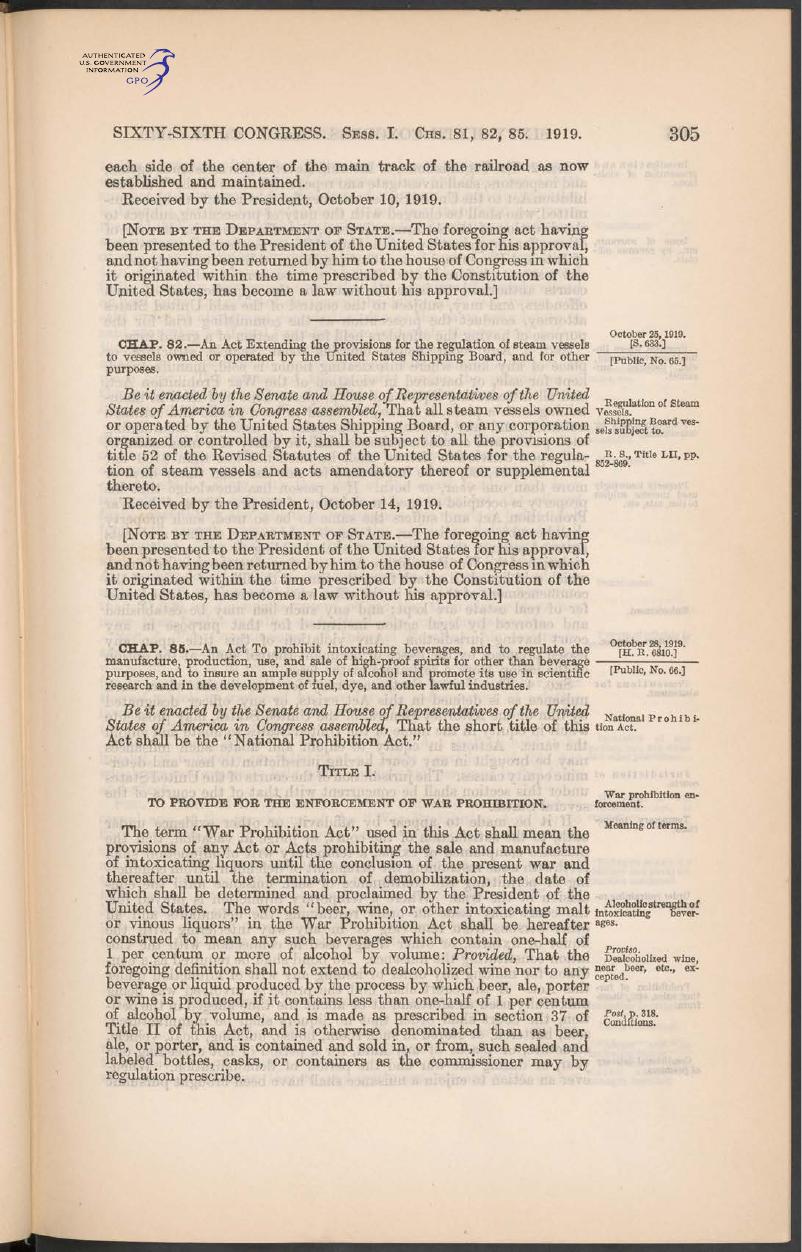
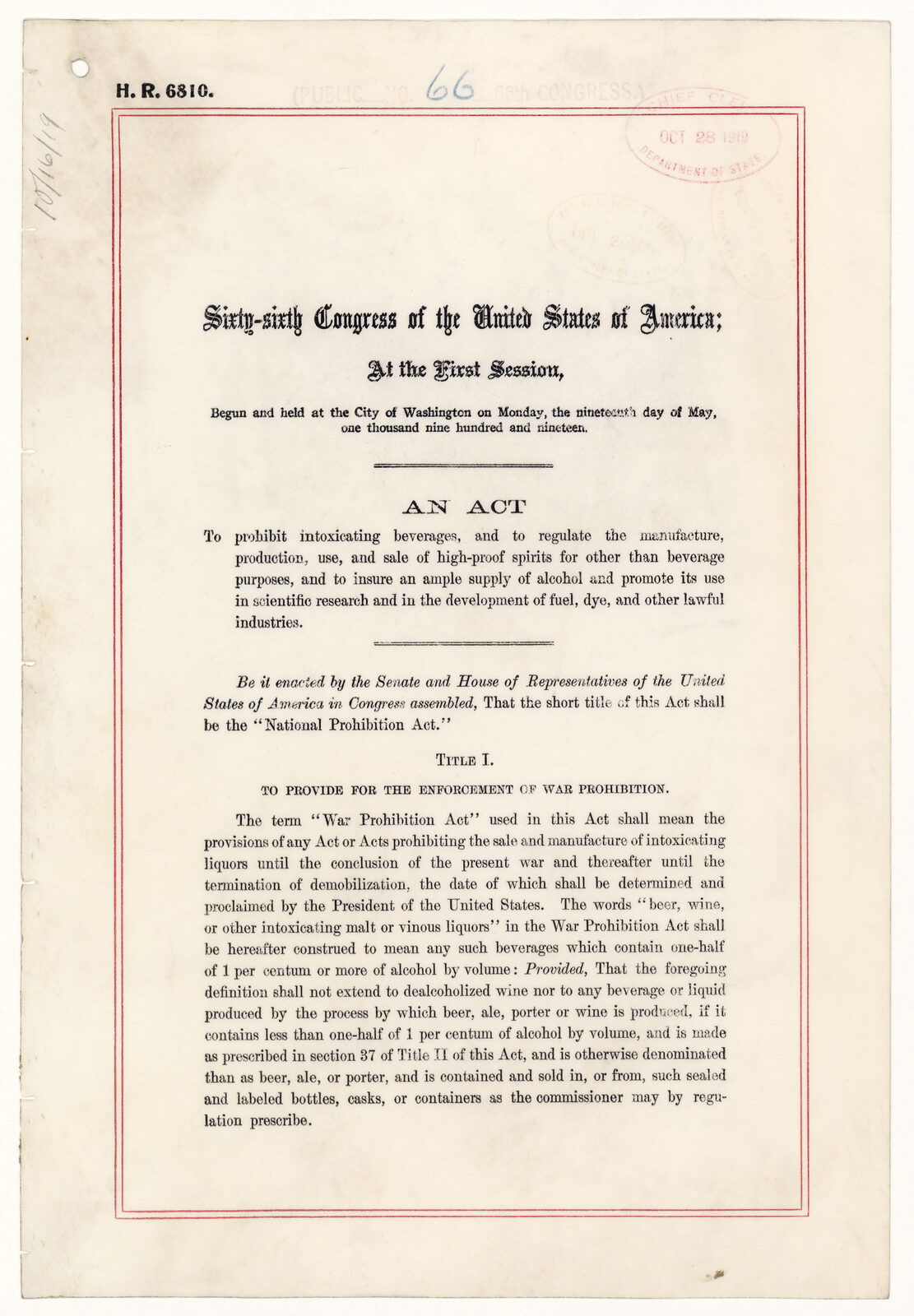
- The National Prohibition Act of October 28, 1919 (41 Stat. 305), the enrolled original of that Act, the joint resolution proposing the Eighteenth Amendment, and the Supreme Court’s Prohibition-era decisions in Carroll v. United States (1925, warrantless search of an automobile on probable cause) and Olmstead v. United States (1928, wiretapping held not a search) are filed in the Prohibition section and appear among the records below.
- Twenty-first Amendment: the 1933 repeal of the Eighteenth Amendment, which left the States power to bar liquor imported in violation of their laws.
The 1930s
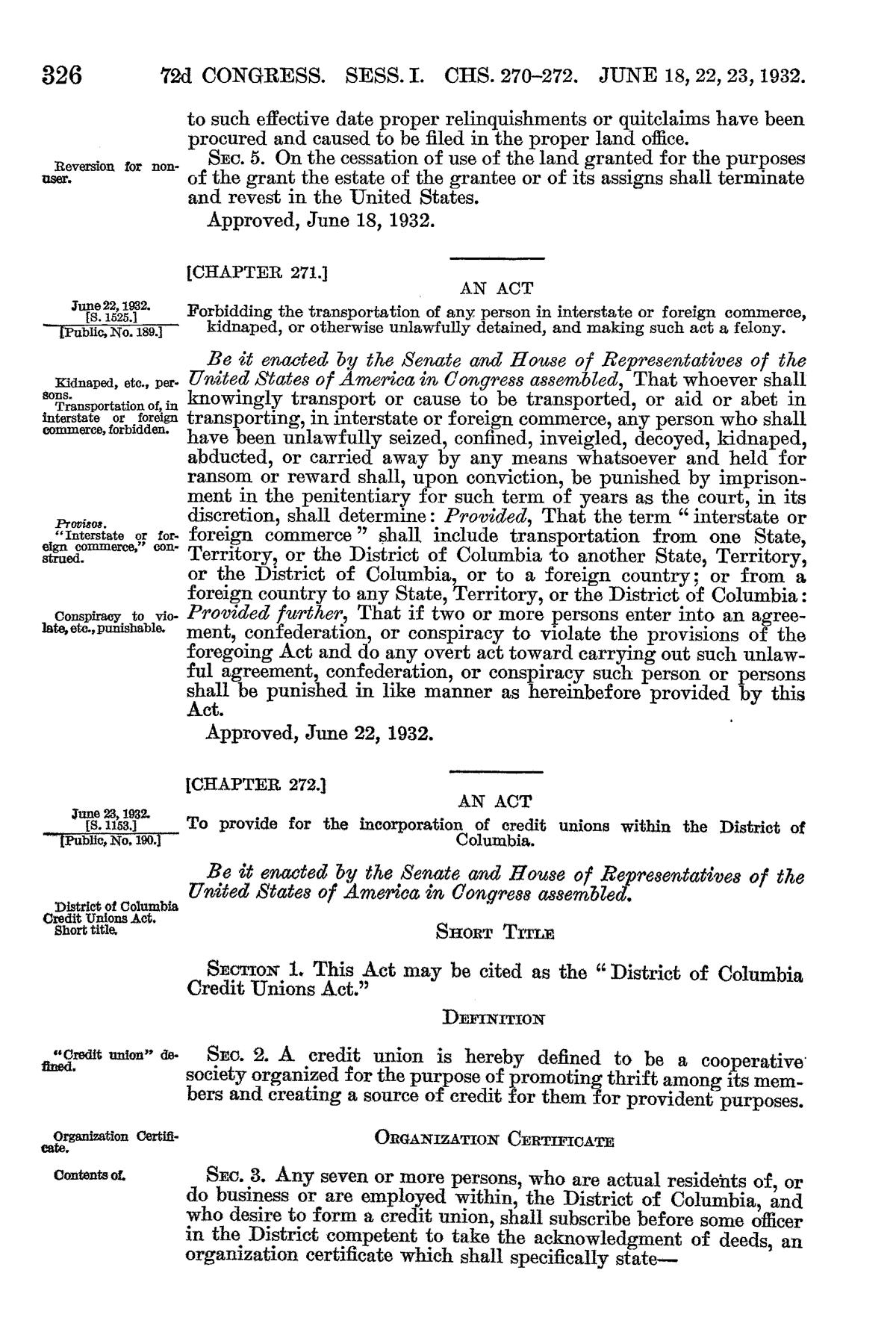
- Federal Kidnapping Act, 1932: 47 Stat. 326, which made it a felony to transport a kidnaped person held for ransom across state lines.
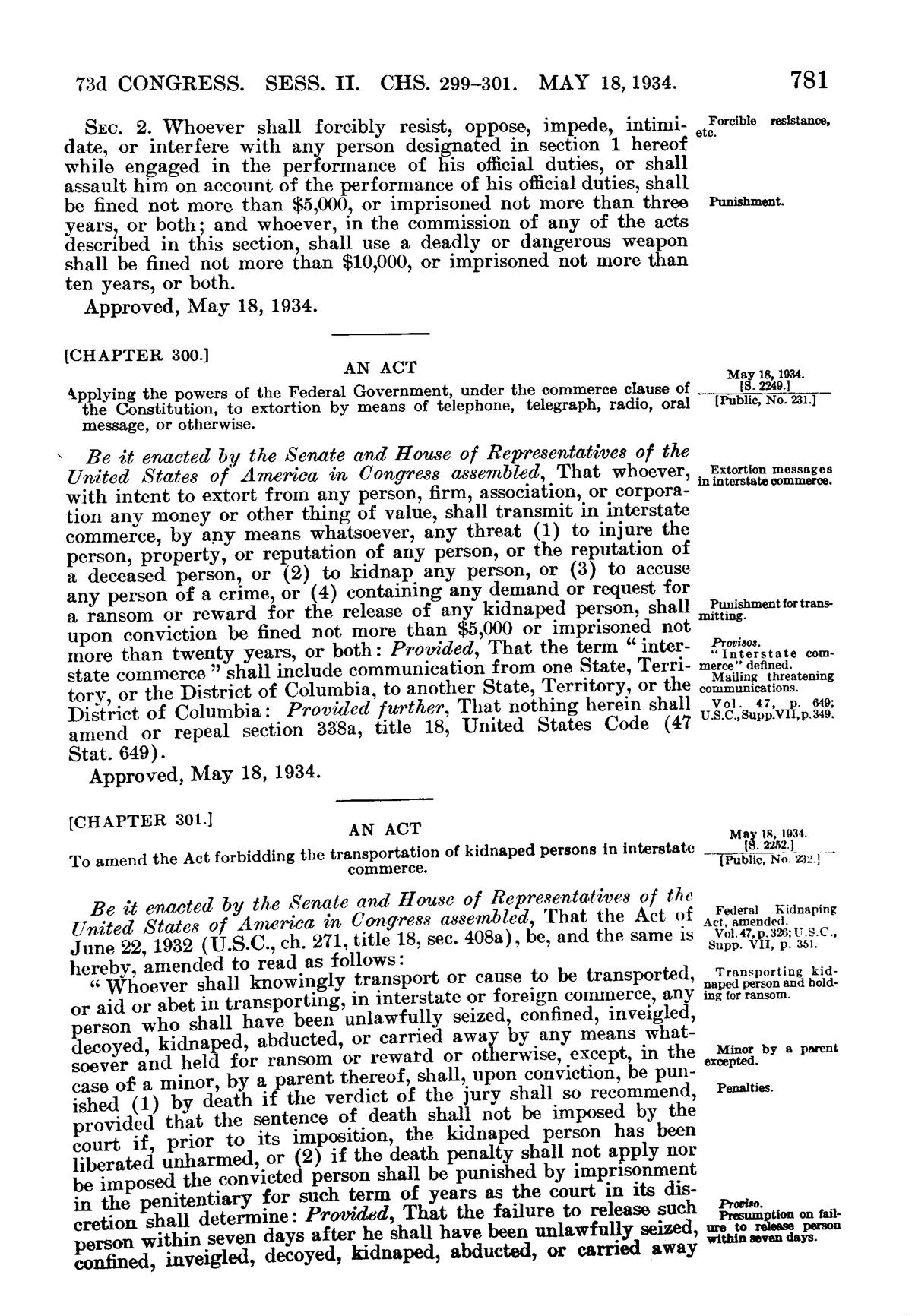
- Kidnapping Act amendment, May 18, 1934: 48 Stat. 781, which allowed a death sentence on the jury’s recommendation unless the victim was released unharmed.
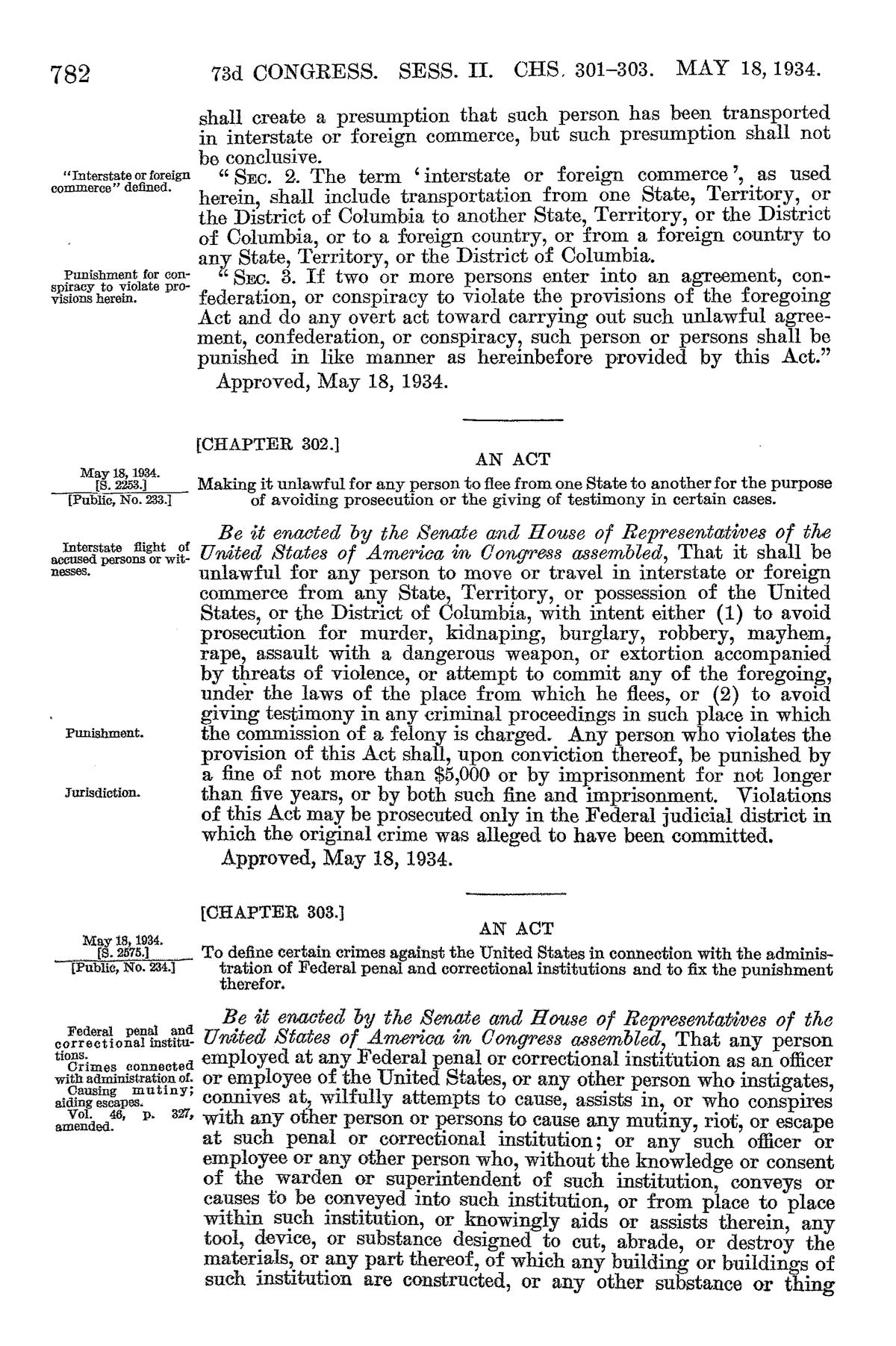
- Fugitive Felon Act, May 18, 1934: 48 Stat. 782, which made it a crime to cross state lines to avoid prosecution for listed violent crimes, extortion included, or to avoid testifying in a felony case.
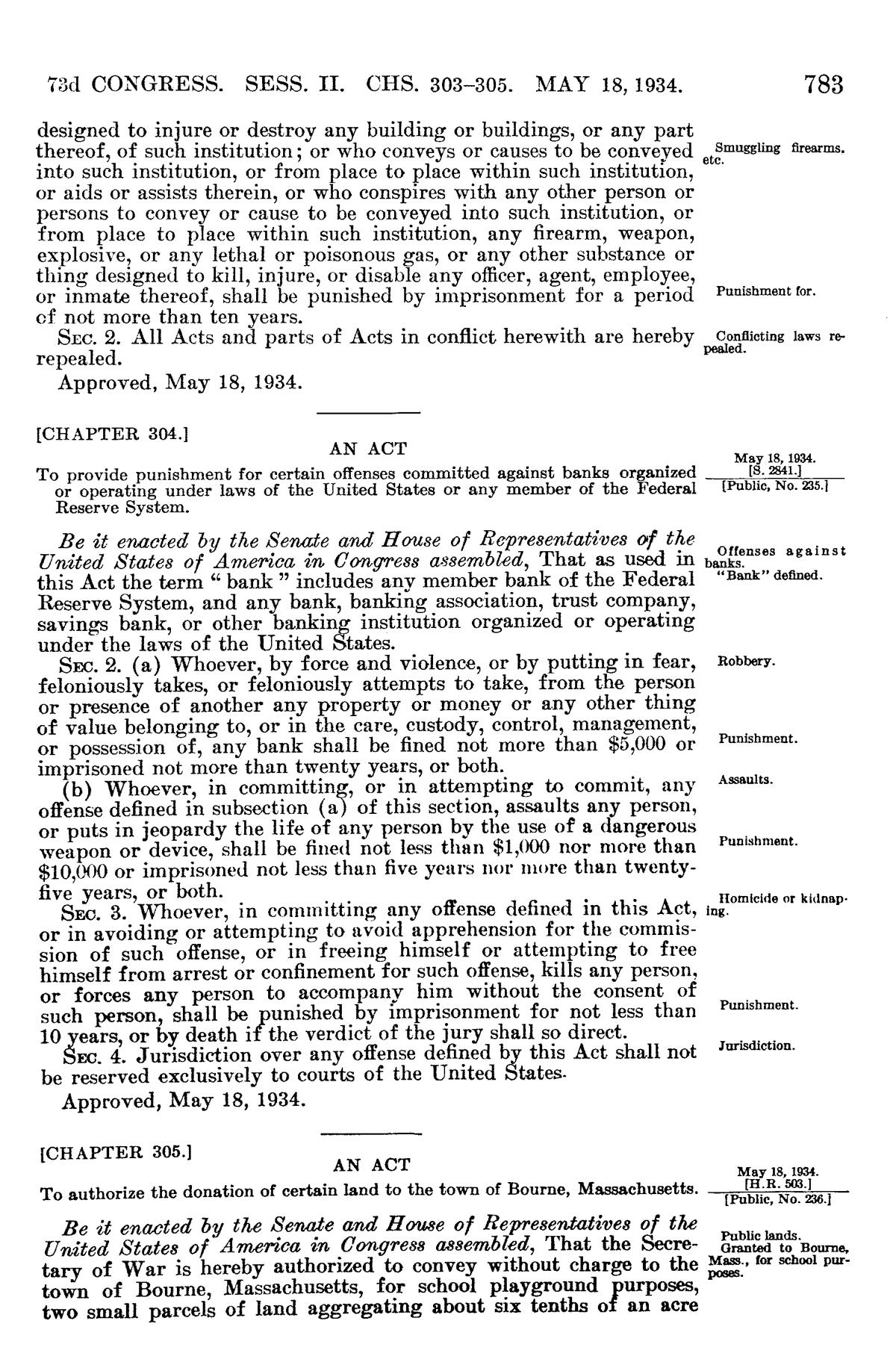
- Bank Robbery Act, May 18, 1934: 48 Stat. 783, which made robbery of a national or Federal Reserve member bank a federal offense.
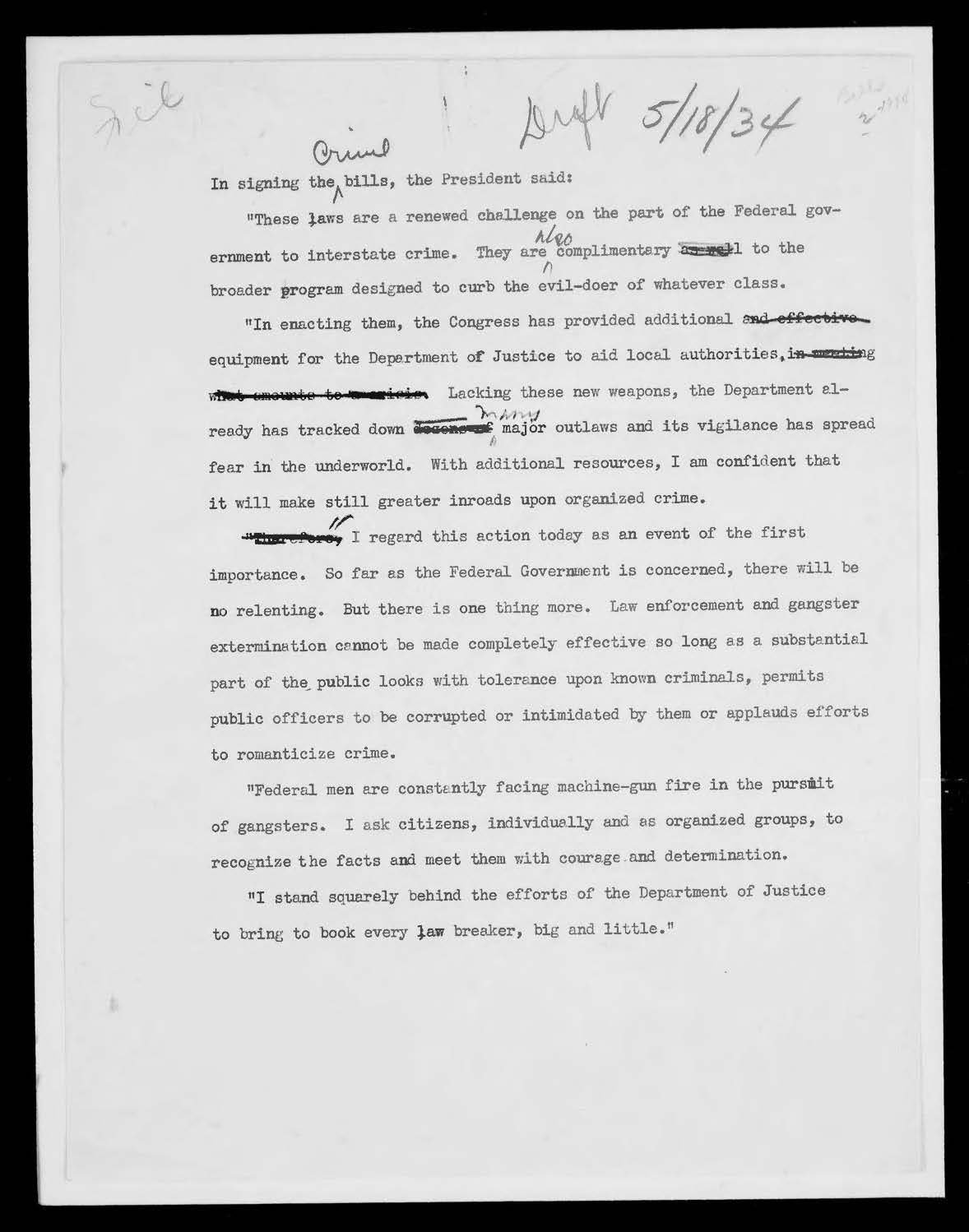
- President Roosevelt’s statement on signing the crime bills: the May 18, 1934 statement held by the Roosevelt Library.
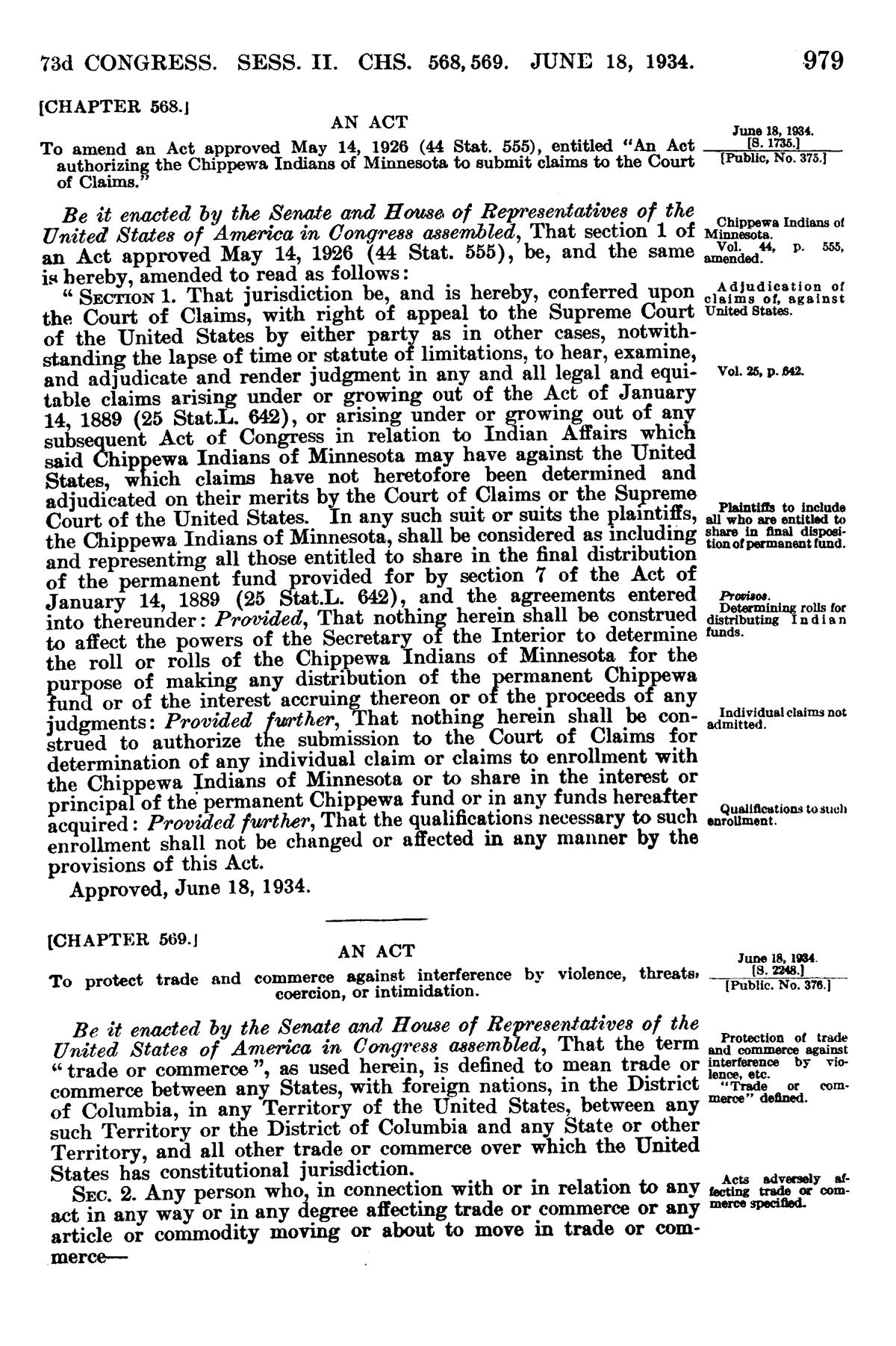
- Anti-Racketeering Act, June 18, 1934: 48 Stat. 979, which made it a felony to obtain money or property in connection with trade or commerce by force, violence or coercion, with a proviso protecting bona fide labor organizations.
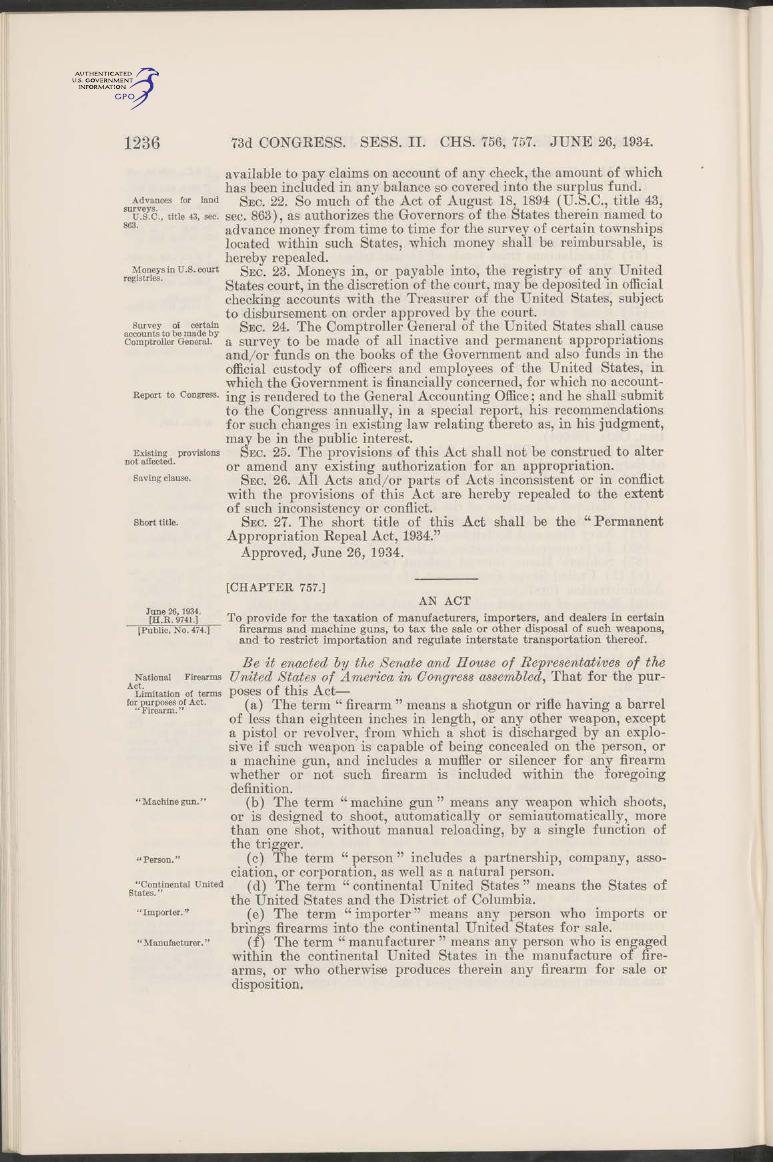
- National Firearms Act, June 26, 1934: 48 Stat. 1236, the tax and registration statute for machine guns, short-barreled guns and silencers, filed earlier from govinfo. ATF’s page on the Act records that the Supreme Court’s 1968 Haynes decision “made the 1934 Act virtually unenforceable” and that Title II of the Gun Control Act of 1968 amended it; neither later record is filed here.
- Nardone v. United States, 1937: 302 U.S. 379, holding that section 605 of the Communications Act of 1934 barred federal agents from testifying to wiretapped telephone messages.
The Hobbs Act and the gambling and tax laws, 1946 to 1957
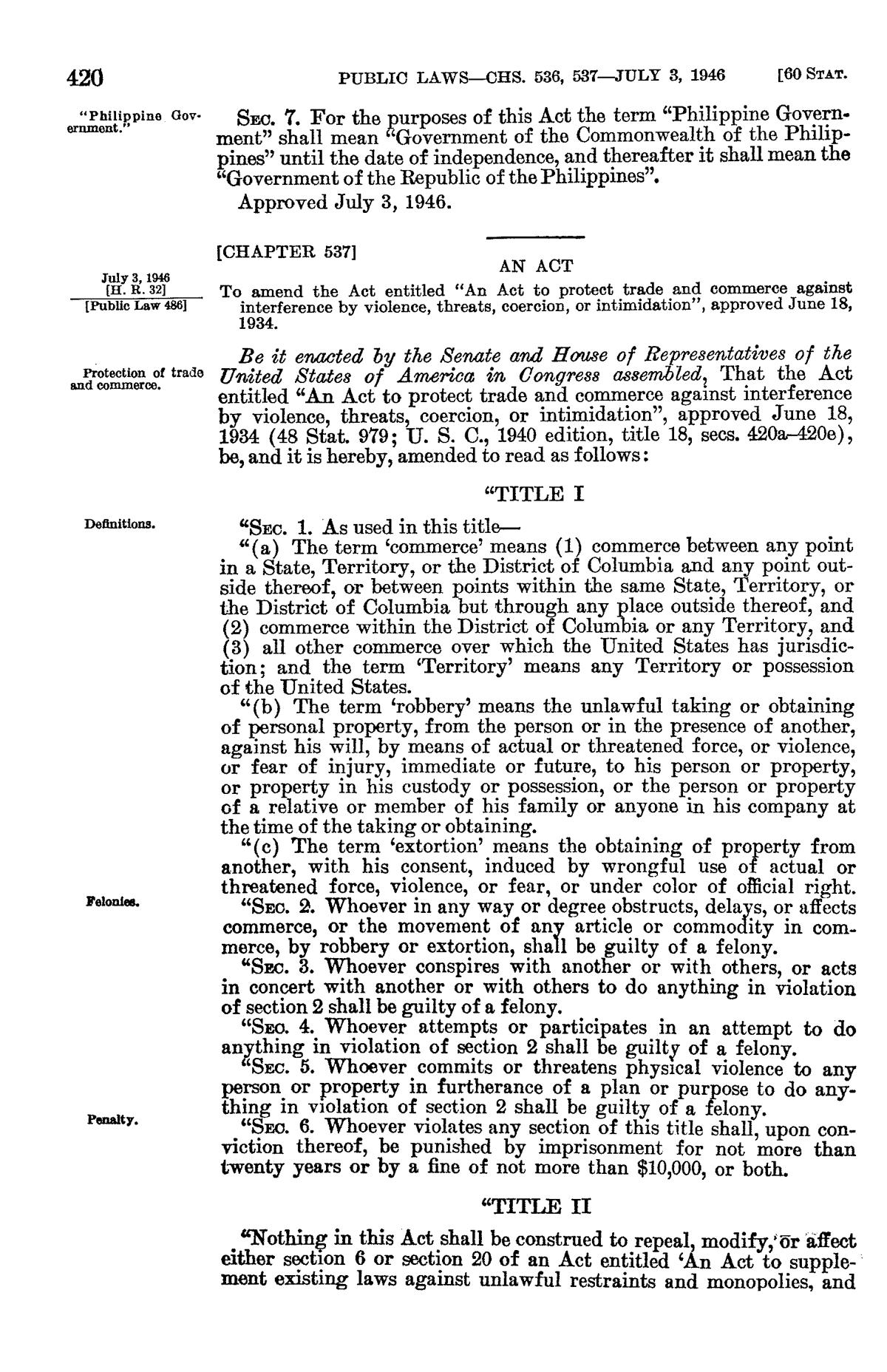
- Hobbs Act, 1946: 60 Stat. 420, which rewrote the 1934 Act to make it a felony to obstruct, delay or affect commerce by robbery or extortion.
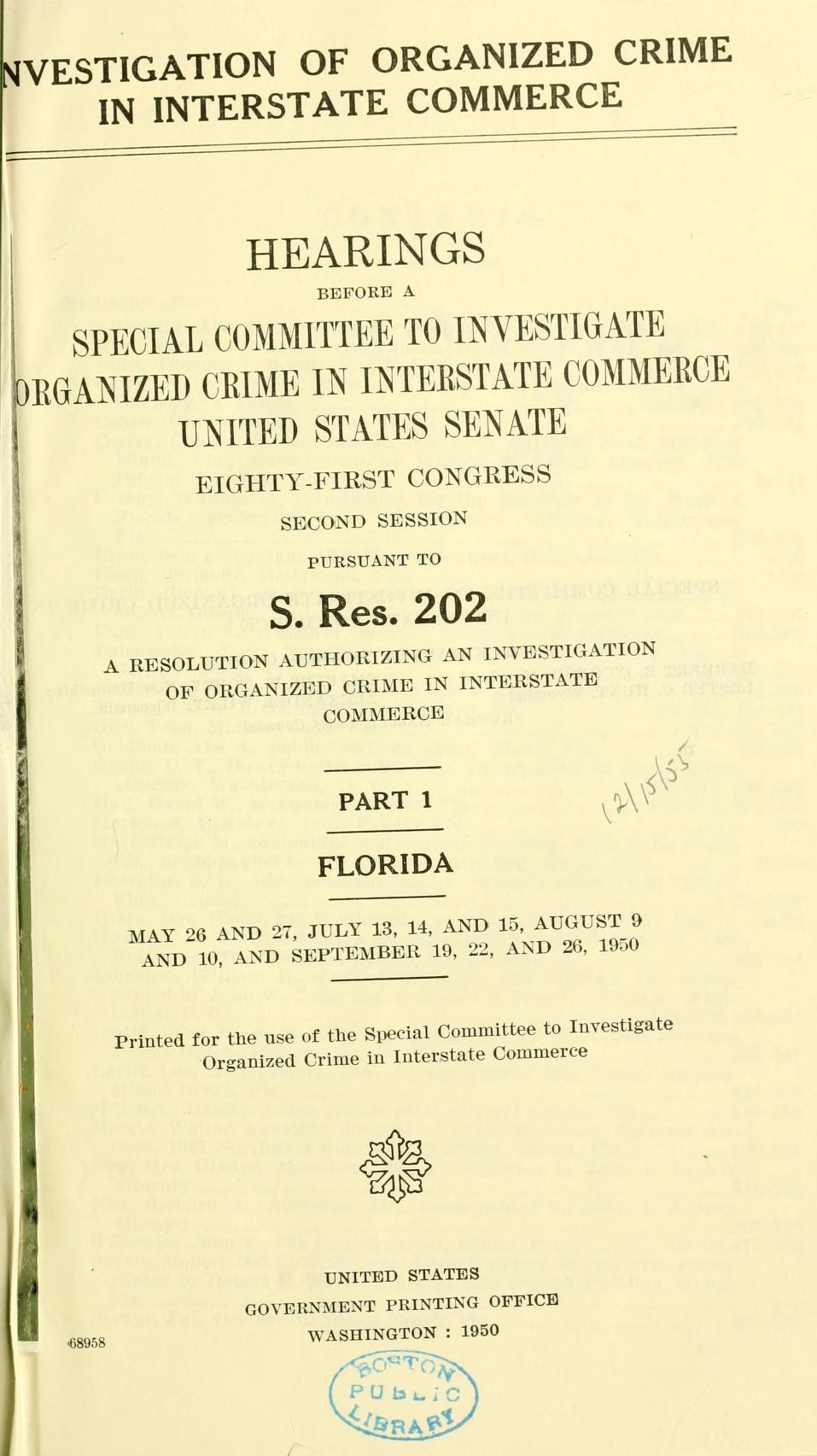
- Kefauver Committee hearings, Part 1: the printed Florida hearings of 1950, in which the chairman reads Senate Resolution 202 into the record at page 135: the committee was to “make a full and complete study and investigation of whether organized crime utilizes the facilities of interstate commerce”. The Senate’s own pages date the resolution May 2 and May 3, 1950.
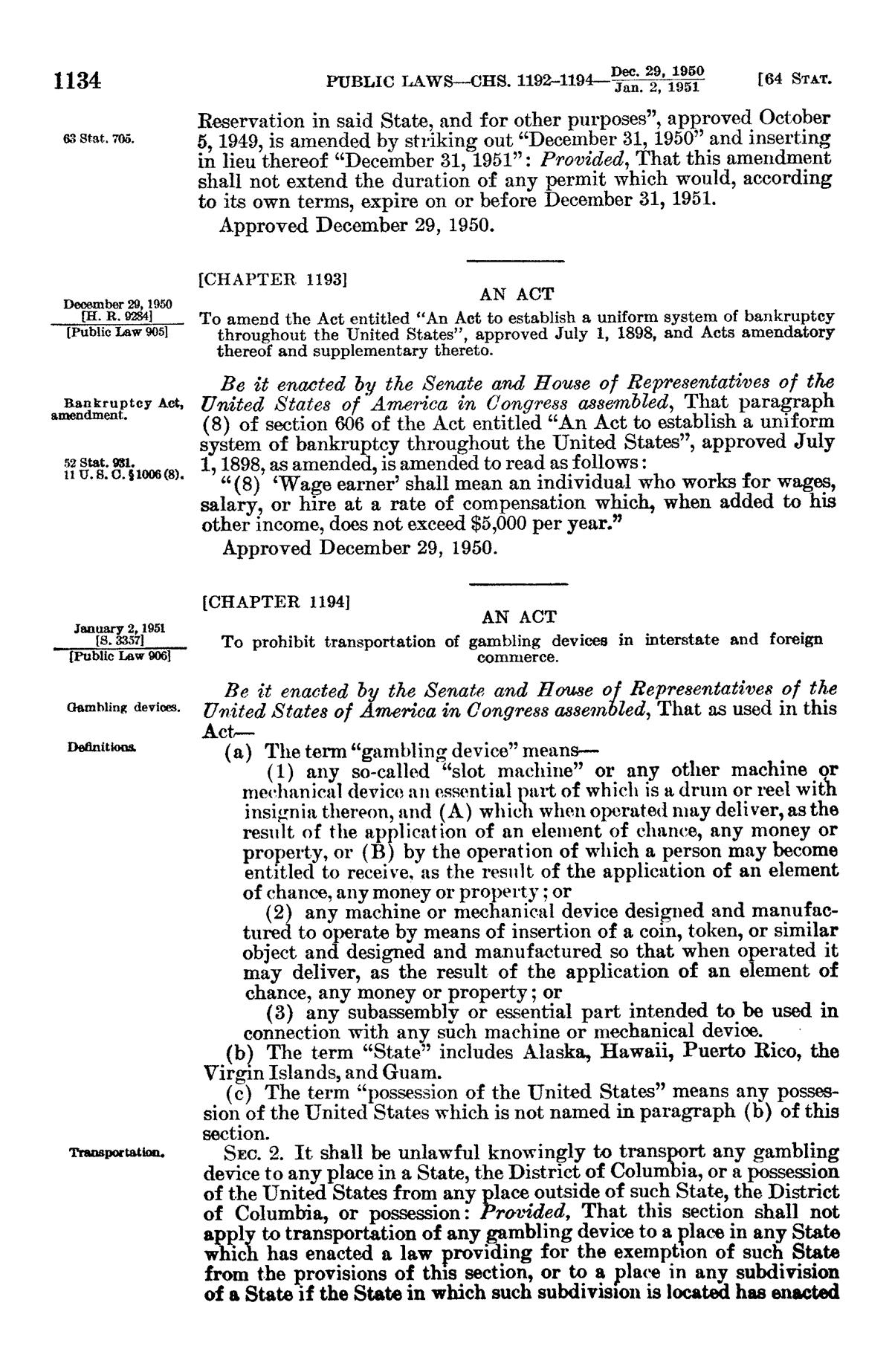
- Johnson Act, January 2, 1951: 64 Stat. 1134, which barred knowingly shipping gambling devices into a State that had not exempted itself and required makers and dealers to register.
- Wagering taxes, Revenue Act of 1951: 65 Stat. 529, a 10 percent excise tax on wagers, including the numbers game and policy, and a $50 special tax with registration. The Supreme Court limited criminal enforcement of these taxes in 1968 (Marchetti and Grosso, below).
- Senate Resolution 74, McClellan Committee, 1957: the resolution of January 30, 1957 creating the Select Committee on Improper Activities in the Labor or Management Field, as the chairman stated it at the first hearing. The chairman elided part of the text; the full resolution was not opened.
The 1960s
- Wire Act, September 13, 1961: 75 Stat. 491, adding 18 U.S.C. 1084 against using wire facilities to transmit bets or wagering information across state lines. The research record notes that its reach beyond sports wagering has been contested in Justice Department legal opinions, none of which was opened here.
- Travel Act, September 13, 1961: 75 Stat. 498, adding 18 U.S.C. 1952 against interstate travel or use of the mail and other interstate facilities to carry on gambling, untaxed liquor, narcotics, prostitution, extortion or bribery businesses.
- Berger v. New York, 1967: 388 U.S. 41, holding New York’s eavesdrop statute too broad under the Fourth and Fourteenth Amendments.
- Katz v. United States, 1967: 389 U.S. 347, holding that FBI recording of a gambler’s calls from a telephone booth was a search, and that the trespass doctrine of Olmstead “can no longer be regarded as controlling”.
- Marchetti v. United States, 1968: 390 U.S. 39, holding that a proper claim of the privilege against self-incrimination defeats prosecution for failing to register and pay the wagering occupational tax.
- Grosso v. United States, 1968: 390 U.S. 62, the companion case on the excise tax on wagers. The dissent says the decisions overrule United States v. Kahriger; the Court’s own holding is narrower.
- Title III of the Omnibus Crime Control and Safe Streets Act, 1968: 82 Stat. 211, which banned private wiretapping and set up court-ordered interception for listed offenses, and which rewrote the section of the Communications Act at issue in Nardone.
1970 and RICO
- Organized Crime Control Act of 1970: 84 Stat. 922, Public Law 91-452 of October 15, 1970, with titles on grand juries, witness immunity, recalcitrant witnesses, witness housing, syndicated gambling, RICO, dangerous special offenders and explosives.
- Title V, protected facilities for government witnesses: 84 Stat. 933, the Attorney General’s authority to protect witnesses and their families, which the U.S. Marshals Service says the Comprehensive Crime Control Act of 1984 amended.
- Title VIII, illegal gambling business: 84 Stat. 937, adding 18 U.S.C. 1955 against gambling businesses of five or more persons that violate state law.
- Title IX, Racketeer Influenced and Corrupt Organizations: 84 Stat. 941, the RICO chapter, 18 U.S.C. 1961 to 1968. Its 1970 forfeiture section was rewritten in 1984.
- Bank Secrecy Act, October 26, 1970: 84 Stat. 1114, Public Law 91-508, on bank recordkeeping and currency reporting.
- Continuing Criminal Enterprise, October 27, 1970: 84 Stat. 1265, section 408 of the Controlled Substances Act, Public Law 91-513. It is a separate Act from the Organized Crime Control Act.
Later laws and opinions
- United States v. Turkette, 1981: 452 U.S. 576, holding that a RICO enterprise may be wholly illegitimate.
- Russello v. United States, 1983: 464 U.S. 16, holding that RICO forfeiture under the 1970 text reached racketeering proceeds.
- Comprehensive Crime Control Act of 1984: Title II of Public Law 98-473, whose Comprehensive Forfeiture Act rewrote RICO’s forfeiture section.
- Sedima v. Imrex, 1985: 473 U.S. 479, holding that a civil RICO plaintiff needs neither a prior conviction nor a separate “racketeering injury”.
- Money Laundering Control Act of 1986: 100 Stat. 3207-18, adding 18 U.S.C. 1956.
- H.J. Inc. v. Northwestern Bell, 1989: 492 U.S. 229, on the “continuity plus relationship” meaning of a RICO pattern, which the Court held is not limited to organized crime.
- Salinas v. United States, 1997: 522 U.S. 52, holding that a RICO conspirator need not agree to commit two predicate acts himself.
Opinions filed in other sections
The Supreme Court’s decision in United States v. Salerno, 481 U.S. 739 (1987), upholding pretrial detention for dangerousness under the Bail Reform Act of 1984, and its decisions in Costello v. United States, 350 U.S. 359 (1956, an indictment resting on hearsay before the grand jury) and 365 U.S. 265 (1961, revocation of naturalization), are filed with the Five Families records. Marcello v. Bonds, 349 U.S. 302 (1955), on the deportation order against Carlos Marcello, is filed with the New Orleans records. They appear among the records below.
The Supreme Court and circuit opinions construing the gambling-device, wagering-tax and travel statutes (Kahriger, Five Gambling Devices, Lewis, Sagansky, Martin, Rewis), with the wire-company cases, are filed on the Gambling and the wire page.