This is a side section, and it is not about organized crime. The people in it were bank robbers, kidnappers and escaped prisoners whom the federal Bureau of Investigation pursued as fugitives in 1933 to 1936; the records here call it the Bureau of Investigation, the Division of Investigation and, by 1936, the Federal Bureau of Investigation. No record filed here places any of them in a Mafia family or in the Chicago Outfit, and no family chart on this site draws on these pages. The two exceptions in the list, the Flegenheimer tax notices and the Gebardi case, are organized-crime records and are marked as such. The rest are shown here because their wanted notices, court files and prison records sit beside the organized-crime records in the same archives: the same FBI Vault, the same district-court series at the National Archives, the same Alcatraz notebooks.
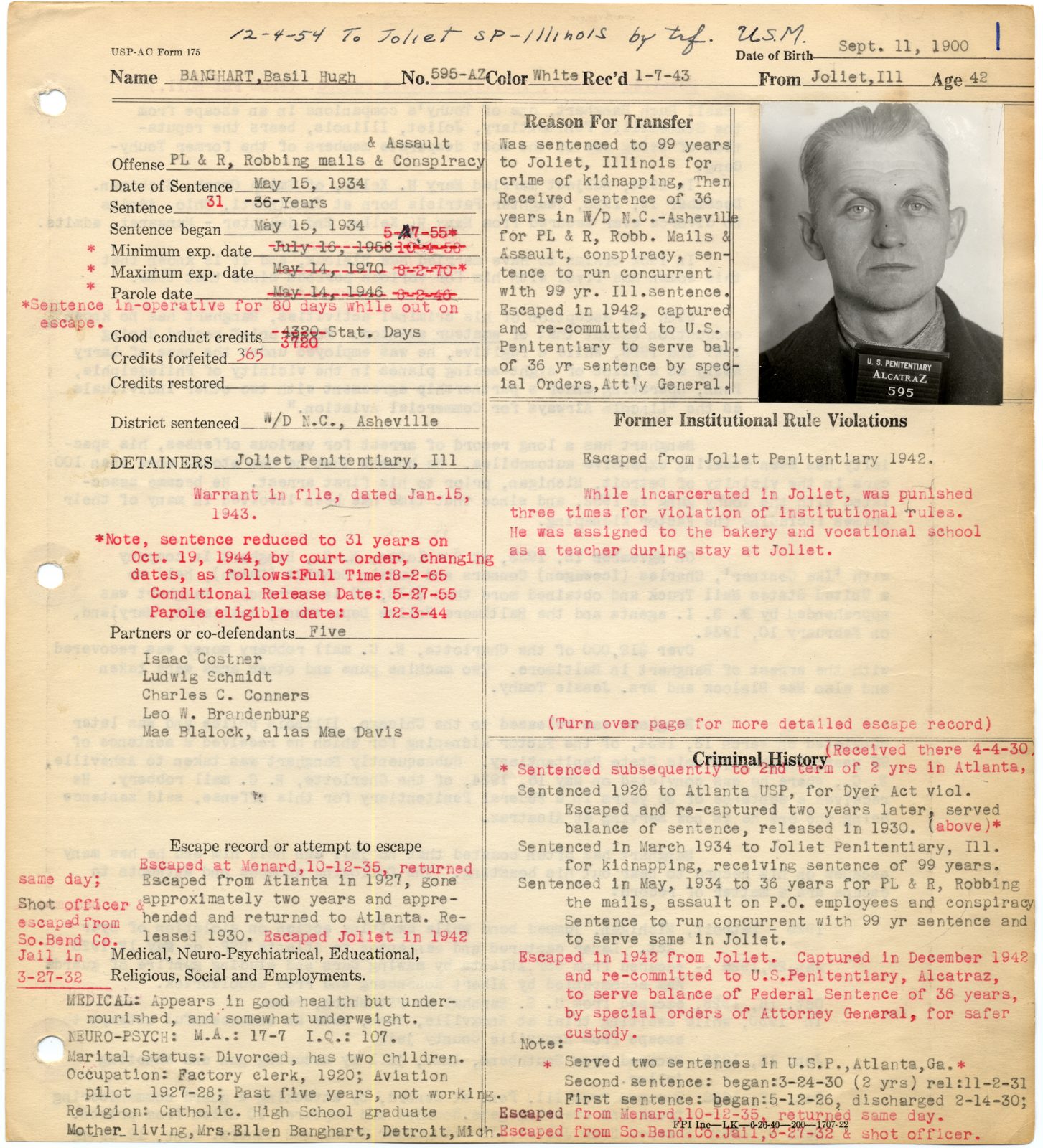
Each tile links to one record. A charge printed on a wanted notice is the Bureau’s allegation as of the date of the notice, not a finding; a conviction is stated only where a court record or a prison record filed here states it. Shootings are described in the words of the record that reports them. Where the FBI’s later history pages and the contemporary records disagree on a date, both are given. The people in these records have their own pages: John Dillinger, Bonnie Parker, Clyde Barrow, Charles Arthur Floyd, Frank Nash, Lester Gillis, John Paul Chase, George Kelly, Albert Bates, Harvey Bailey, Arthur Barker, Alvin Karpis, William Daniel Jones, Roger Touhy and Basil Banghart.
The Identification Orders
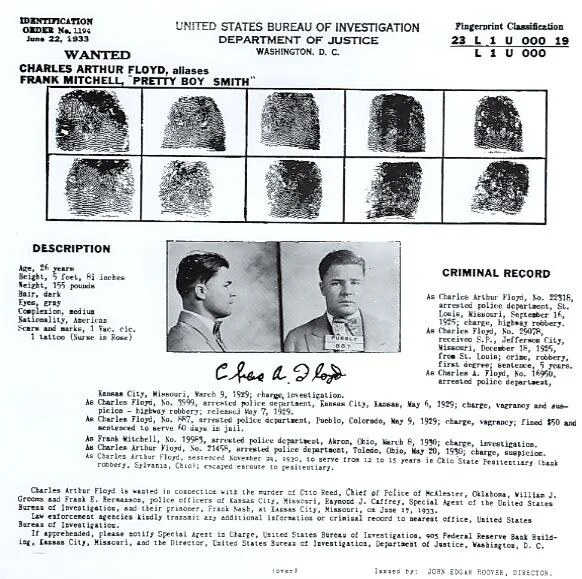
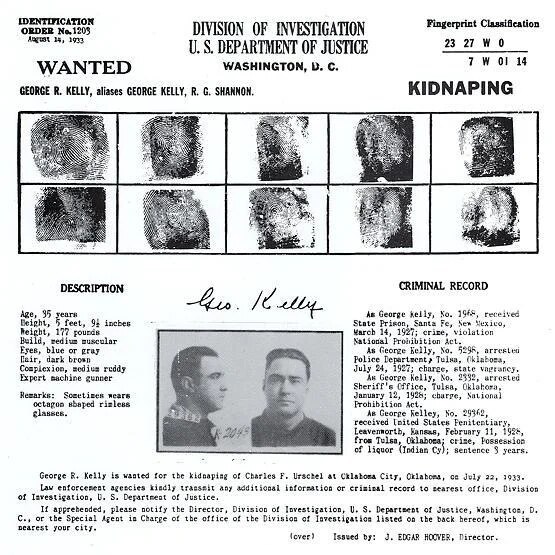
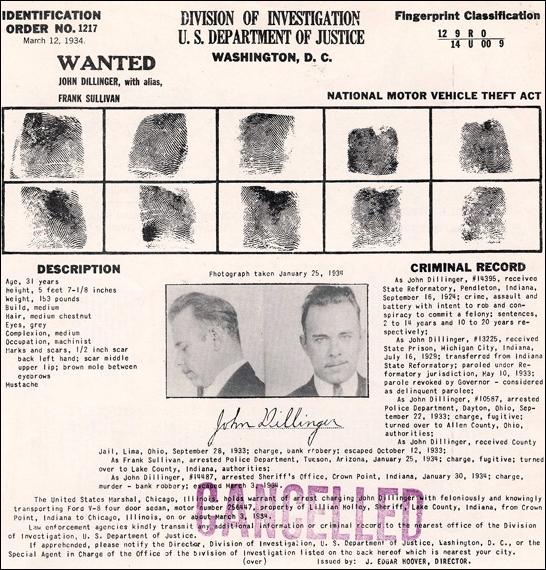
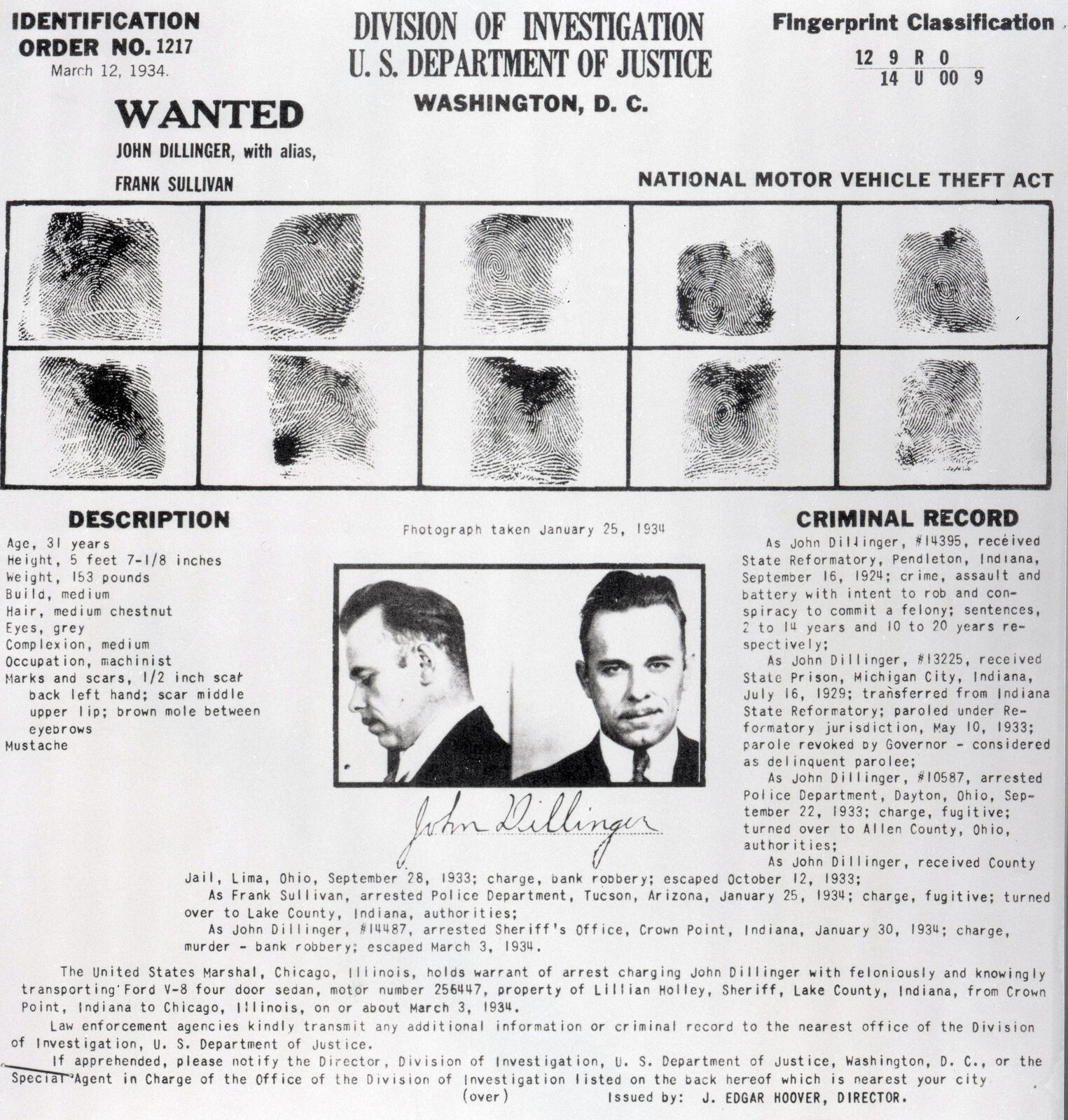
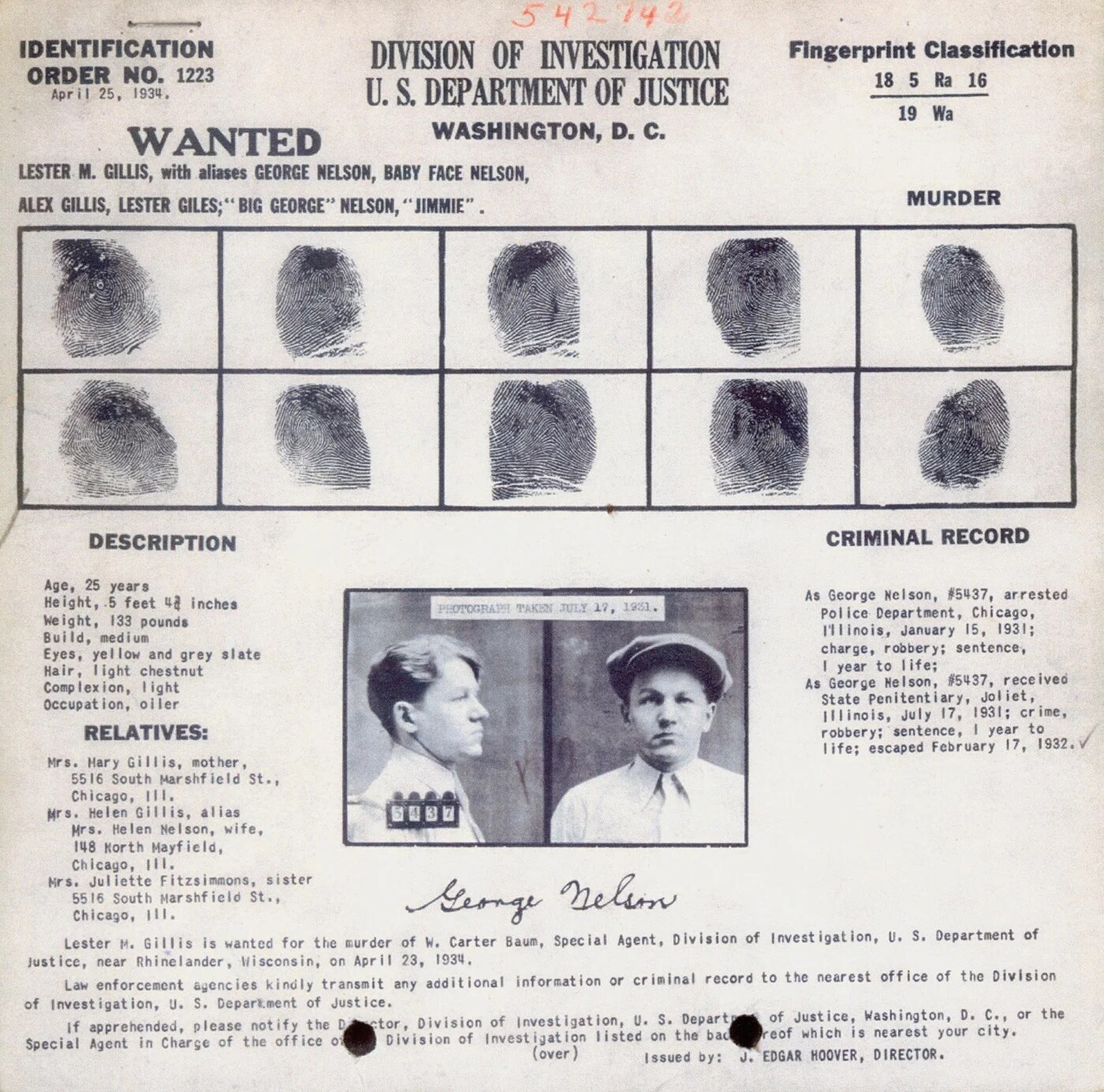
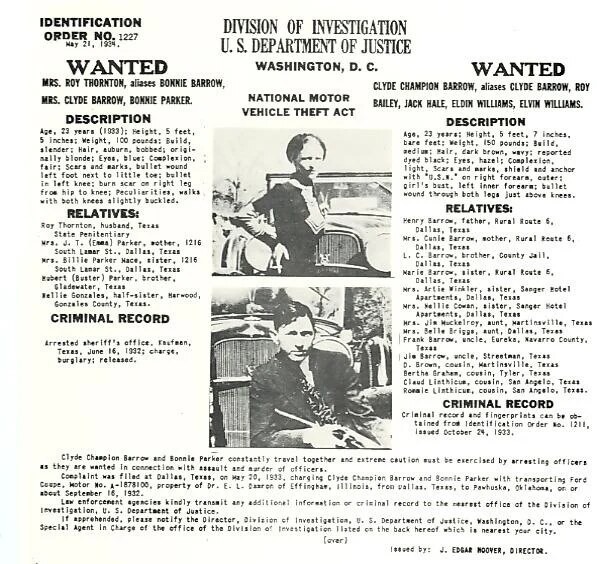
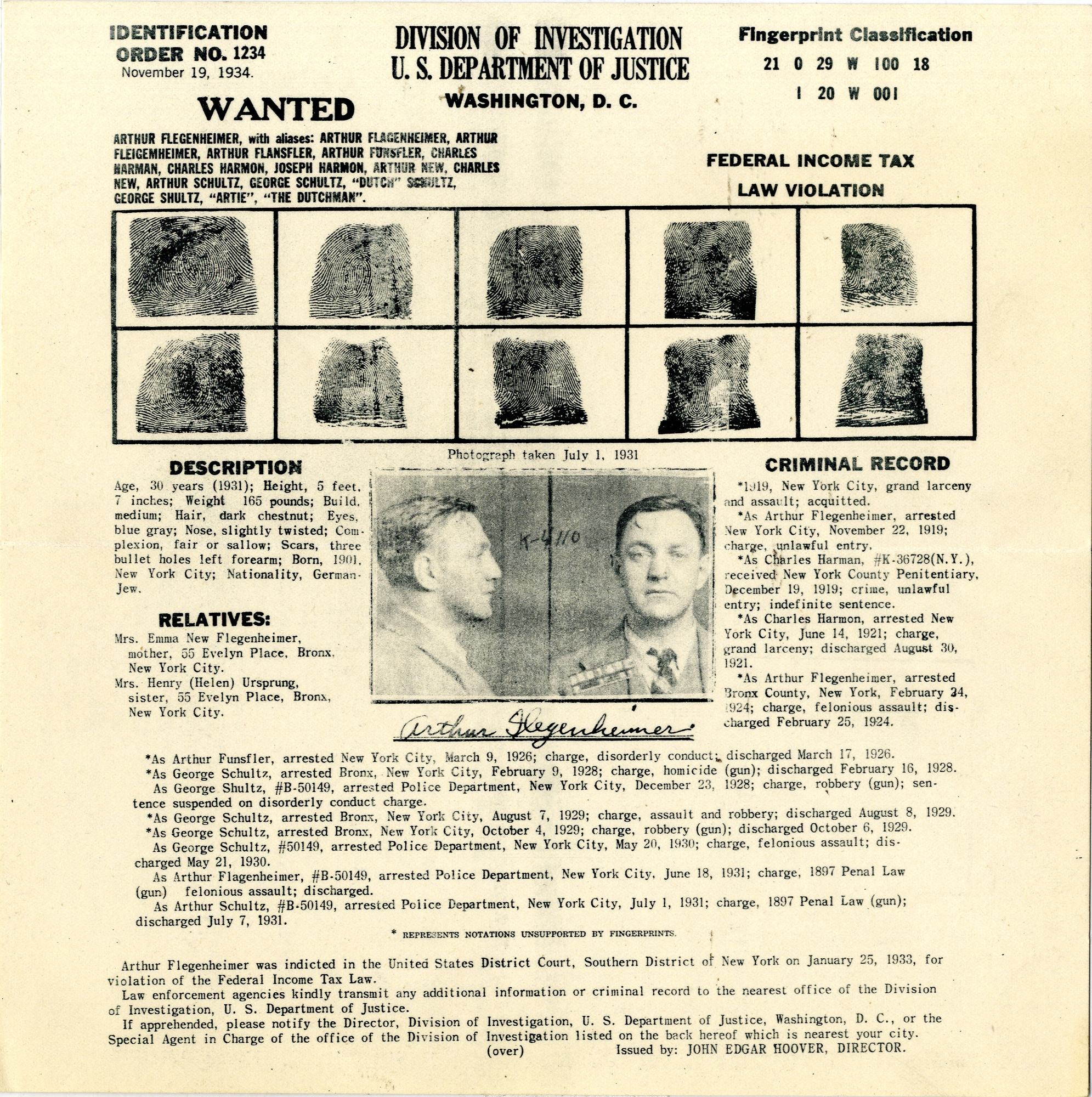
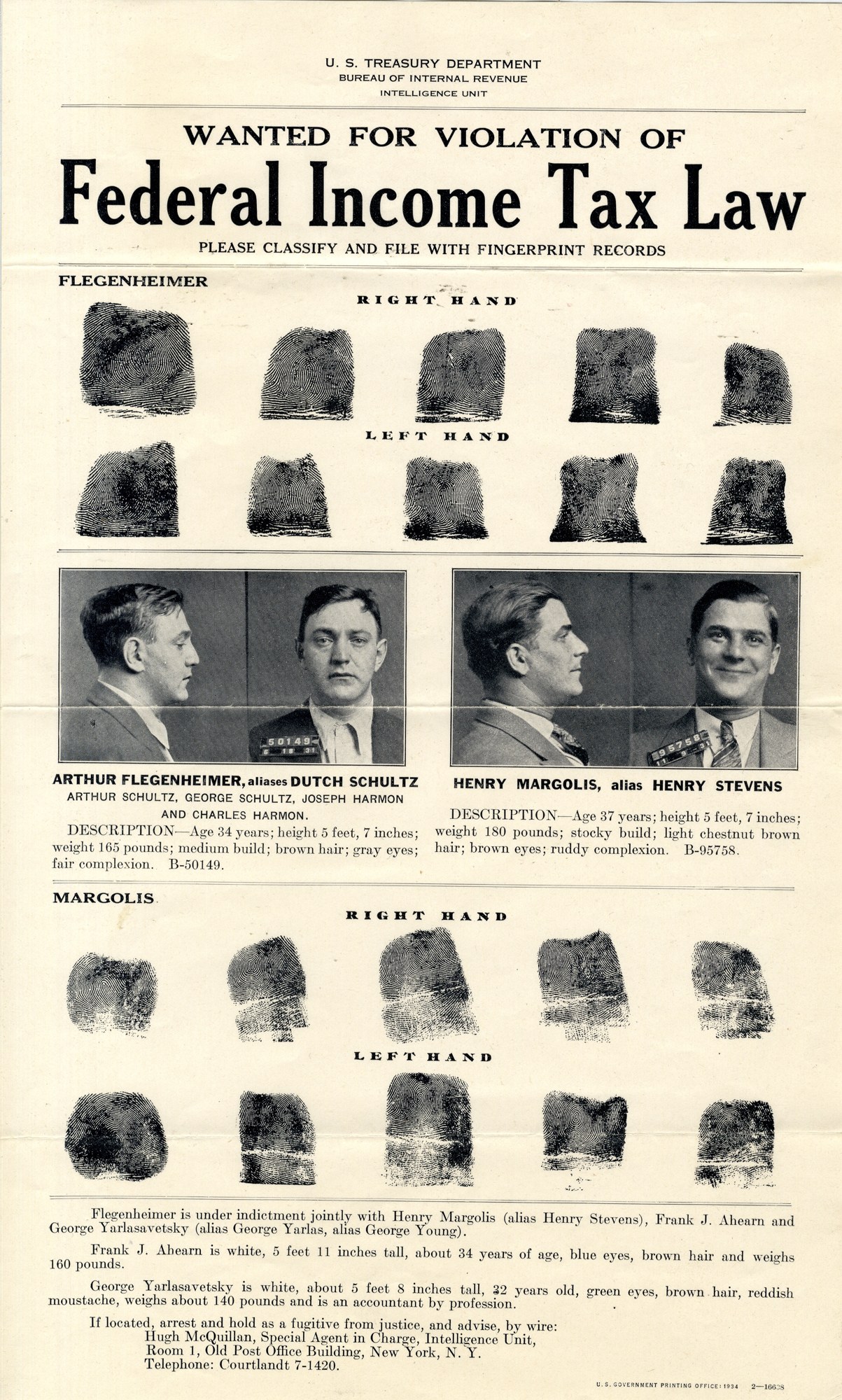
An Identification Order was the Division’s printed wanted notice: ten fingerprints, a photograph, a description, a criminal record, and a paragraph saying what the person was wanted for. Six are filed. No. 1194 (22 June 1933) names Charles Arthur Floyd in connection with the Kansas City killings. No. 1203 (14 August 1933) names George R. Kelly for the Urschel kidnaping. No. 1217 (12 March 1934) names John Dillinger under the National Motor Vehicle Theft Act; the FBI’s copy is stamped CANCELLED, and the National Archives holds another. No. 1223 (25 April 1934) names Lester M. Gillis for the killing of Special Agent W. Carter Baum. No. 1227 (21 May 1934) names Bonnie Parker and Clyde Champion Barrow, again under the stolen-car law, two days before both were killed. No. 1234 (19 November 1934) is a tax case: Arthur Flegenheimer, “Dutch” Schultz, a New York figure from the organized-crime records, filed here beside the others with the Treasury’s income-tax broadside of the same year. The FBI’s wanted flyer for Lepke Buchalter and Jacob Shapiro is filed with the organized-crime records.
Dillinger
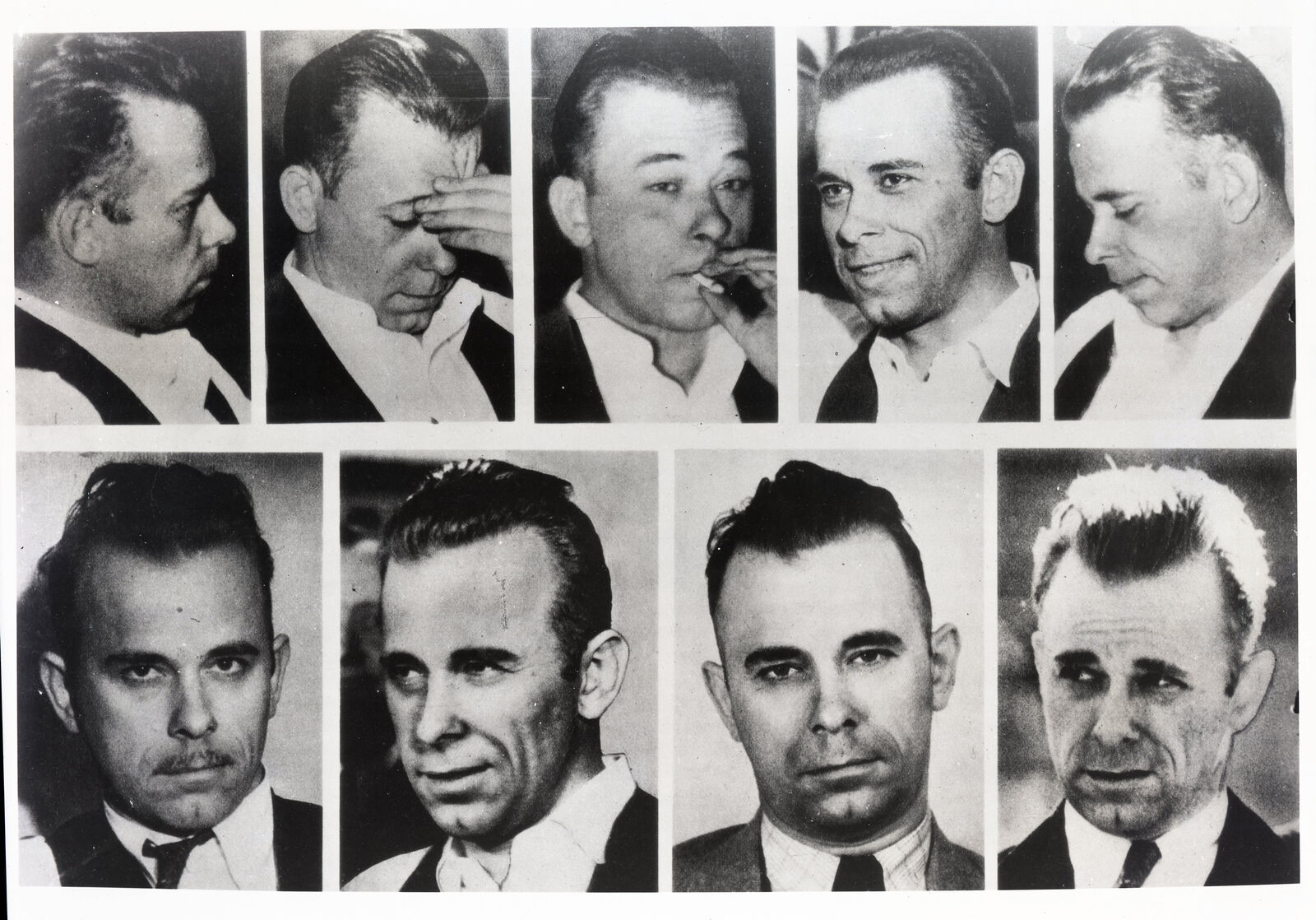
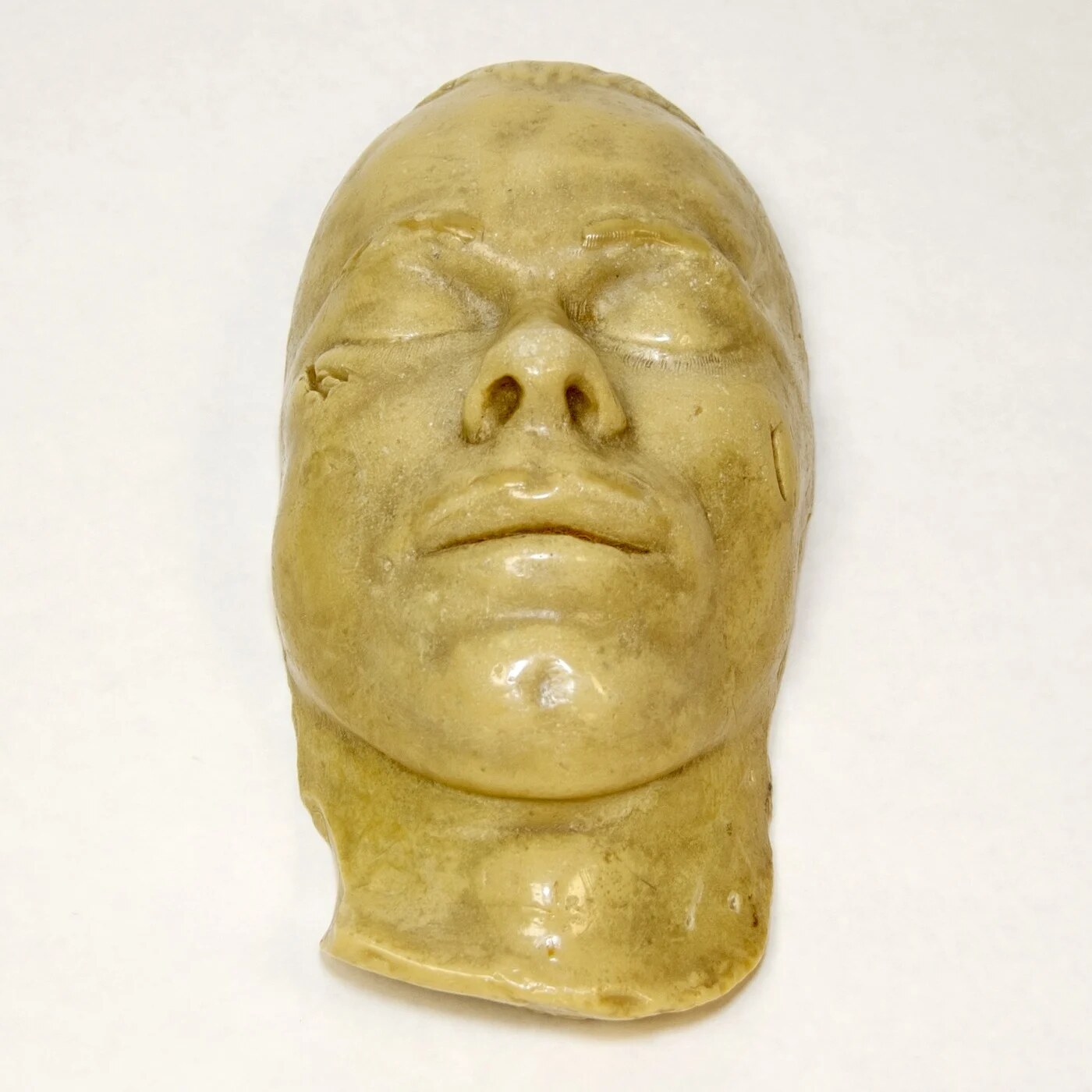
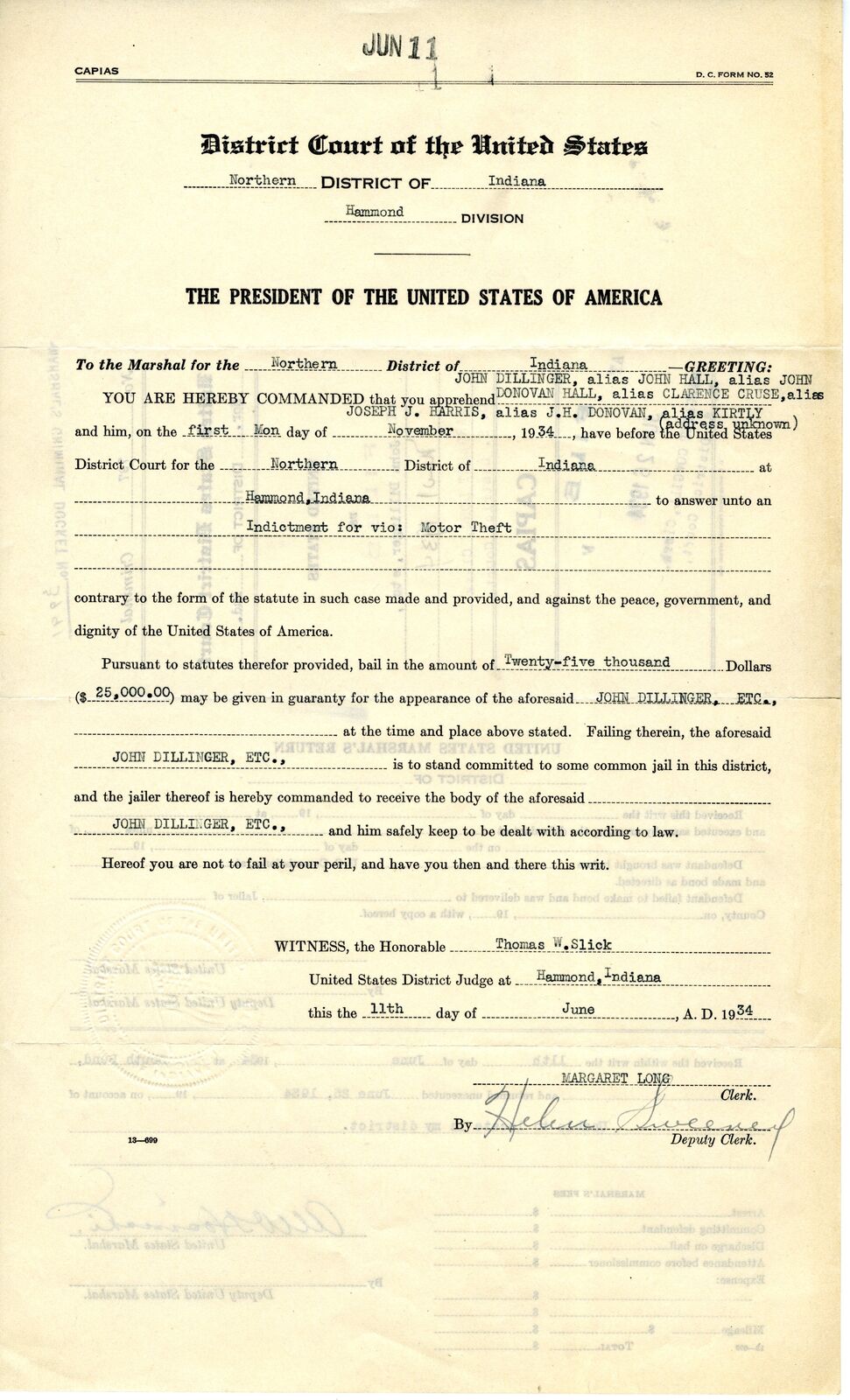
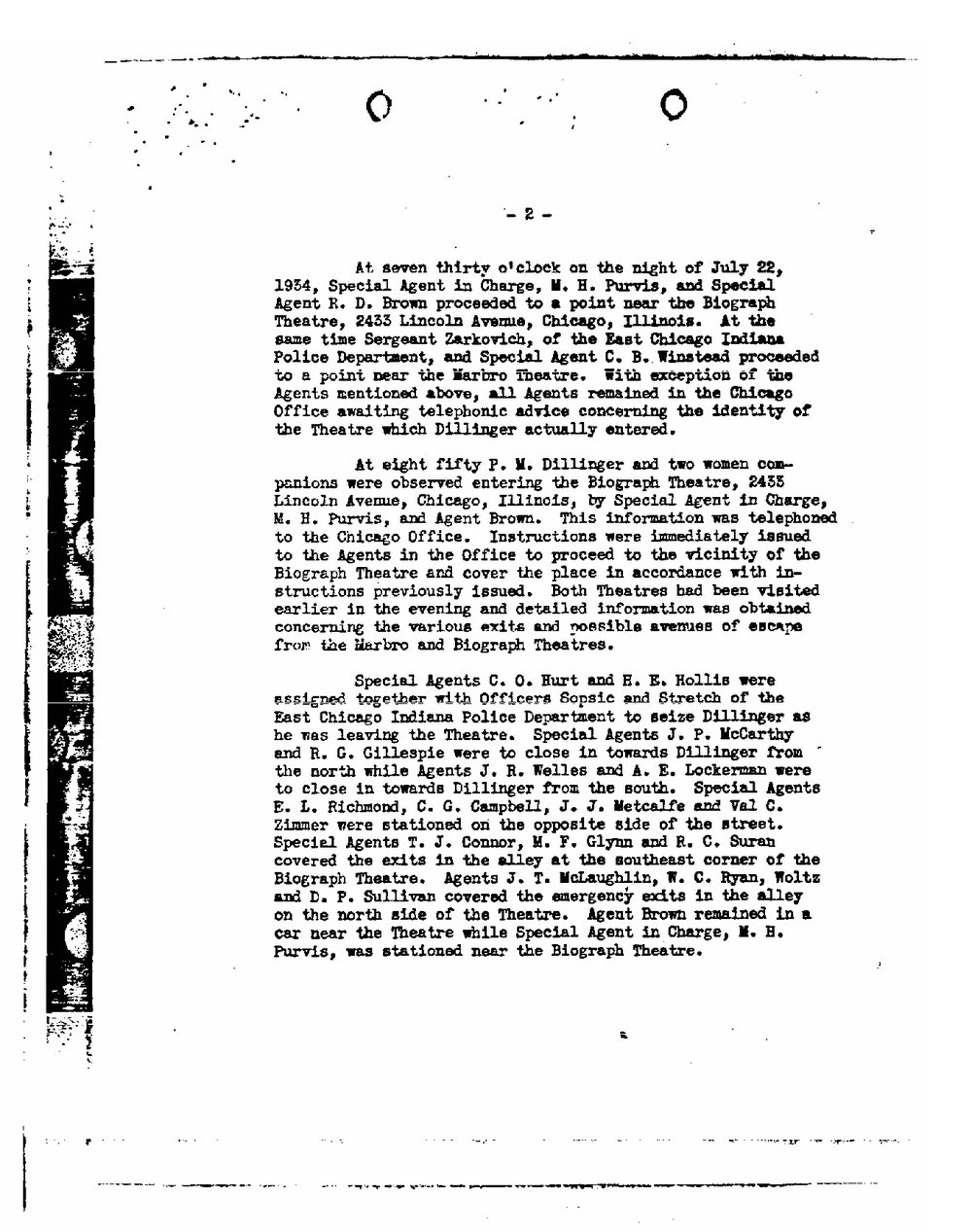
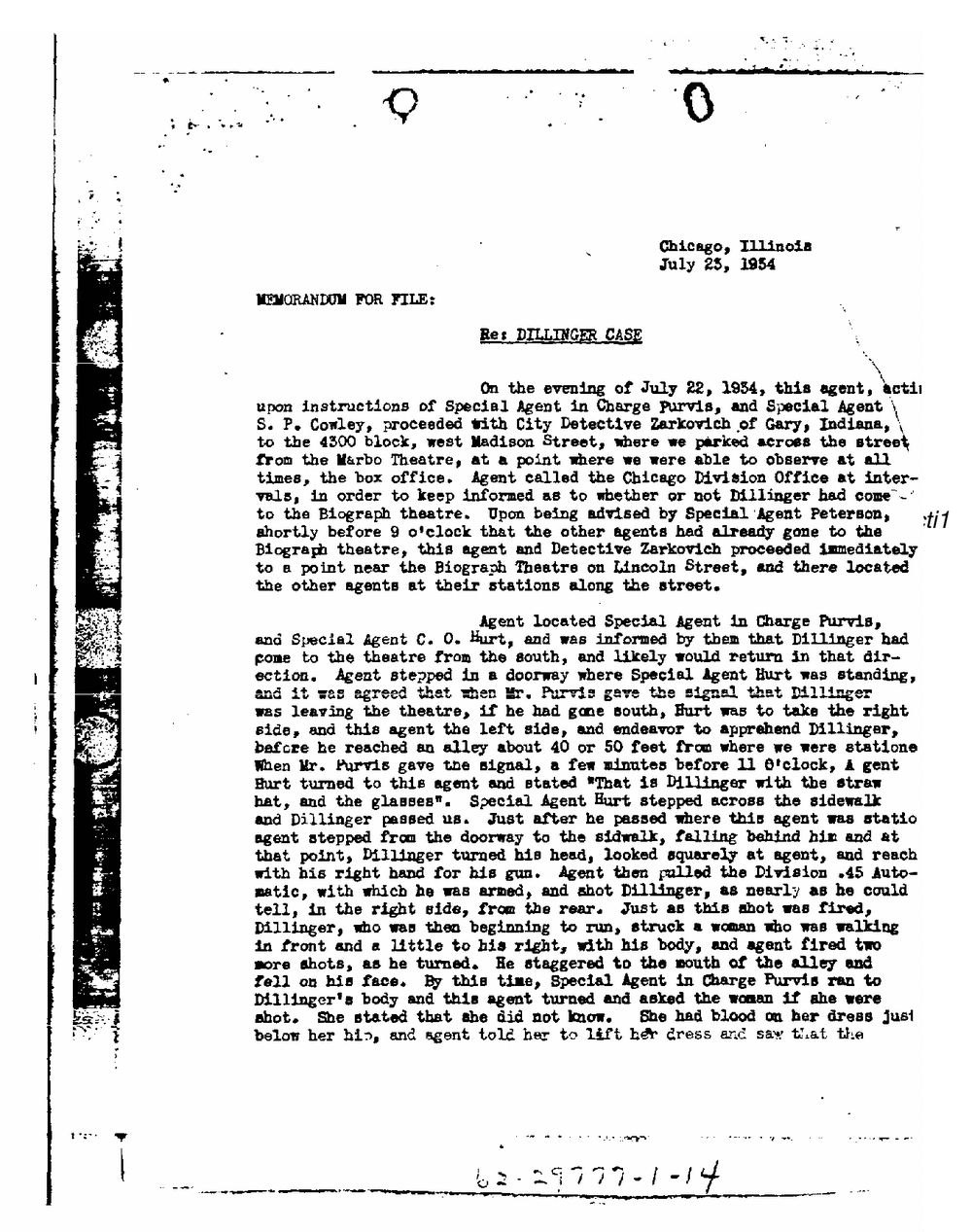
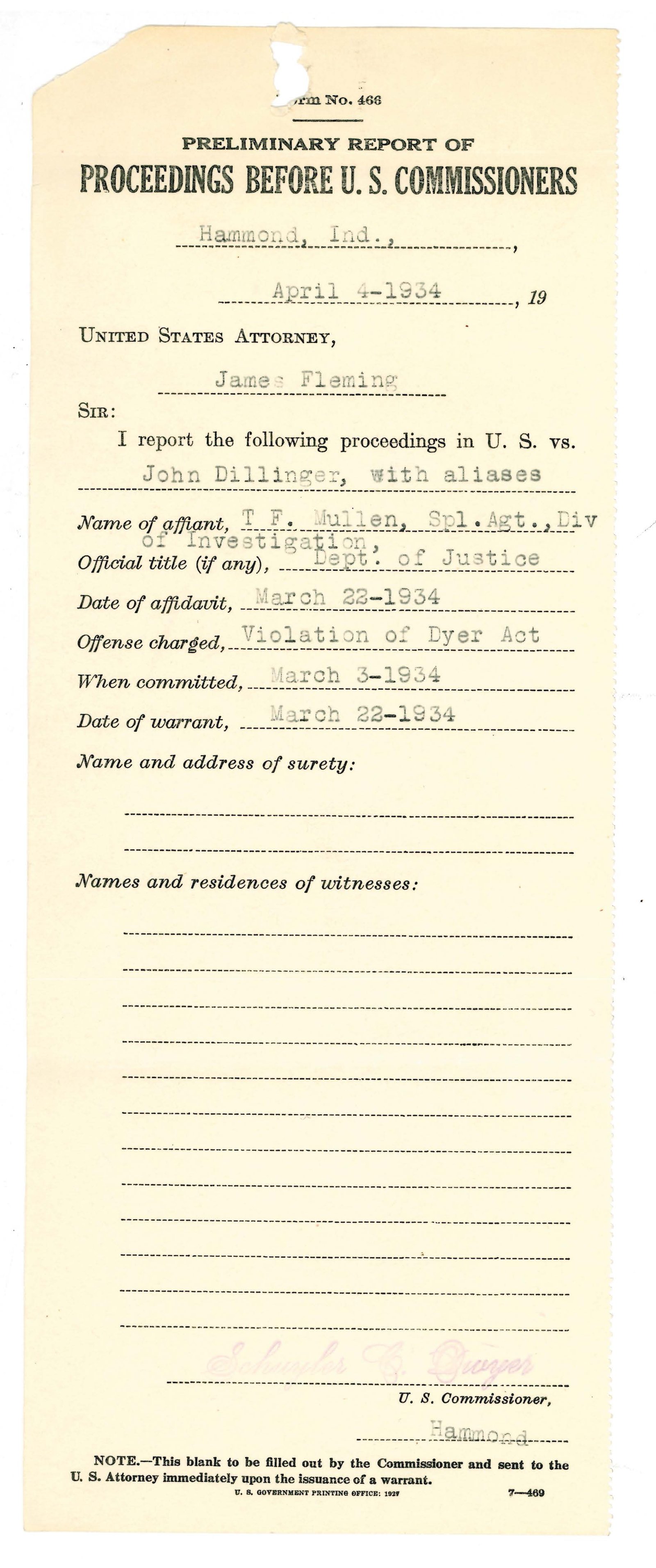
The federal case against John Dillinger began as a stolen-car case. Identification Order No. 1217 and the Hammond capias of 11 June 1934, in the case file dismissed after his death, both rest on the sheriff’s Ford taken at the Crown Point escape of 3 March 1934, which the Michigan forfeiture opinion also recites; the U.S. Attorney’s Crown Point file records the escape itself. The Lima jail break of October 1933, in which the sheriff was killed, is an Ohio case. The Little Bohemia Lodge prosecutions in Wisconsin (No. 10922 and No. 10923) charged the gang with resisting agents on 22 April 1934. The harboring cases followed: the Sault Ste. Marie case and the prosecutions of his attorney Louis Piquette (No. 28341, No. 28821), whose appeal shows he was acquitted on the Dillinger charge and convicted on the Van Meter charge. The night of 22 July 1934 is recorded in a Bureau account of the agents’ positions at the Biograph Theatre, in Special Agent Winstead’s memorandum, and in a 1935 memorandum on the shooting. The FBI also holds his death mask and a composite of nine photographs.
Baby Face Nelson, Little Bohemia and Barrington
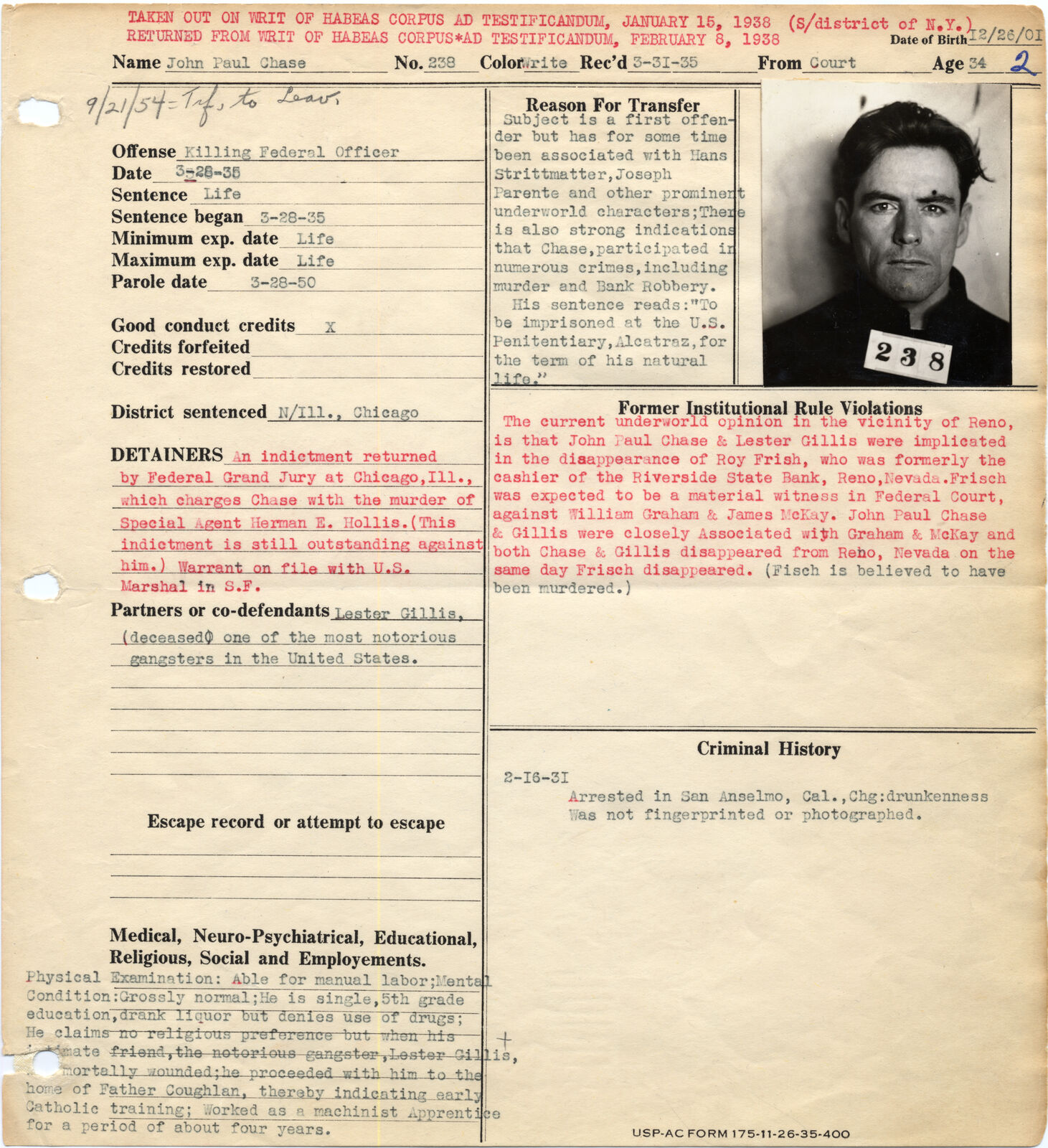
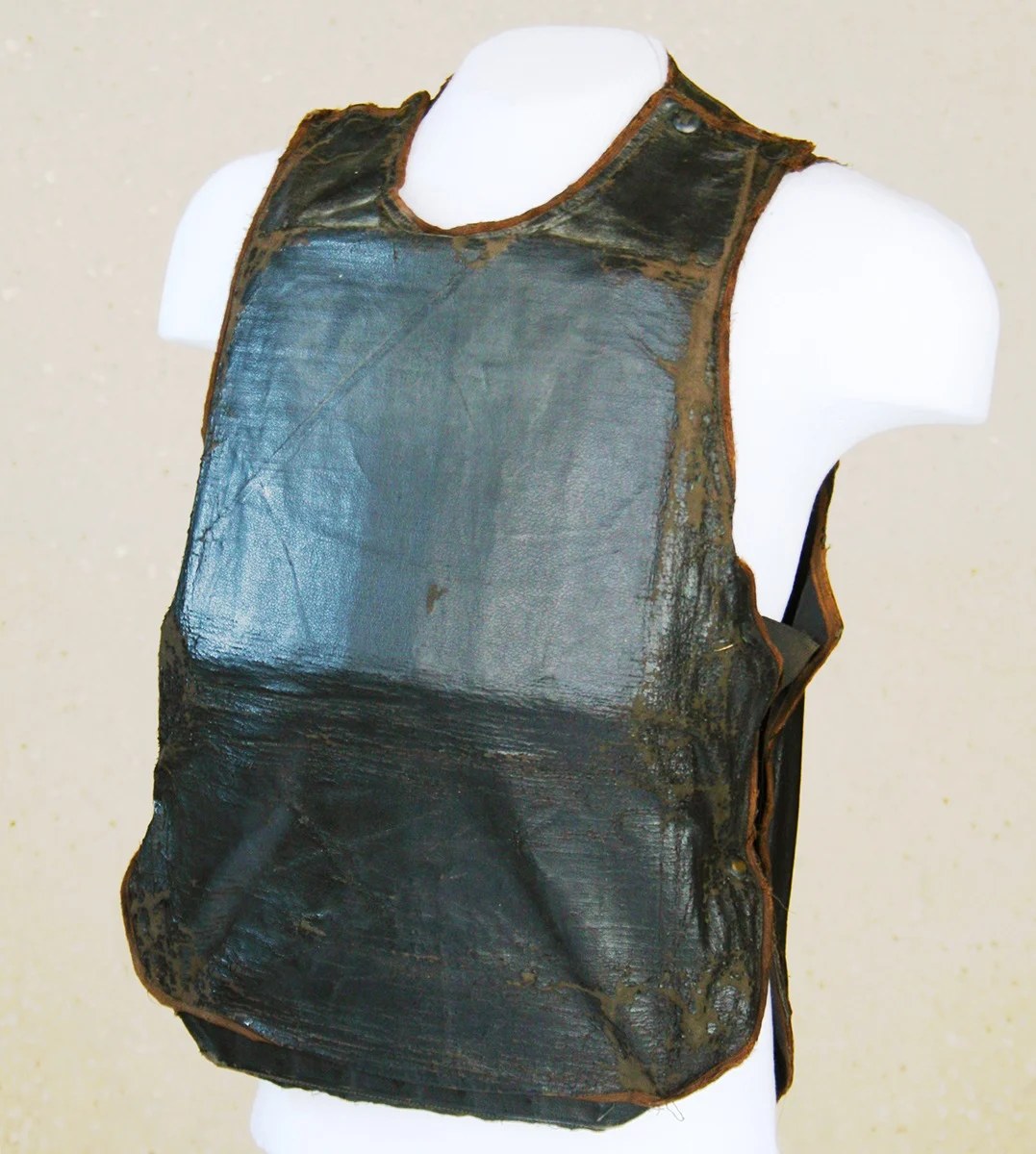
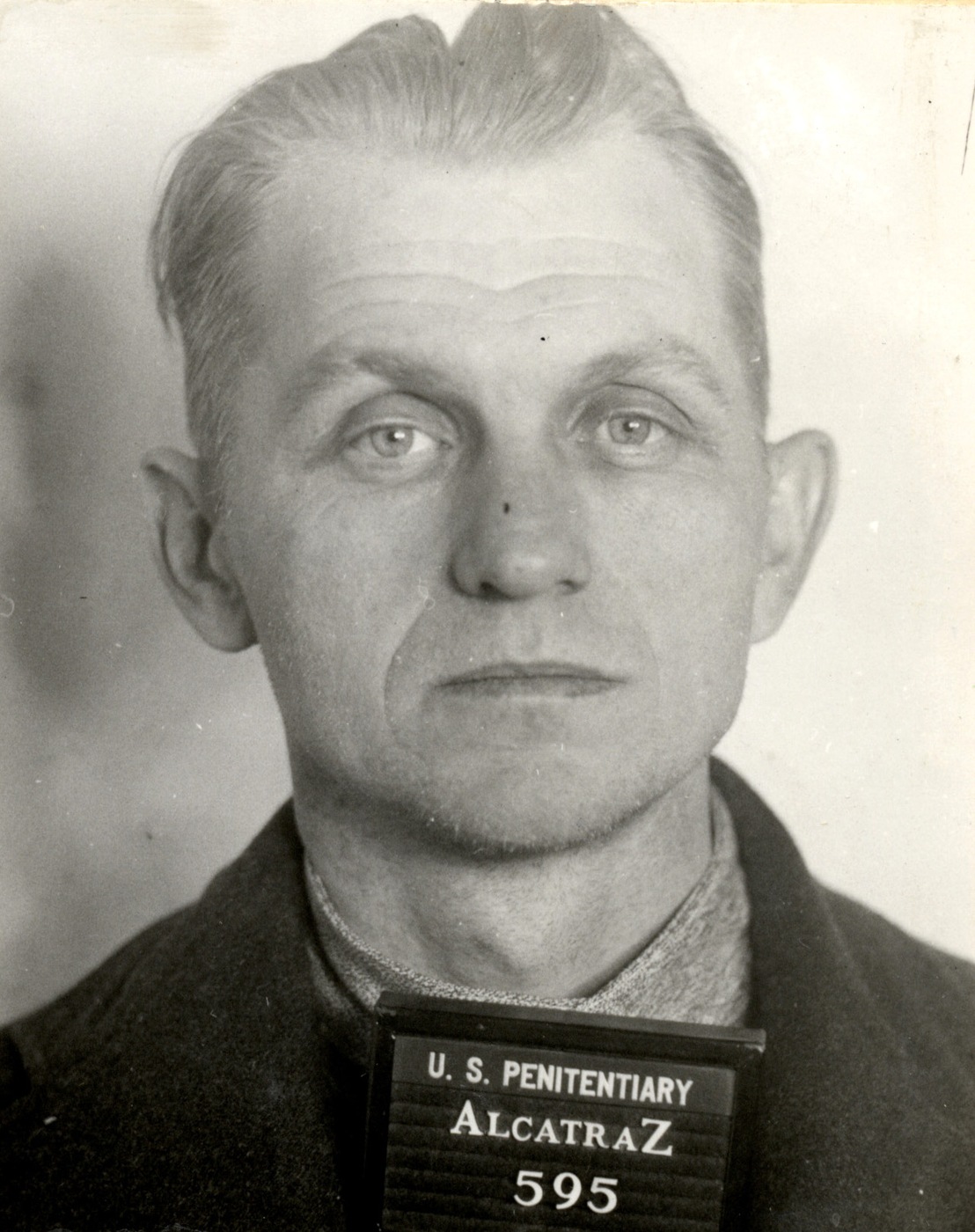
Lester Gillis was named in the Little Bohemia indictment and in Identification Order No. 1223; the FBI’s history page carries his story to 27 November 1934, when Inspector Samuel P. Cowley and Special Agent Herman E. Hollis were killed at Barrington, Illinois. John Paul Chase was convicted at Chicago under the Act of 18 May 1934 for killing a Division agent, and his Alcatraz notebook page records his life sentence. The Vault’s Gillis file and the body armor the FBI says was recovered that day are also filed.
The Barrow gang
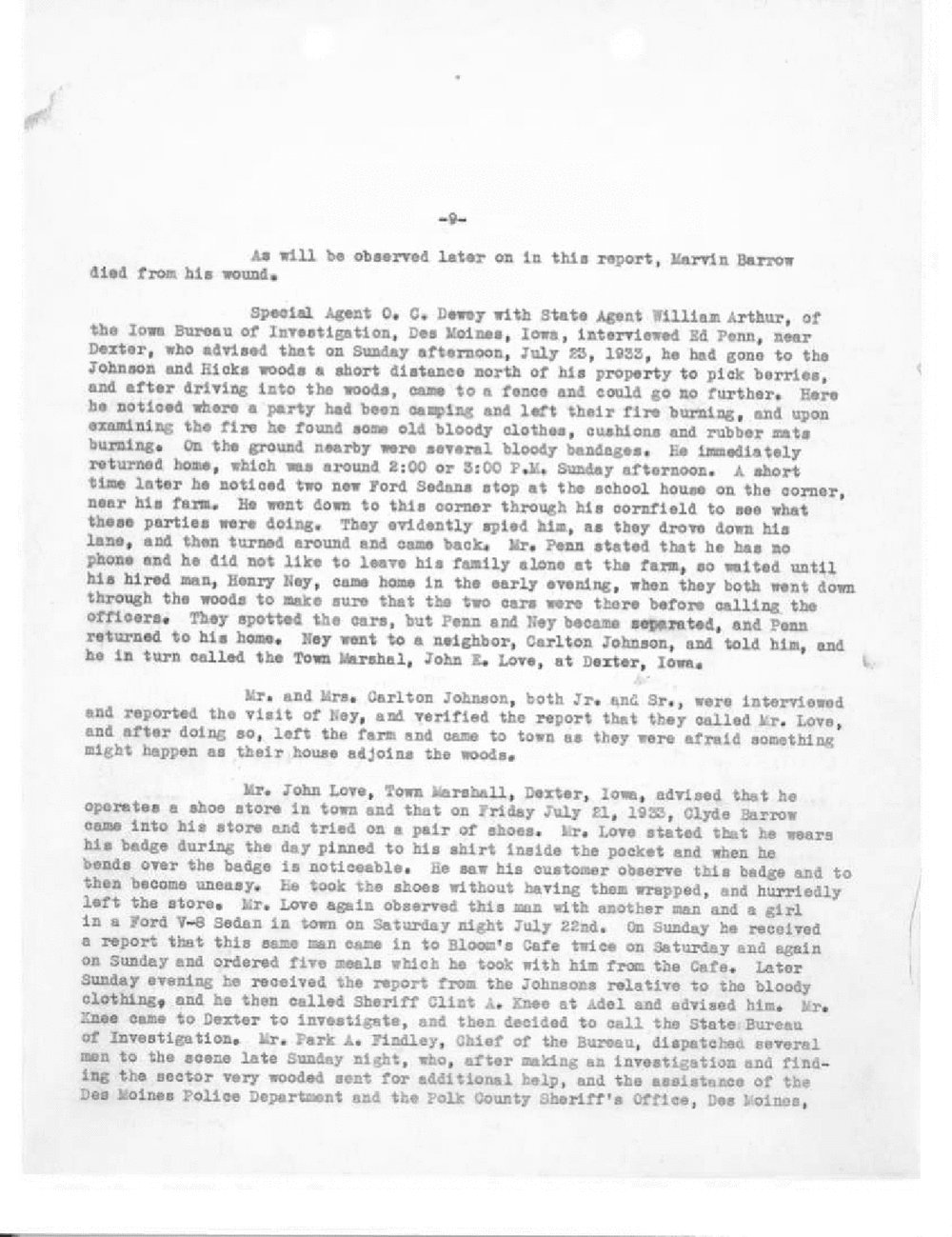
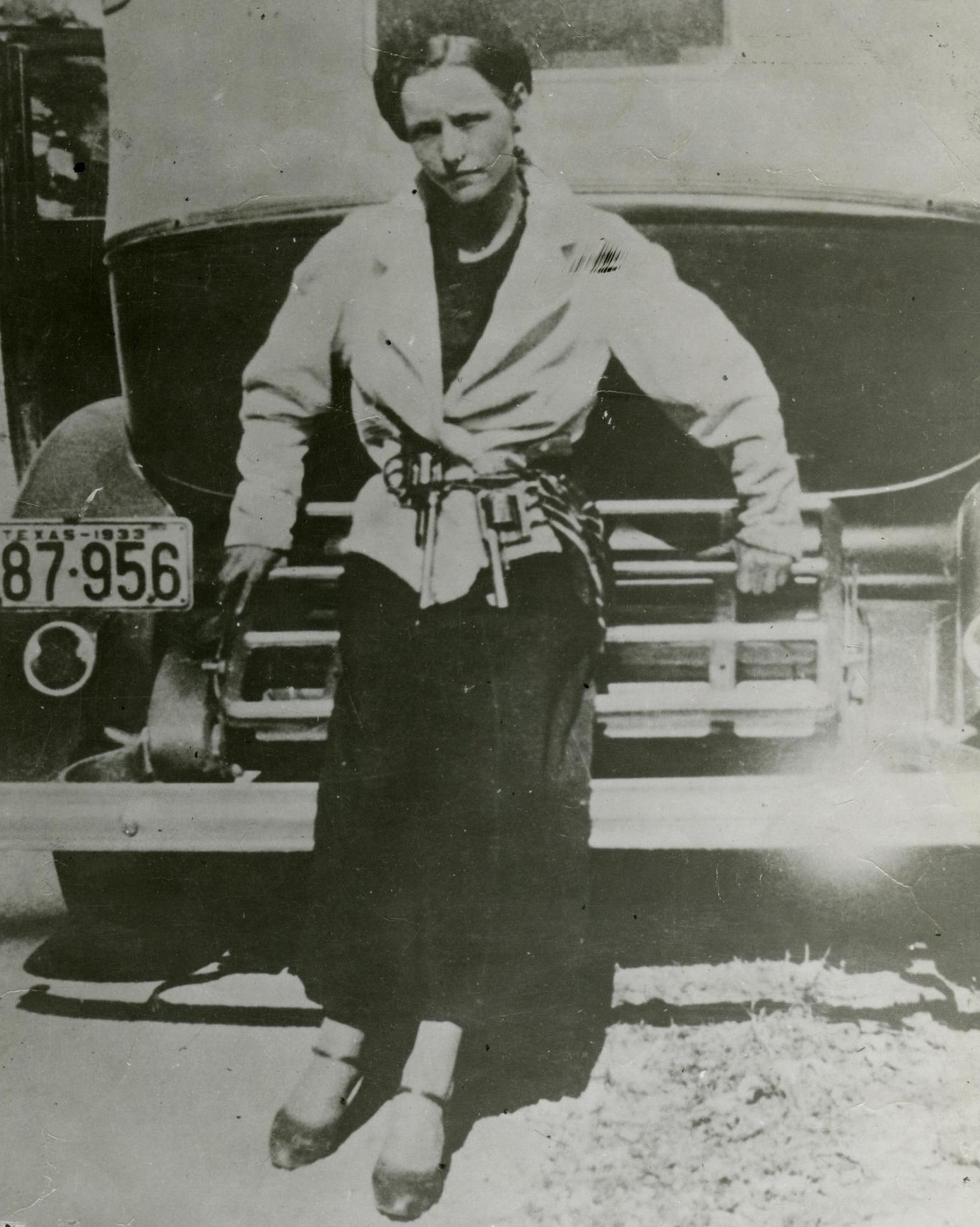
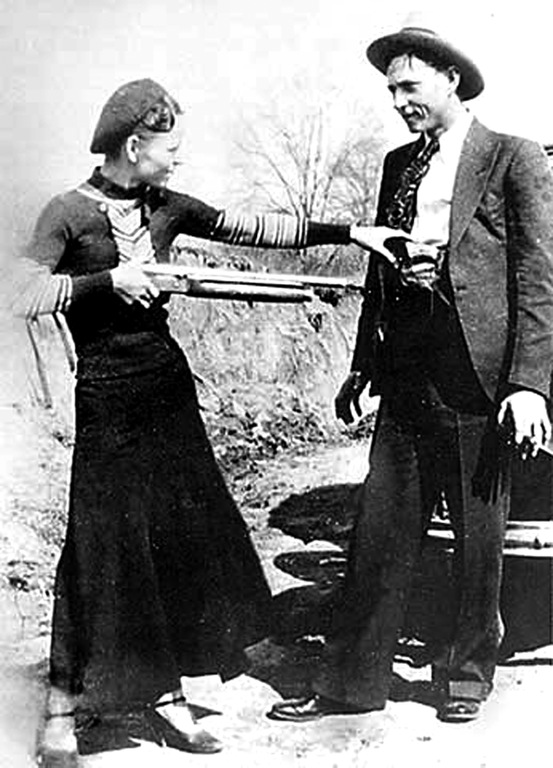
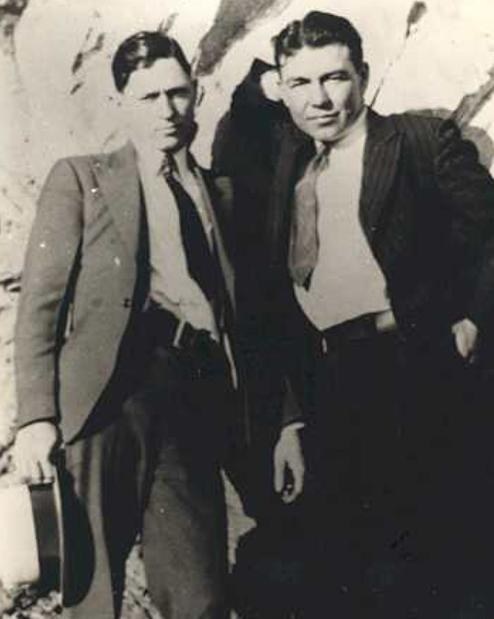
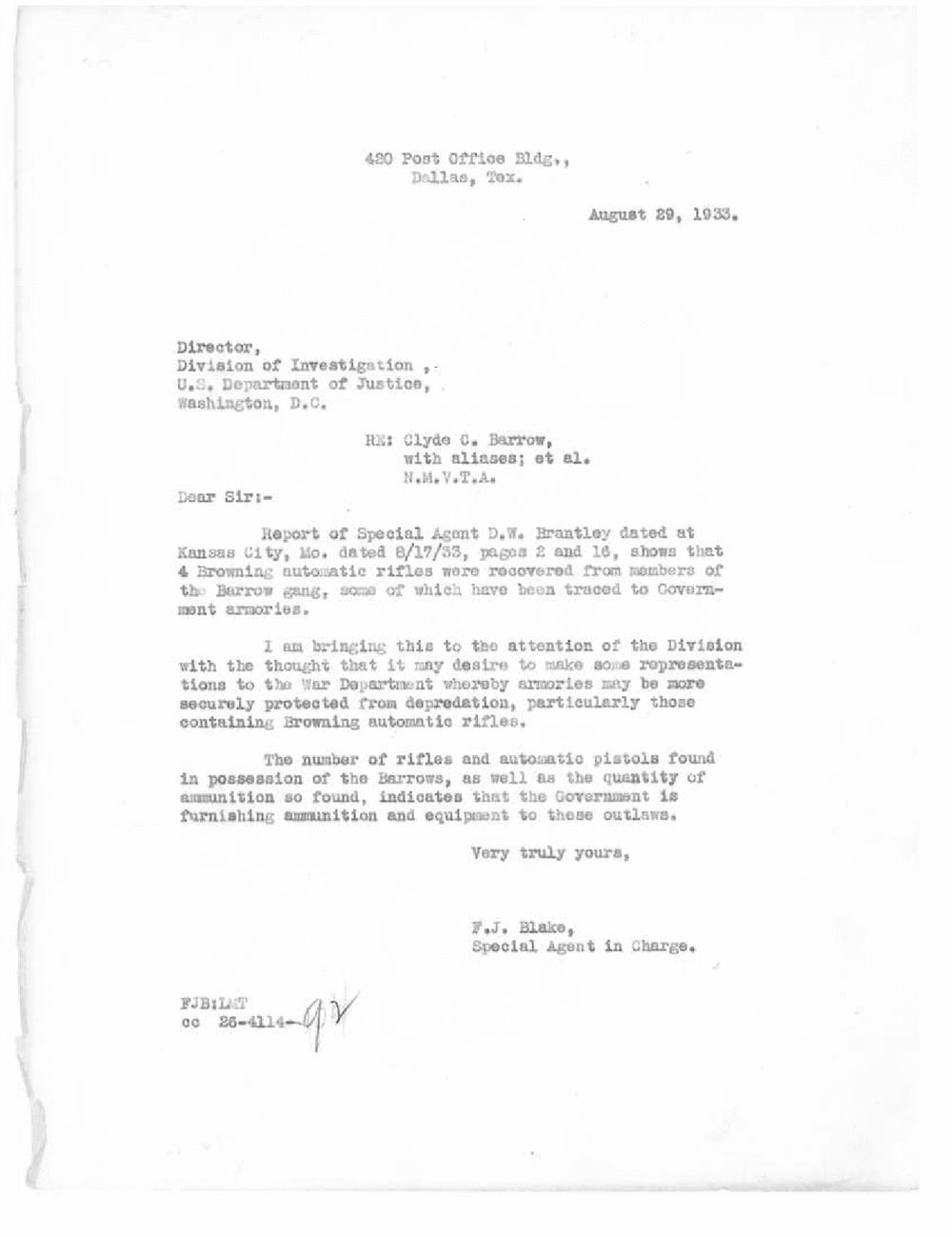
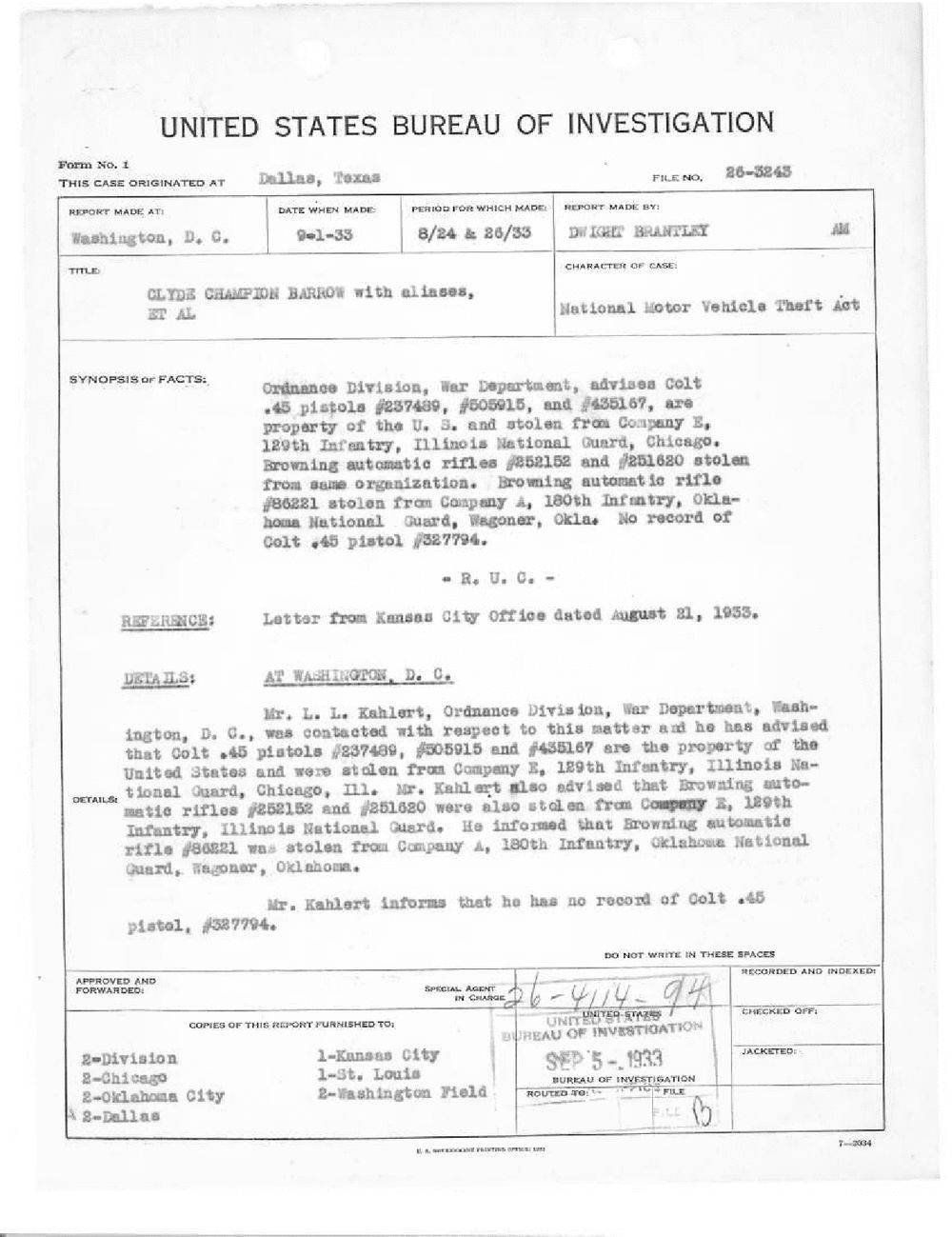
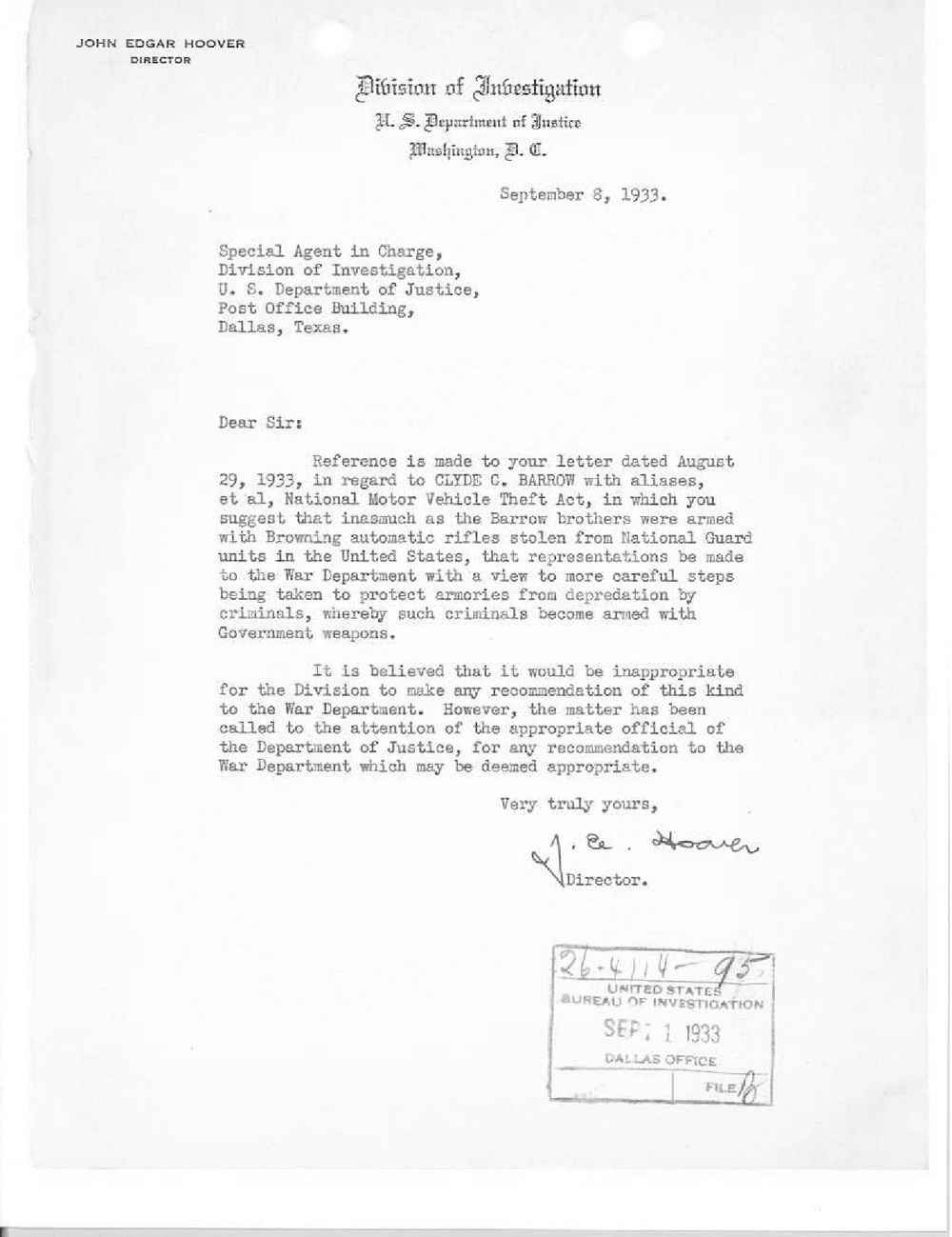
The Bureau’s interest in Clyde Barrow and Bonnie Parker was, as its own history page says, “solely on the charge of transporting a stolen automobile.” Its 1933 report on the raid near Dexter, Iowa is the closest record to the events of July 1933, and its letters on the Browning rifles are filed with the weapons records. The federal files at Fort Worth charge others with harboring the pair and charge the gang with theft from a Texas armory. Two state opinions record the Eastham farm break and the killing at Commerce, Oklahoma. Three snapshots the FBI publishes, of Bonnie Parker, of the pair with a shotgun and of Barrow with William D. Jones, are private photographs filed on the owner’s decision of 12 October 2026; each record says so.
The Kansas City massacre and Frank Nash
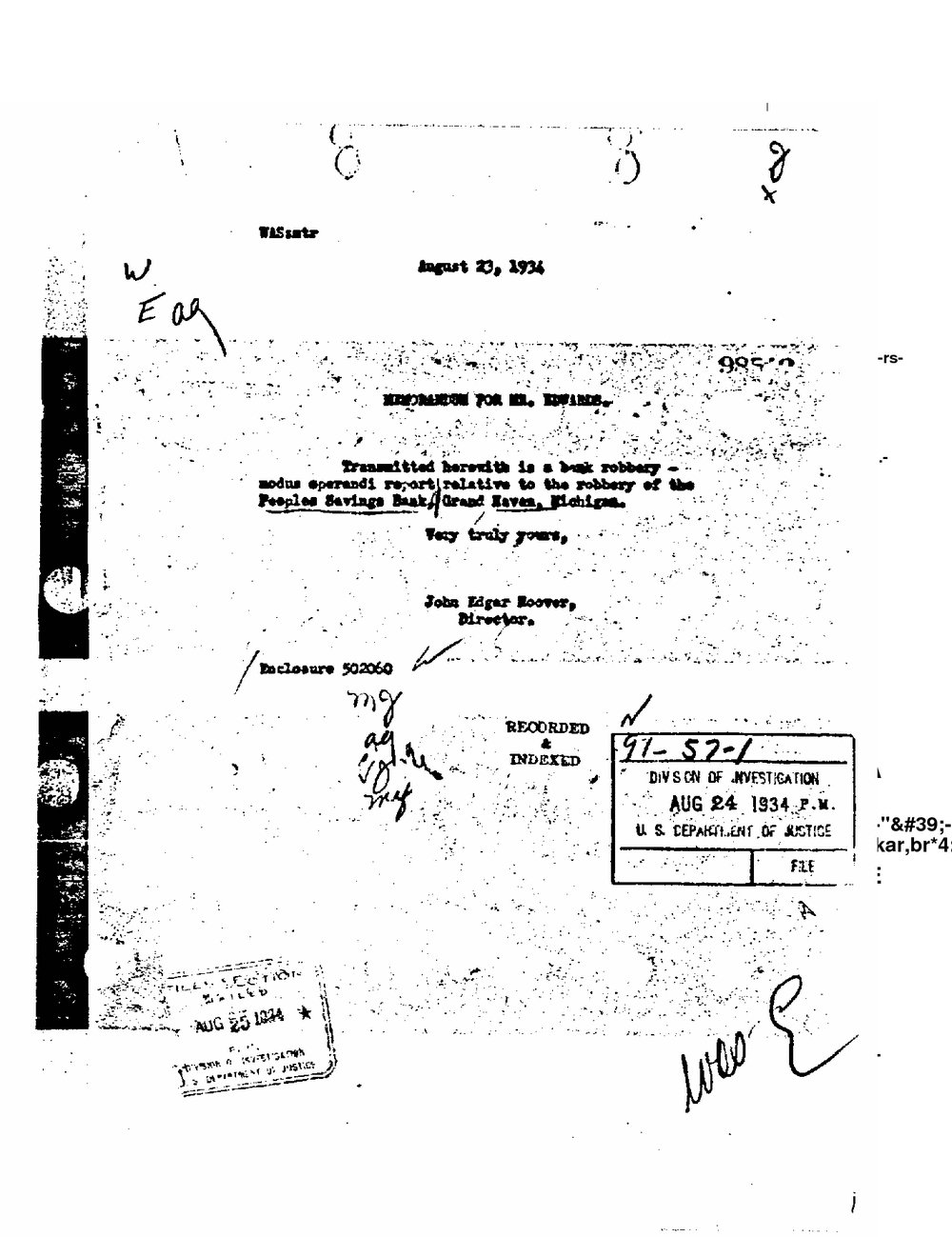
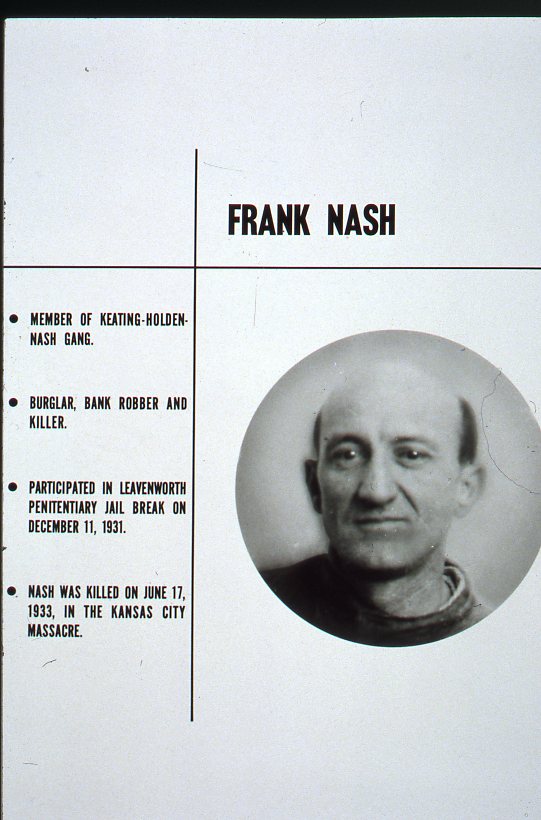
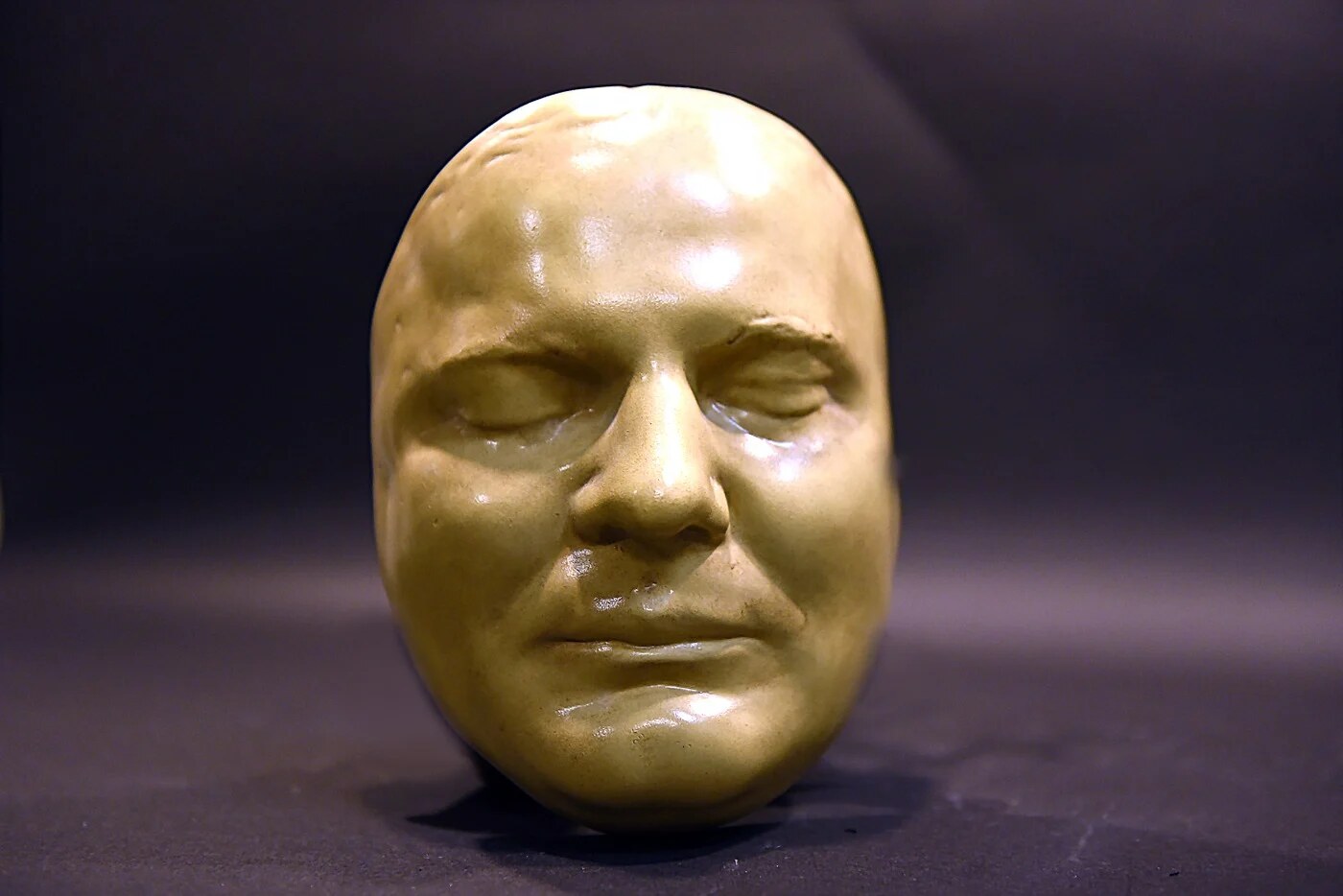
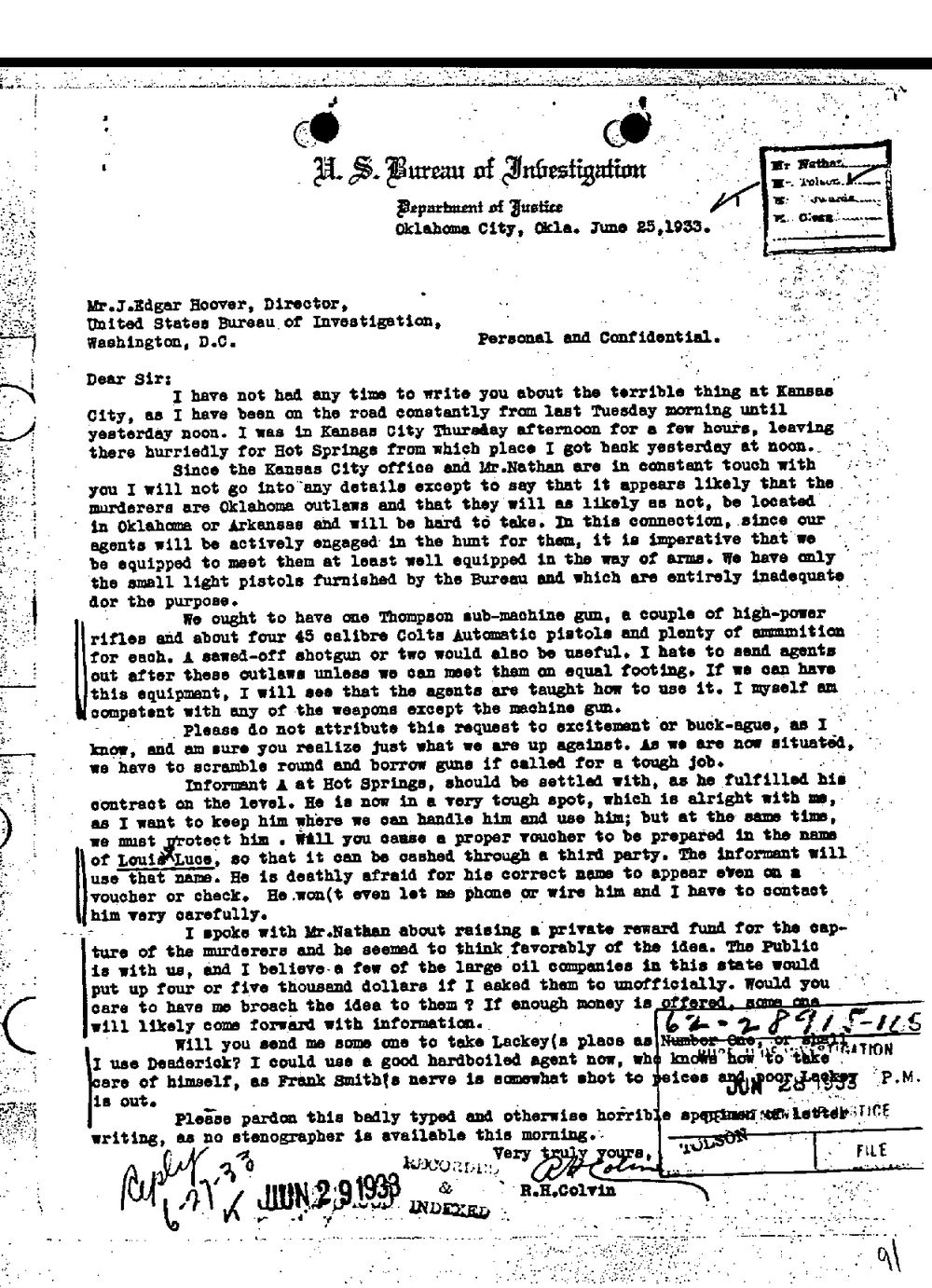
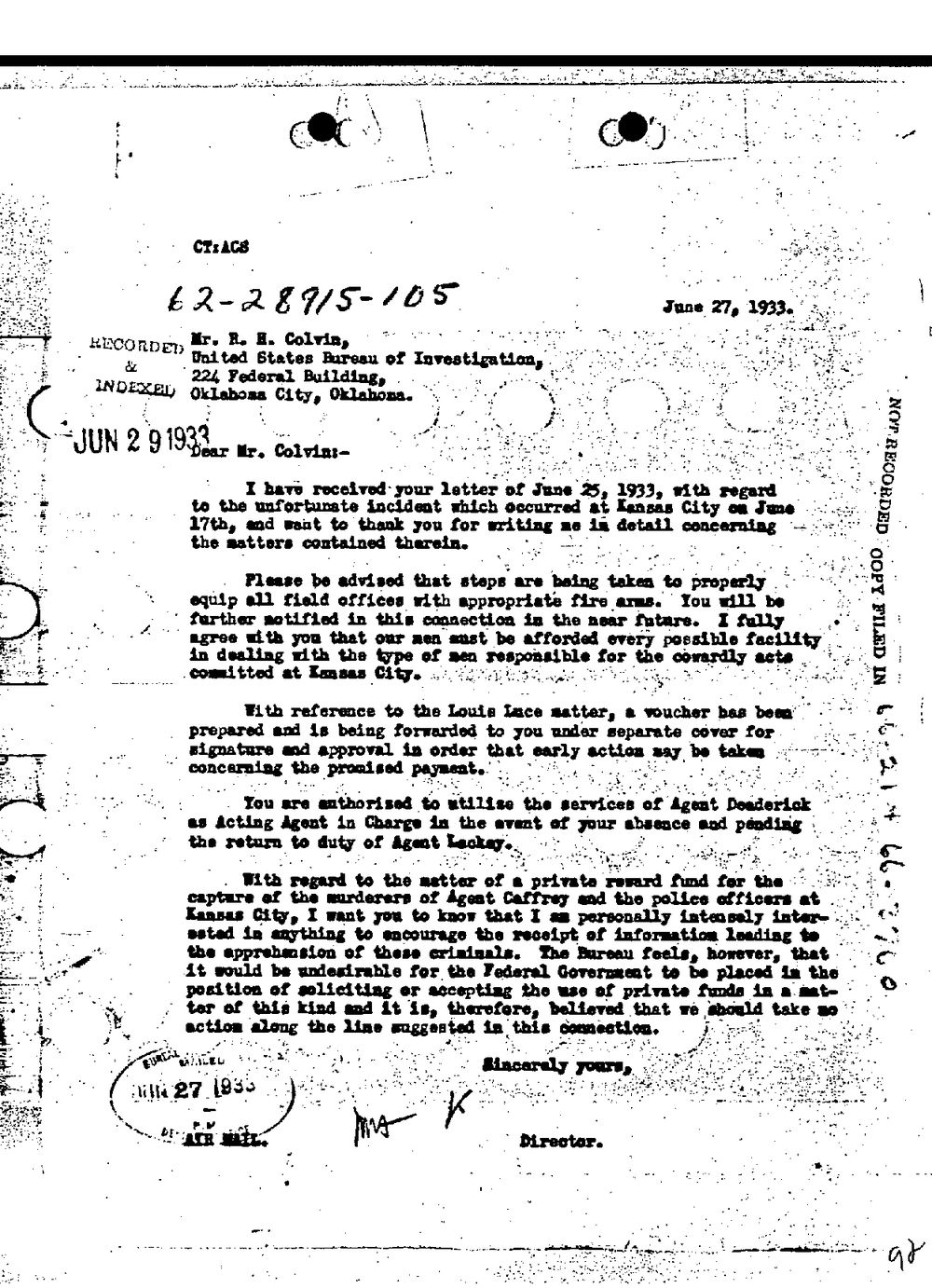
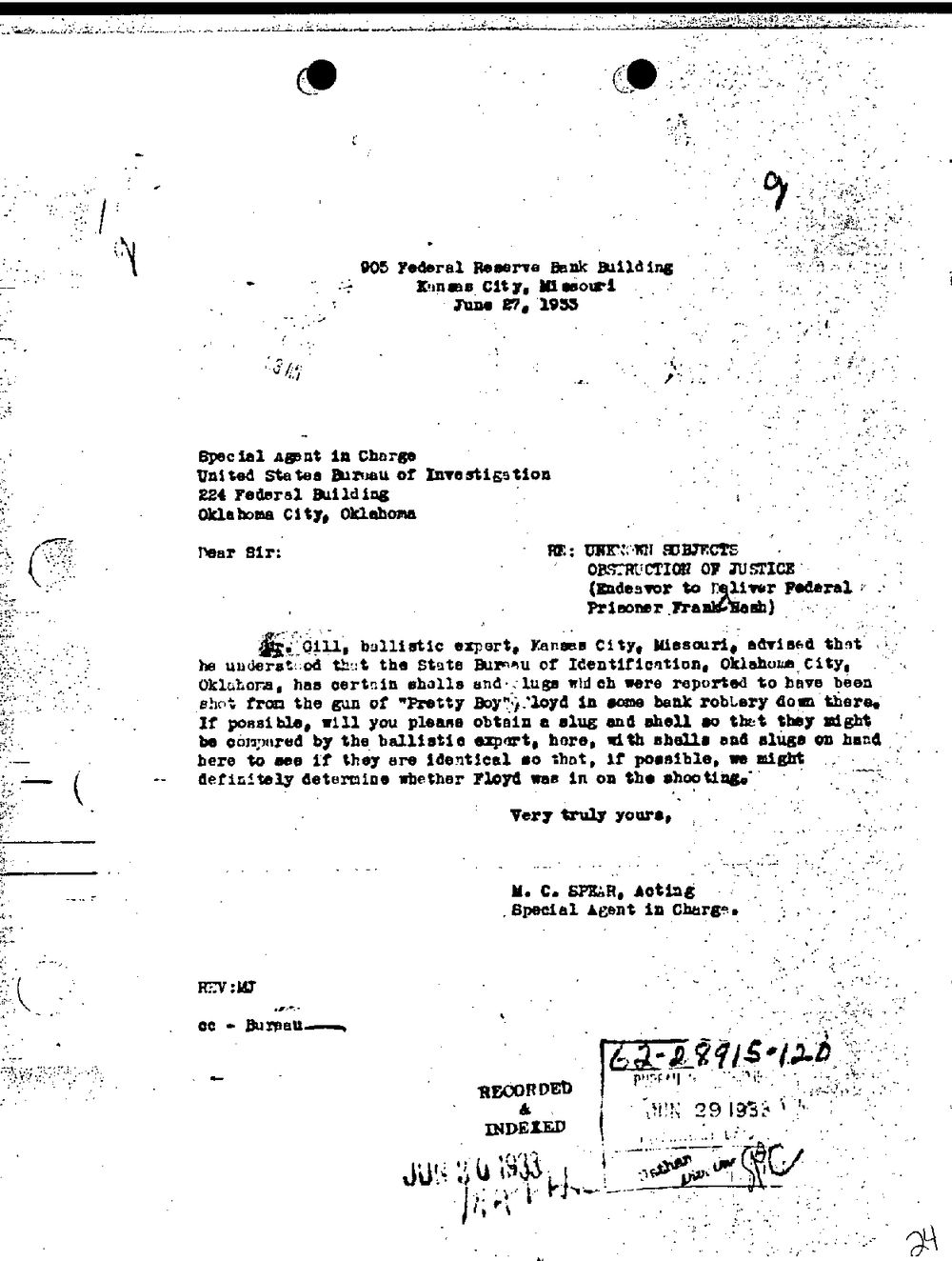
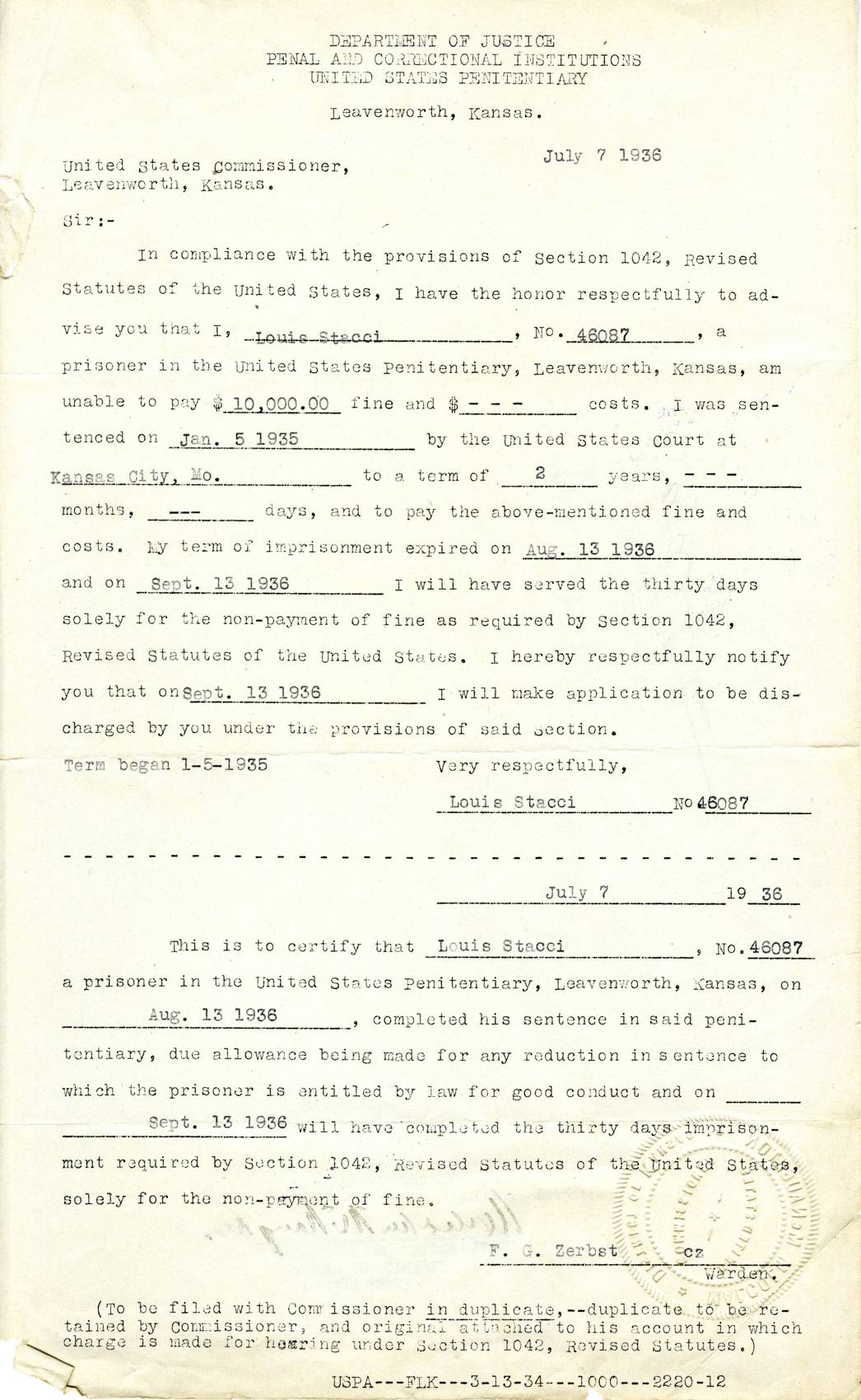
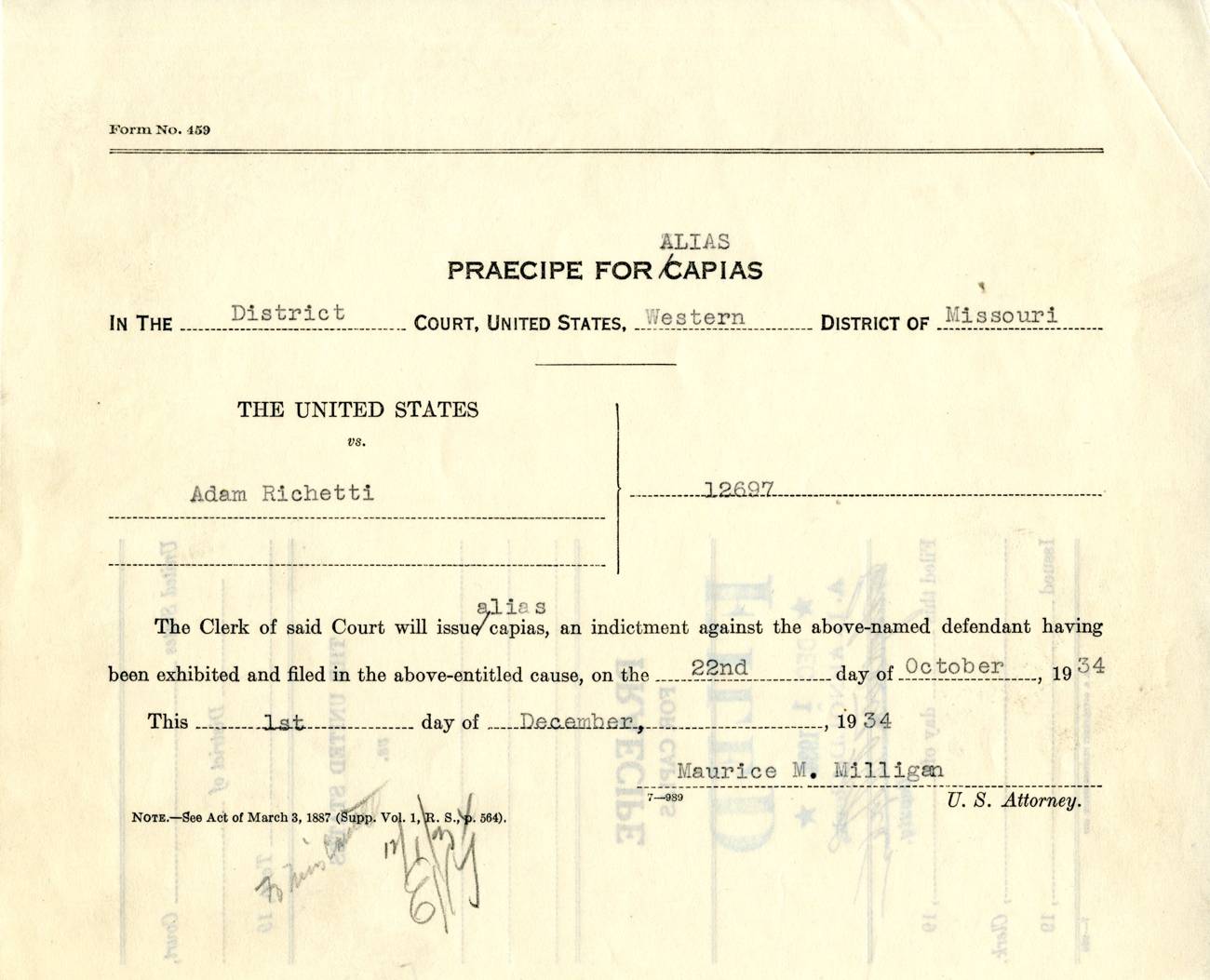
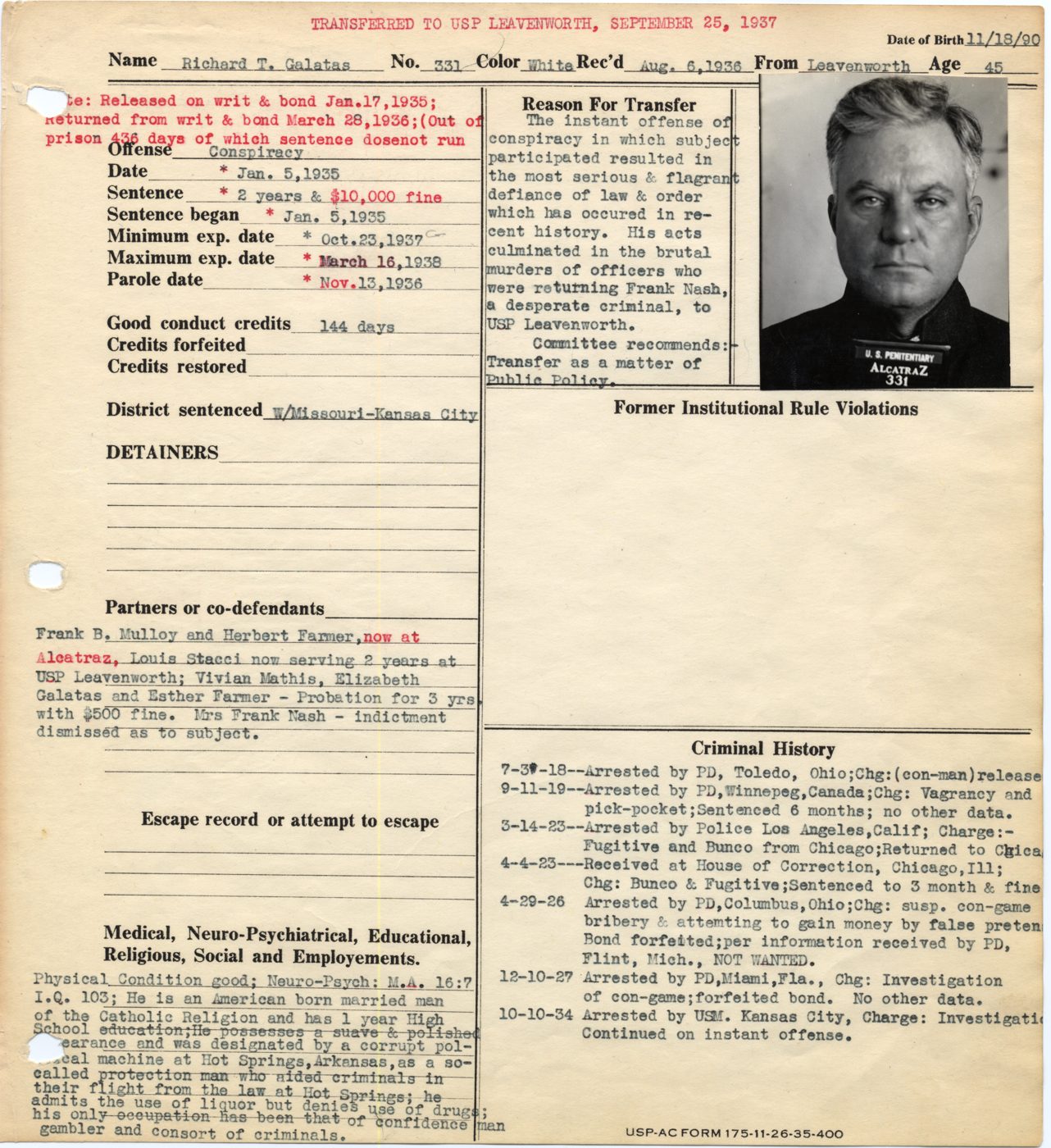
On 17 June 1933 officers bringing the escaped federal prisoner Frank Nash back to Leavenworth were fired on outside Union Station, Kansas City; four officers and Nash were killed. The FBI’s history page gives the Bureau’s account. The court records are the federal conspiracy file against Richard Galatas and three others, the Eighth Circuit’s opinion affirming their convictions, a federal file naming Richetti and Floyd, and the Missouri Supreme Court’s opinion in State v. Richetti, which reviews the eyewitness and ballistic evidence. Galatas’s Alcatraz record, the Vault’s file 62-28915, the Bureau’s Floyd summary, Floyd’s death mask, and three Bureau letters of June 1933 complete the group.
The Urschel kidnaping and George Kelly
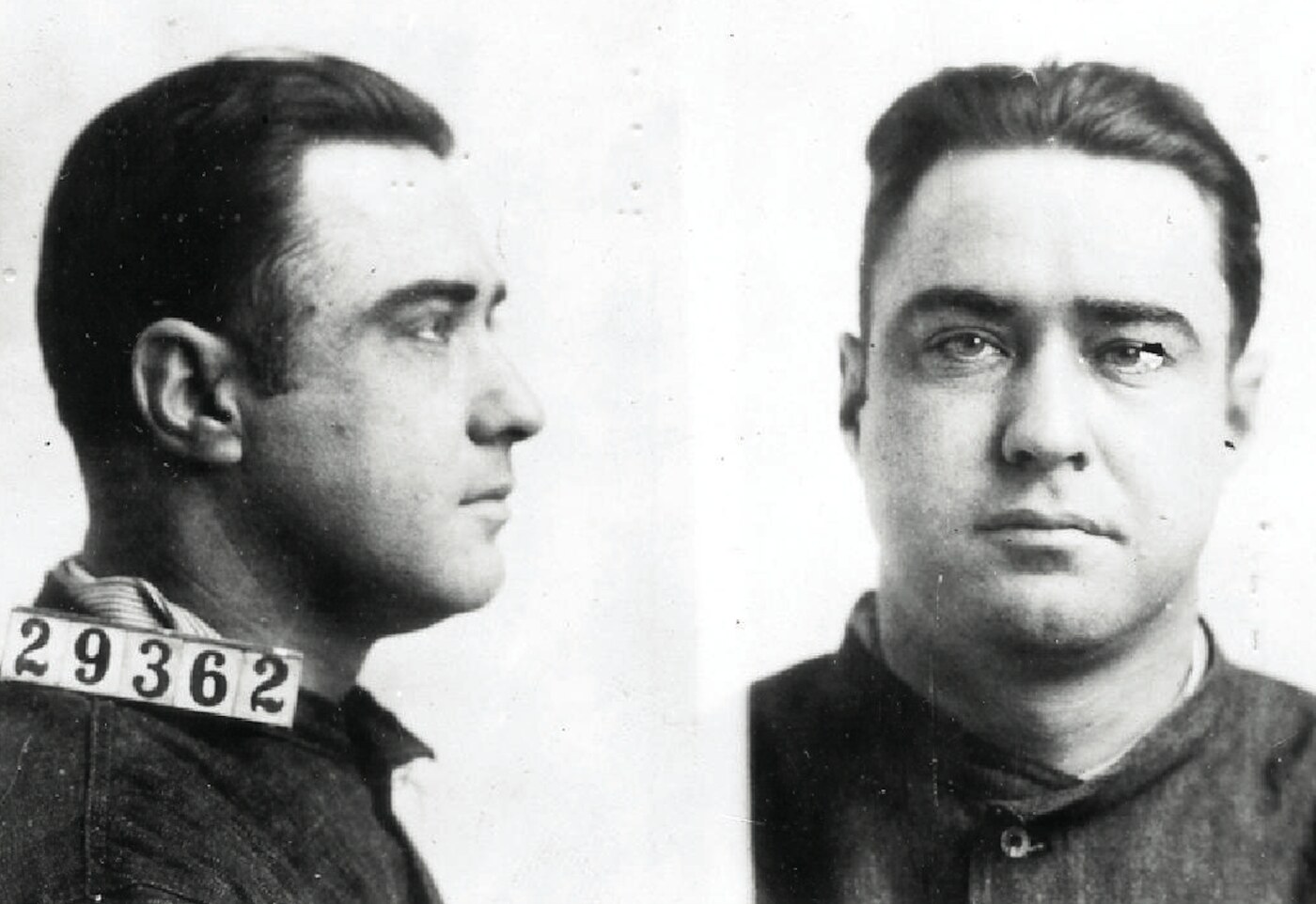
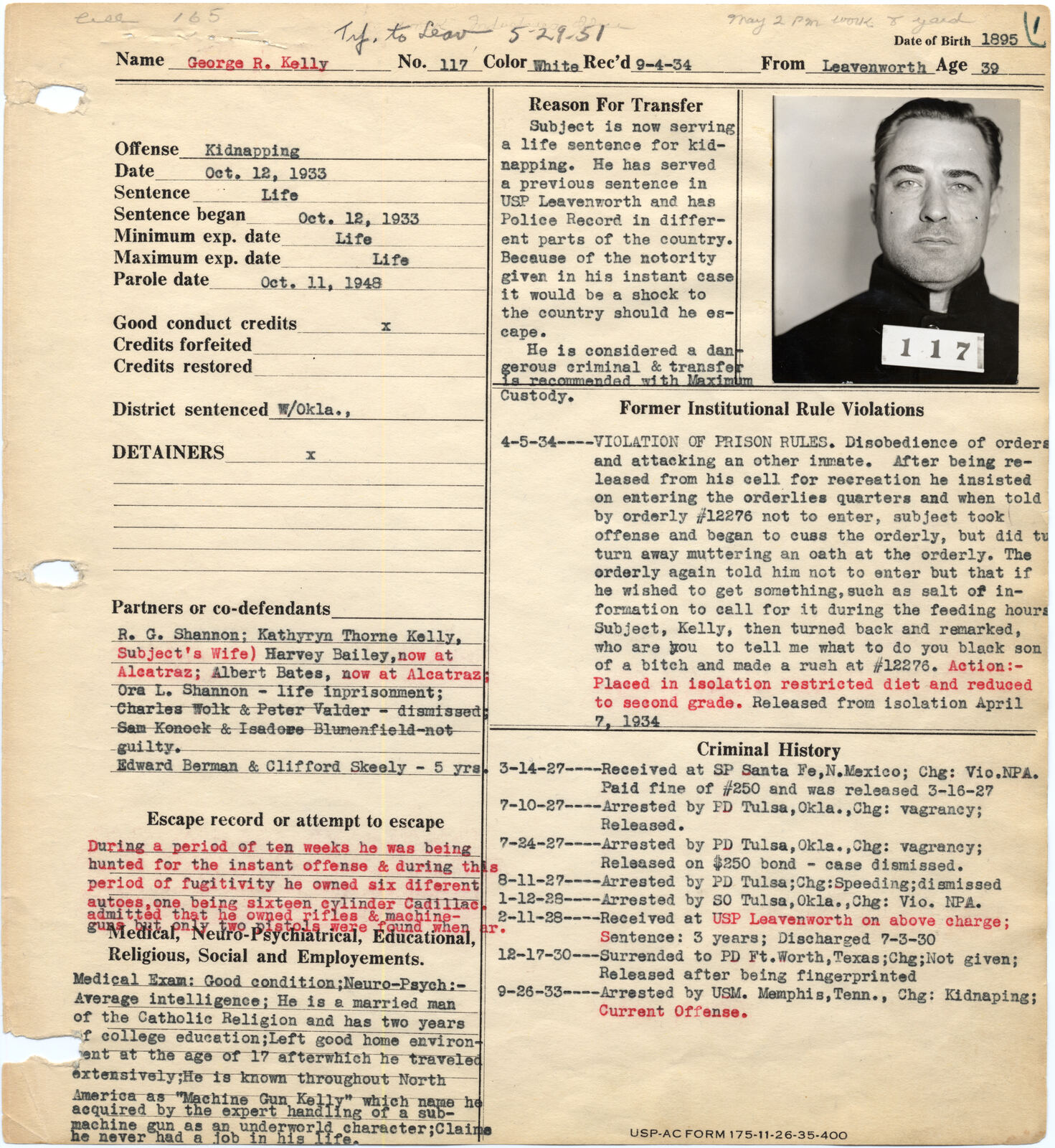
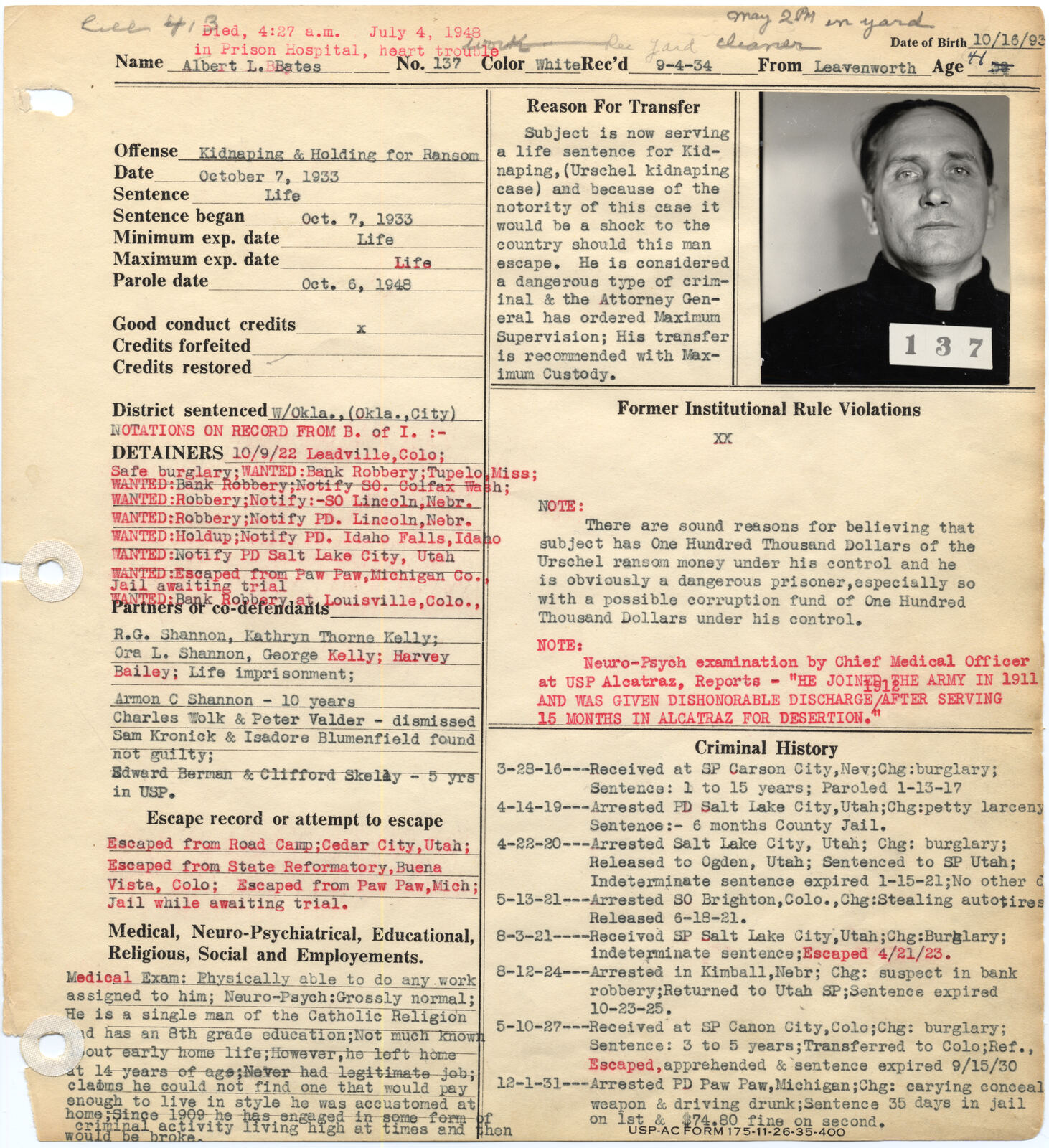
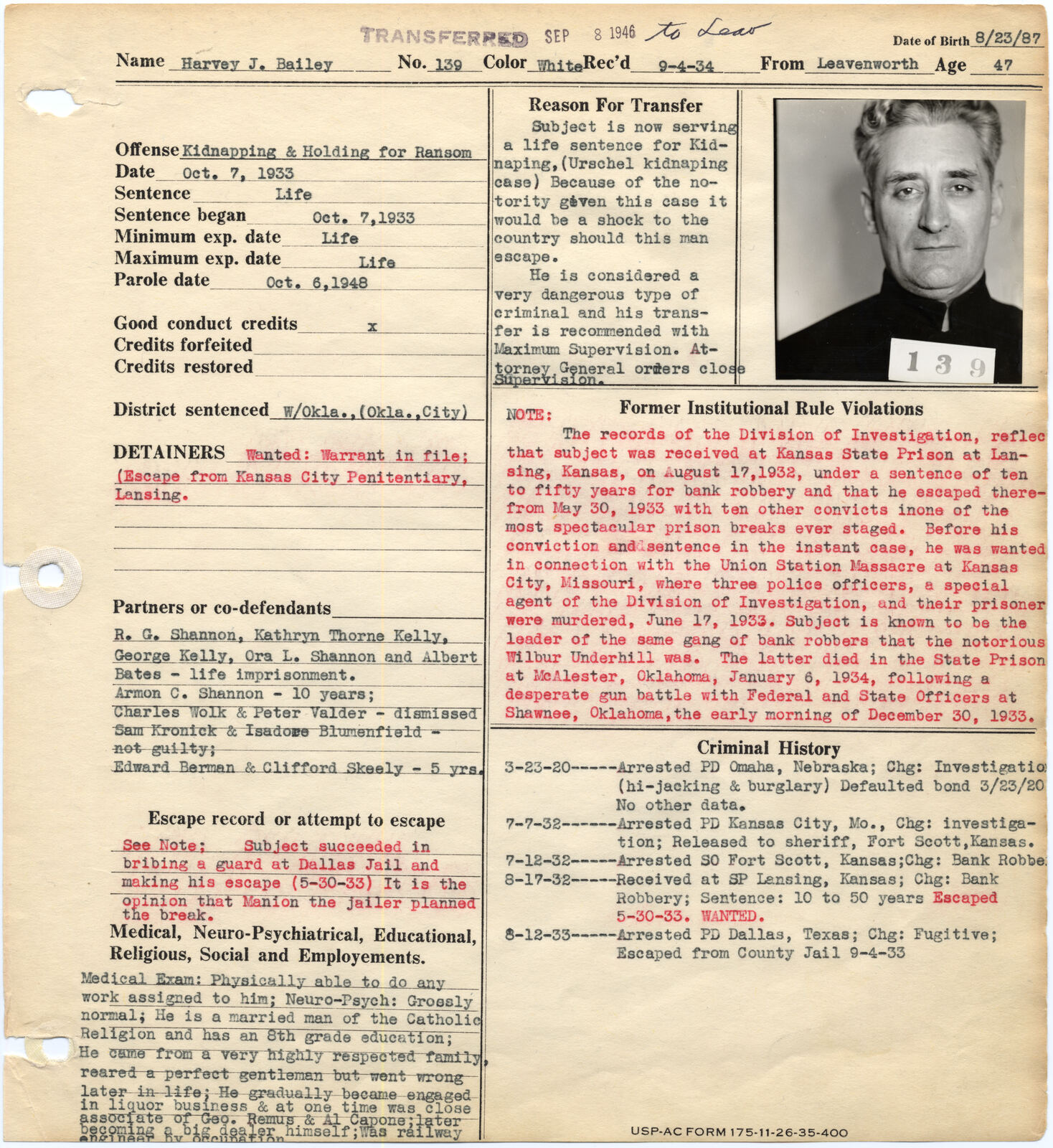
Charles F. Urschel was taken from his Oklahoma City home on 22 July 1933 and held on the Shannon farm in Texas until July 31; the Tenth Circuit says Kelly collected $200,000 in ransom on July 30. The federal case file at Fort Worth is digitized item by item: the indictment, the jury instructions of the first trial, the Kellys’ trial transcript, the commitments of George Kelly, Kathryn Kelly and Harvey Bailey, Kelly’s petition for appeal and the agreed statement for Bailey’s appeal. The Tenth Circuit’s opinions in Bailey, Shannon, Kathryn Kelly and Laska state the facts the court found, and its 1959 opinion reversed a district court order that had vacated the Kathryn Kelly and Ora Shannon sentences. The Alcatraz notebook pages of Kelly, Bates and Bailey, Kelly’s 1,410-page case file, his Leavenworth photographs, the FBI’s history page and the first part of the Vault file complete the group.
The Barker–Karpis gang
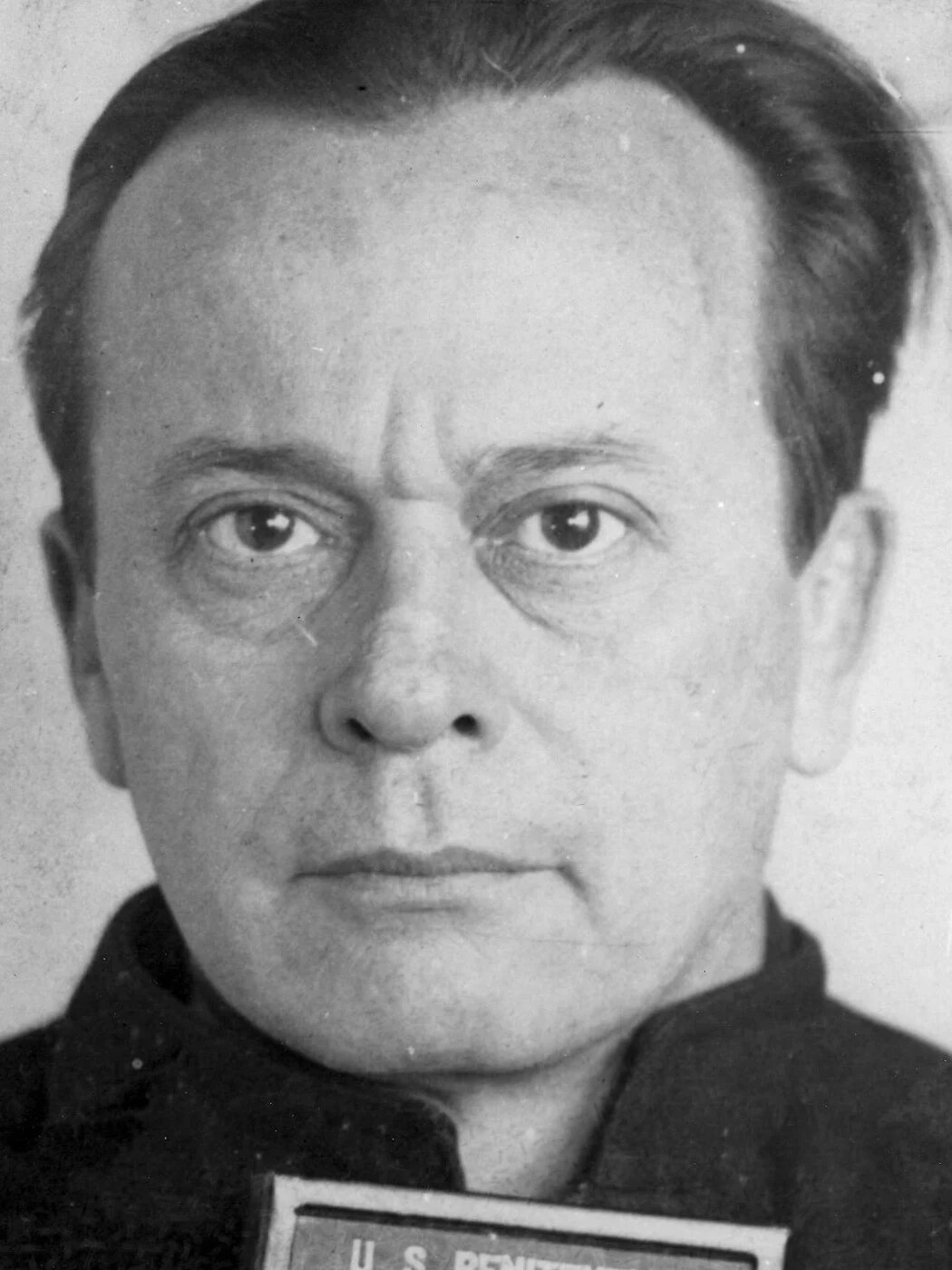
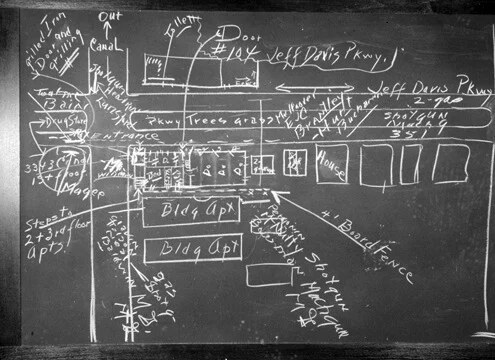
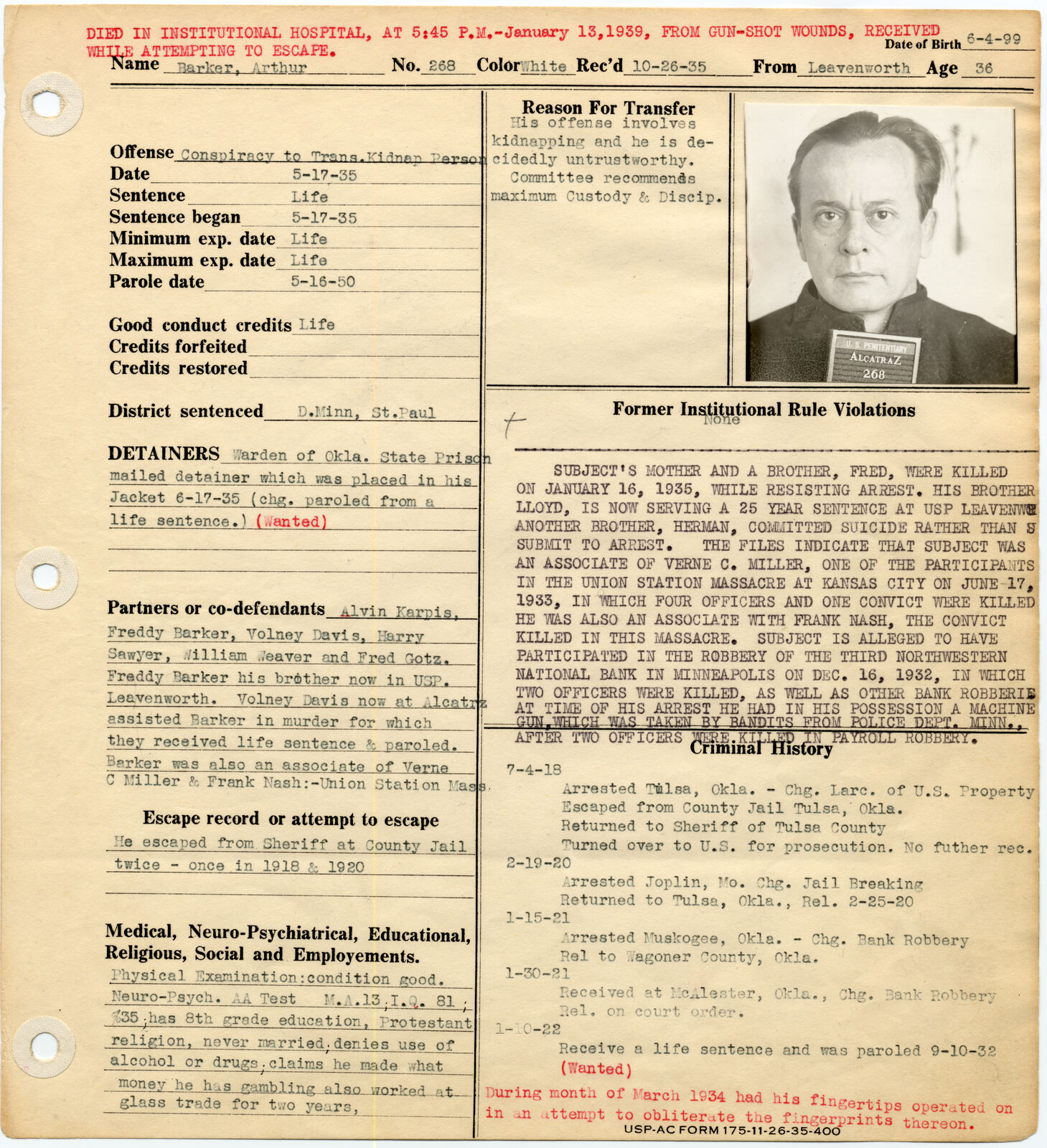
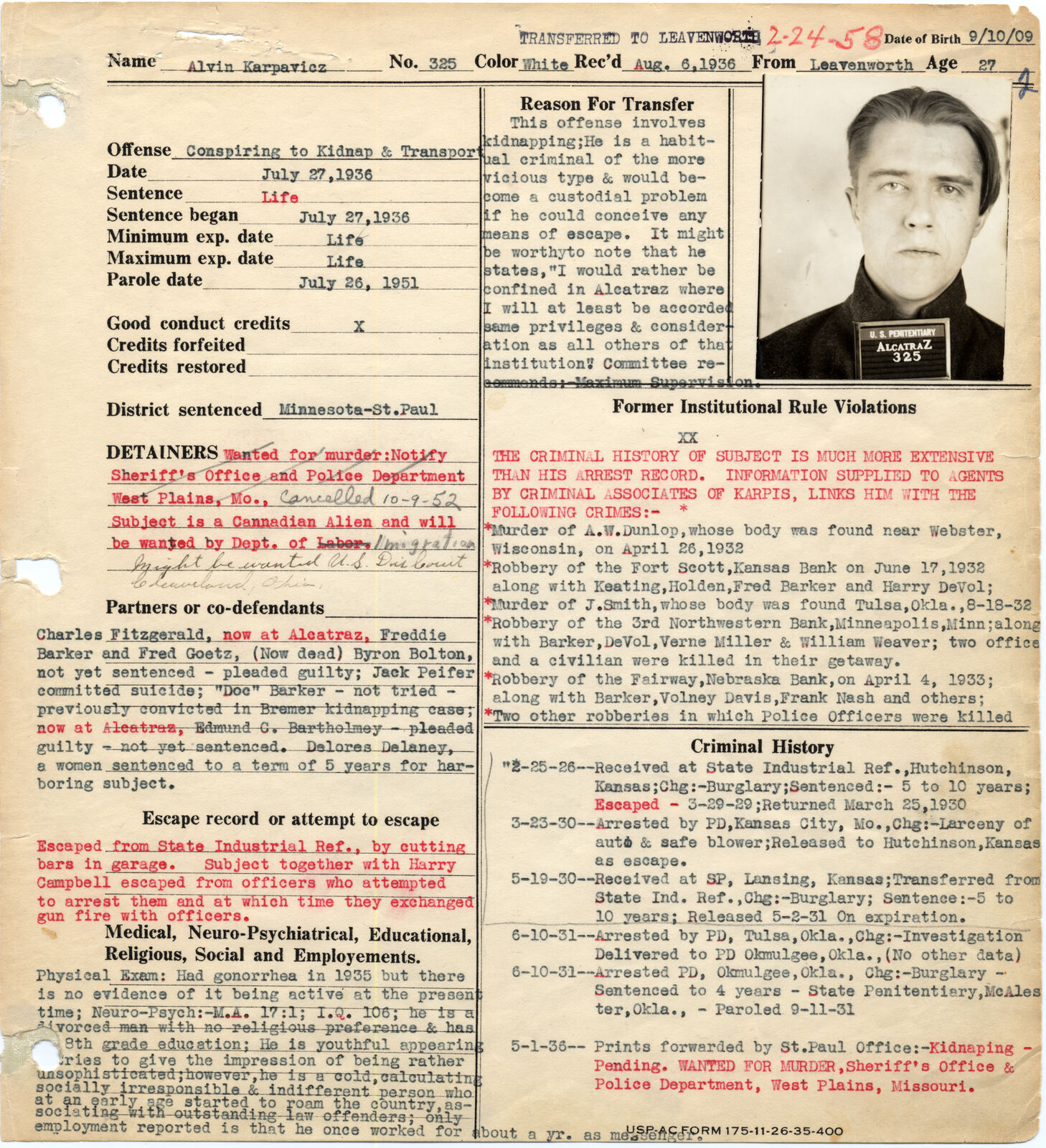
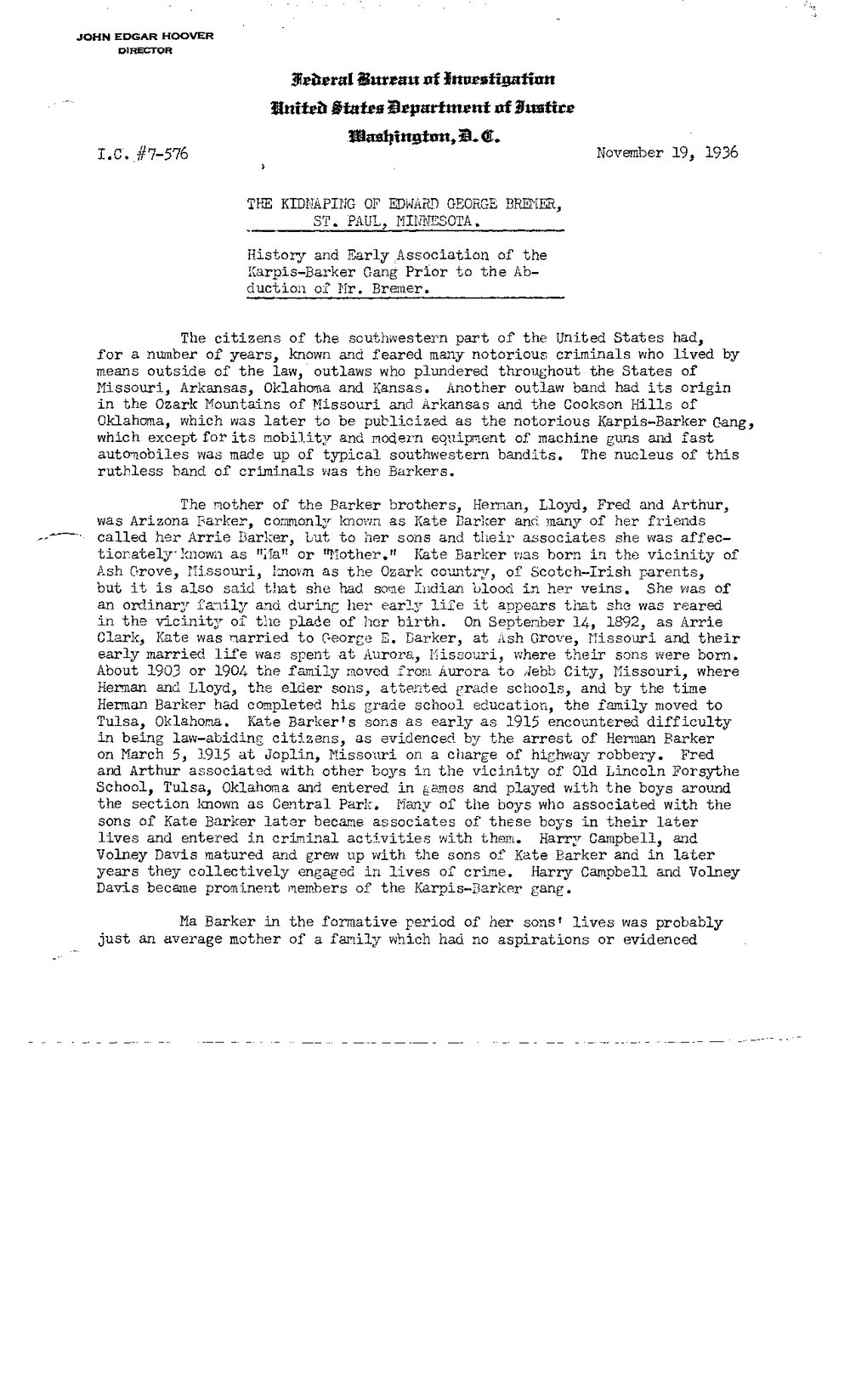
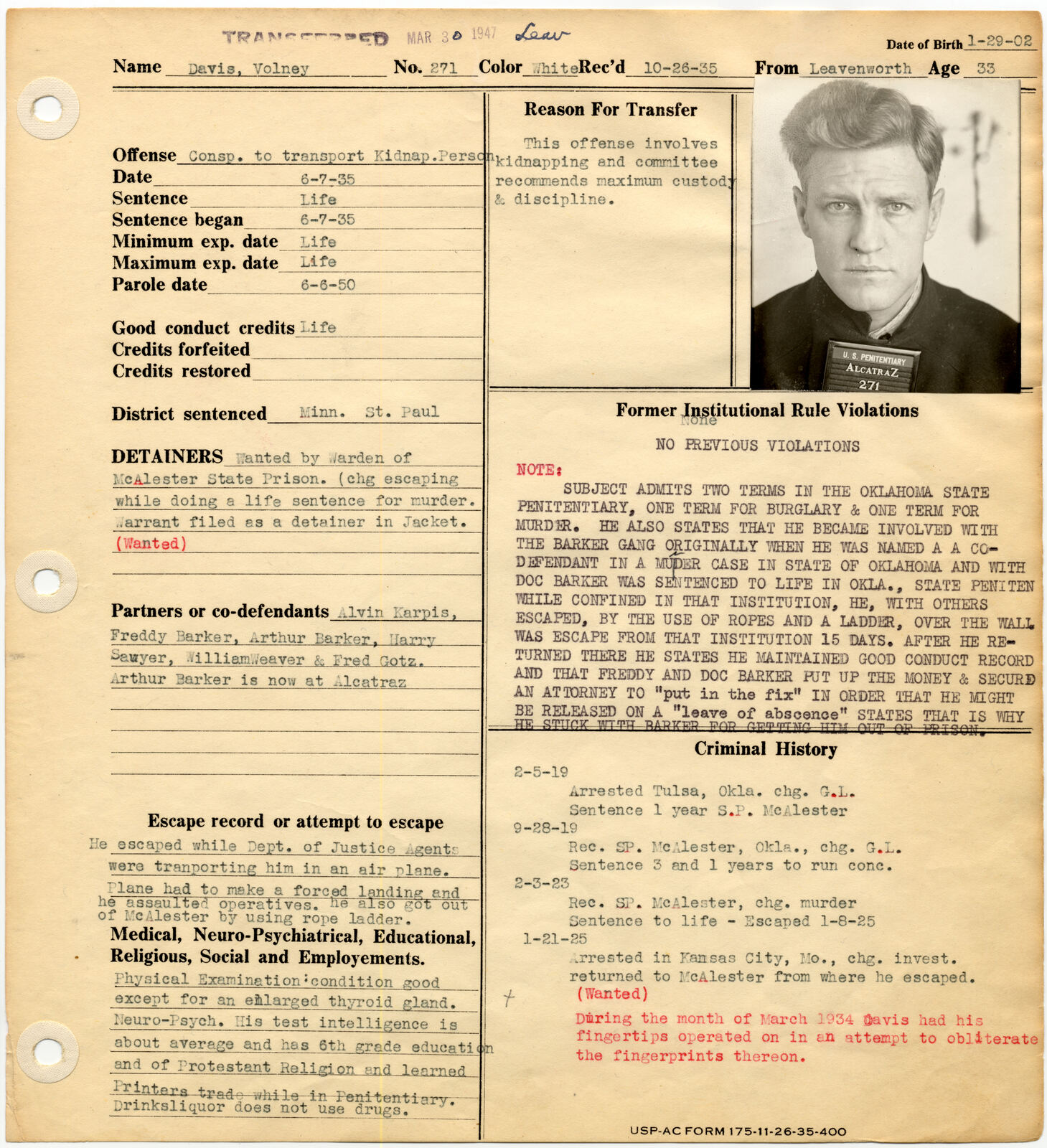
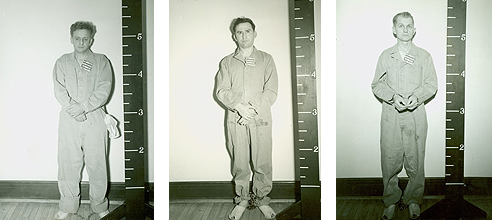
The FBI’s history page covers the Hamm and Bremer kidnapings at St. Paul. The Bureau’s own 1936 summary of the Bremer case is the fullest record filed here: it describes the 16 January 1935 shooting at the Lake Weir cottage in which Kate and Fred Barker were killed, and Karpis’s arrest in New Orleans on 1 May 1936, planned on a blackboard. The court records are the St. Paul case file No. 6258 against Karpis, Arthur Barker and five others, the Volney Davis file, and the Eighth Circuit’s opinions in McDonald, Sawyer and Davis. The Alcatraz notebook pages of Arthur Barker, who died of gunshot wounds in an escape attempt in 1939, of Karpis and of Volney Davis, an FBI photograph of Barker at Alcatraz, the Vault’s Herman Barker file, the weapons cache and Russell Gibson’s notebook complete the group.
The 1934 laws and other files
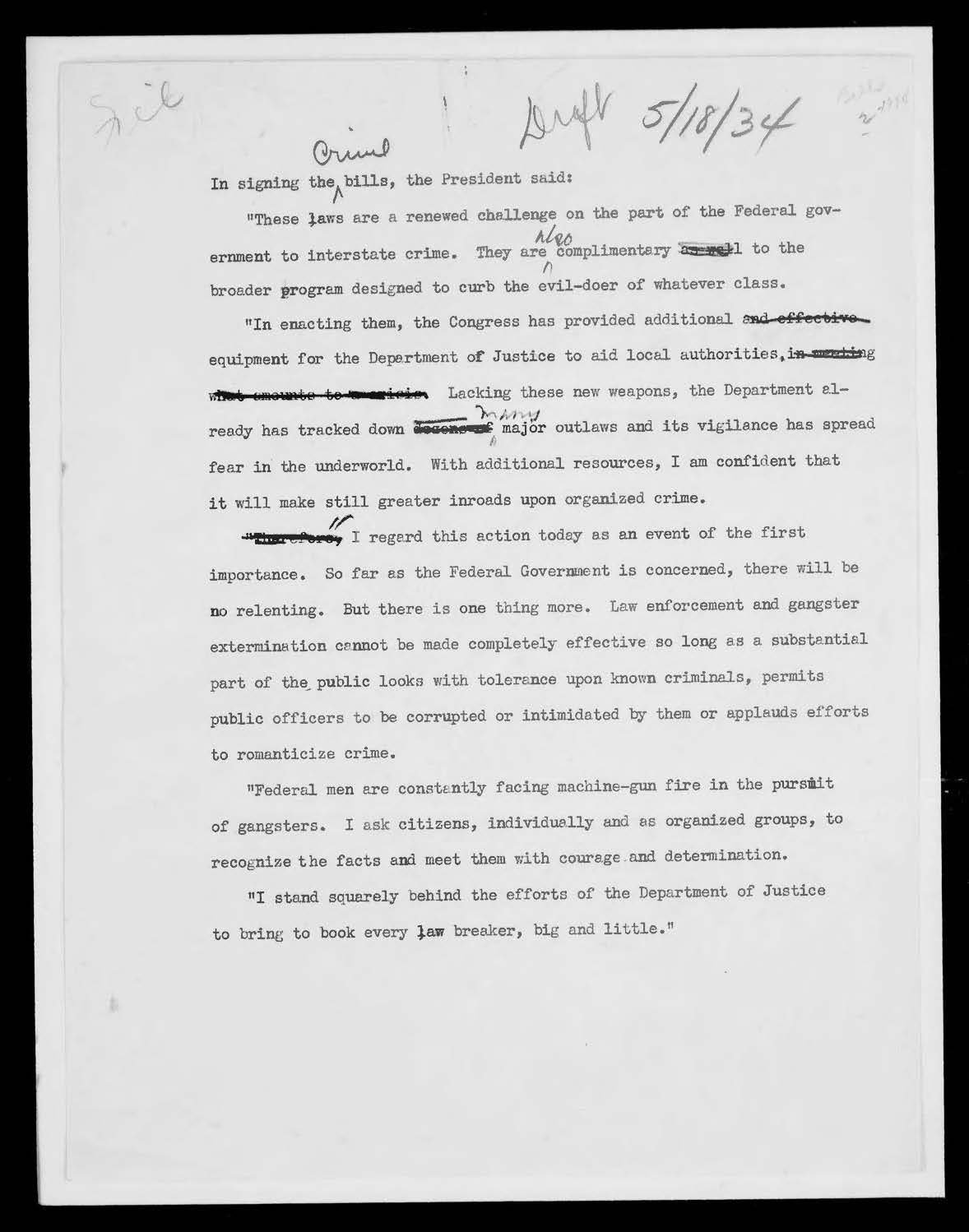
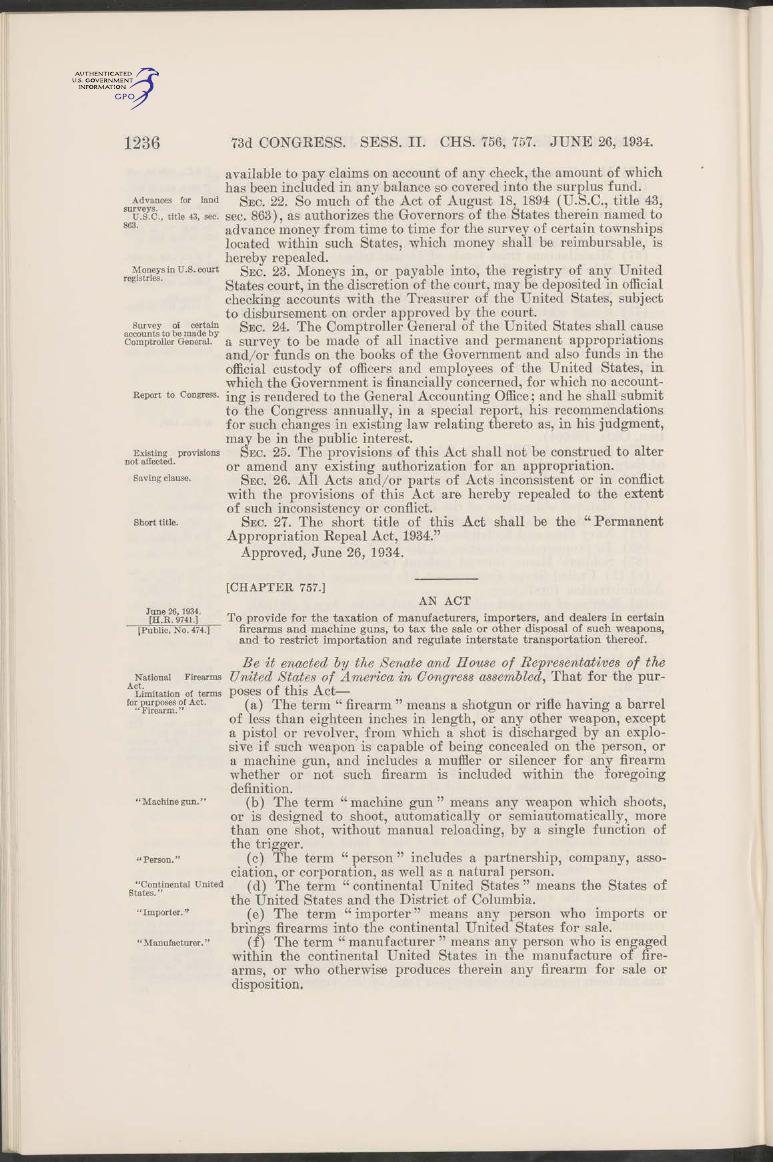
In May and June 1934 Congress made it a federal crime to kill a federal officer, extended the kidnaping act, made robbery of national and member banks a federal crime, gave the Division’s agents power to arrest and carry firearms, and passed the National Firearms Act; the President’s statement on the crime bills is filed with them. Two Chicago federal files close the section: a draft-registration case against Roger Touhy, whose gang the FBI says escaped from an Illinois prison in 1942 (see the Touhy and Banghart records), and the Mann Act case against Jack Gebardi, alias Jack McGurn, which is a Chicago organized-crime record from the same court series rather than a fugitive case.
A Clifford Berryman cartoon of 22 February 1942 in the Senate’s collection shows Uncle Sam having old portraits labelled Dillinger, “Pretty Boy” Floyd, Arthur Barker, Alvin Karpis and “Baby Face” Nelson taken down in favor of wartime loose talkers; it is cited without a stored copy, because a newspaper drawing of 1942 may still be under copyright.
Tiles with a document plate in place of a picture are records this archive holds no image of; their pages say why.